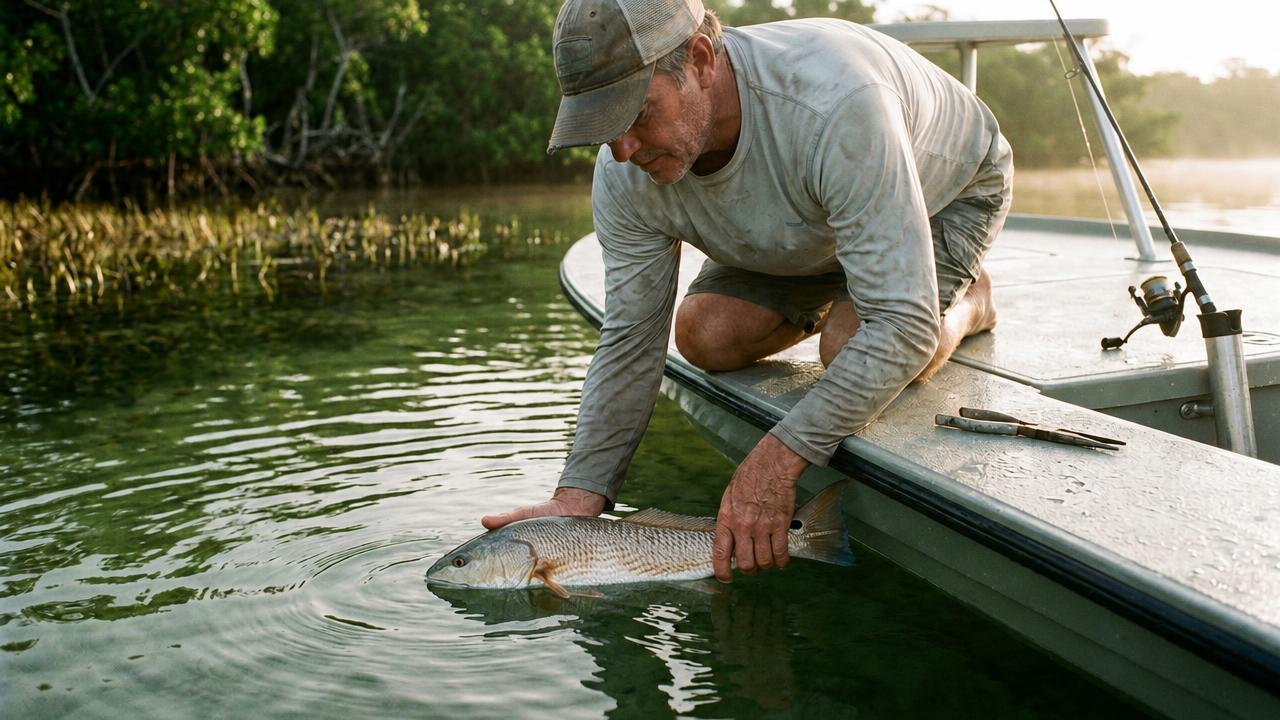
Let's talk about the part of the trip that happens after the fish is already caught. You get it to the boat or the dock, you take the hook out, you open your hands and watch it swim off. Most of us feel good about that moment, and we should. But a fish swimming away and a fish surviving are two different things, and what you did in the minute or two before you let go has a lot to say about which one you got.
Here is a number worth sitting with. Florida Fish and Wildlife (FWC) says anglers here caught roughly 452 million marine fish in 2018, and about 272 million of them were released. That is a lot more than half. Between bag limits, slot limits, closed seasons and anglers' own choices, plenty of fish go back into the water, so how you release them matters.
The good news is that the research is encouraging. FWC's fisheries researchers found that most fish released after hook-and-line capture survive. Snook held in net pens after being caught by anglers had a 98 percent survival rate. Spotted seatrout caught in Tampa Bay came in at 95 percent. Redfish ranged from 84 percent in Georgia waters to 96 percent in Texas. Out of 27 tarpon tagged with sonic transmitters in Boca Grande Pass, 26 lived. So catch and release works. The trouble is hiding in the details of those same studies, and those details are where a seasoned angler can still pick up something new.
The hook decides more than most people think
Look at what happened to the fish that did die. In the research FWC describes for snook, seatrout and striped bass, most hook-related deaths involved gut-hooked fish, often caught on live bait. In the redfish work, more than half of the fish hooked in the throat or gut died. That is a big swing from a 96 percent survival rate overall in the Texas study, and where the hook ended up made a real difference.
The reason is simple once you picture it. A lure is moving when a fish hits it, so the fish is usually hooked before it can swallow. A live shrimp or a pinfish sitting still gives the fish time to take it all the way down. Anything that keeps the hook in the corner of the mouth is on your side.
That is why circle hooks have such a good reputation. FWC says circle hooks are about 90 percent more likely to hook a fish in the mouth than in the throat or stomach. They work differently than a J-hook, and this is the part people get wrong. You do not jerk the rod when the fish takes the bait. You let the fish take it, let the line come tight as it turns away, and just start reeling. If you snap the rod up like you would with a J-hook, you can pull the hook right out of its mouth. FWC's own advice is not to set a circle hook.
If you are fishing live bait on a J-hook, the older FWC research points the other way: it says to set the hook quickly, because the longer a fish runs with natural bait, the better the chance it swallows it. So pick your hook and fish it the way it was built to be fished.
Two small habits help on top of that. FWC says catch rates on barbed and barbless hooks are not significantly different, and a barbless hook comes out of a fish, or out of your own thumb, much faster. Squeeze the barb down with pliers. If you are throwing a lure with treble hooks, FWC suggests taking off a hook or two and trimming one point from the ones that remain. And when you have a choice, steel or bronze hooks are better than stainless, because they rust away sooner if one gets left behind.
When the hook is deep, leave it
This one goes against every instinct. A fish is hooked down in the throat or the gut, you can see the shank, and everything in you wants to go in there and get it. Don't. FWC's researchers tested this directly on snook. They had 24 deep-hooked snook. They pulled the hook out of 12, and four of those died. On the other 12, they cut the leader as close to the hook as they could and left the hook inside. None of those died.
Fish are better at dealing with a hook than we give them credit for. They can spit it out, push it out, or wrap it in tissue over time. Rust helps too. Cutting the line short at the hook, while the fish is still in the water, is often the kindest thing you can do with a bad hookup. A pair of long-nosed pliers will take care of the easy ones, and for the rest, carry a pair of cutters you can reach with one hand.
The fight, the handling and the water
A fish that fights for ten minutes on tackle that is too light comes up worn out, with lactic acid built up in its muscles and blood. FWC compares bringing an exhausted fish out of the water to asking a triathlon winner to jump into a pool and hold their breath. That tired fish needs oxygen right away. So match your tackle to what you are really after, and if you keep landing fish that need a long revival, FWC's advice is to go heavier. For big fish like tarpon and sharks, FWC says to get them to the boat within about 20 minutes.
Wet your hands before you touch a fish. That slime coat is its first line of defense against infection. Hold it the way it swims, which is level. FWC is blunt about this: fish swim horizontally, so never hold one by the jaw, gills or eyes. Hanging a big fish vertically by the lip for a photo puts the weight on organs that were never meant to carry it. FWC's snook researchers warn that a large snook held by the jaw with nothing under the belly can tear the connection between its head and body, and the fish then slowly starves because it cannot gulp food the way it needs to. Put one hand under the belly every time.
Leave the fish in the water for as long as you can while you work. Take the hook out in the water if it is possible. If you want a picture, take it fast and horizontal, and with a fish you can't keep, FWC says that photo is fine as long as you let it go right away. Tarpon over 40 inches have to stay in the water by rule. The only exception is someone chasing a state or world record with a tarpon tag bought before fishing starts. Even the one tarpon out of 27 that died in the Boca Grande study had been lifted out of the water for a photograph.
Make your decision about what you intend to keep before you start, and check that each fish is legal to harvest. FWC's researchers advise against putting a fish in the livewell with plans to release it later if you catch a bigger one. Fish released from a livewell have a lower chance of survival, so release the ones you don't intend or aren't allowed to keep promptly.
Reviving a tired fish
Sometimes the fish just hangs there when you open your hands. Then your job is to get water moving over its gills. Hold it level in the water with one hand under the belly and the other on the lower lip or the base of the tail, and point its head into the current. If you are anchored and there is no current, FWC says to hold the fish alongside the boat and nudge the boat gently ahead. If you are in a kayak, move the fish through the water in a slow figure-eight with a grip on the front lip.
Never push it back and forth. FWC says that pattern does not let water flow over the gills the right way, and the FWRI researchers make the same point: a fish does not swim backward and forward, so don't make it. The moment you feel it kick and try to leave, let it go, head first. Long revival attempts are stressful in their own right.
Deep water changes the rules
Everything so far applies to the flats, the creeks and the dock. Once you are fishing deep for snapper and grouper, there is a second problem, and it has nothing to do with the hook. FWC says that when a fish is pulled up from water deeper than about 50 feet, the gas in its swim bladder expands and can cause damage that FWC calls barotrauma. You will know it when you see it: a stomach pushed out of the mouth, bulging eyes, a bloated belly, scales that look like they are bubbling, or a fish that floats and can't swim back down.
A fish showing those signs may not be able to get back down on its own. At the surface, it is more exposed to predators and the elements. FWC says using a descending device or venting tool promptly and properly can help, and that research points to descending devices as the most effective method. A descending device carries the fish back down to depth, where the pressure recompresses the gas so the fish can swim away. They come in three styles: lip clamps, inverted hooks and fish elevators, and all need a weight to take the fish down. FWC suggests about one pound of weight for every five pounds of fish. You do not need to buy anything fancy to start, either. FWC's page links a video on making your own.
A venting tool is the other option, but it takes care and practice. FWC says it must be hollow and sharp; a knife, an ice pick or a hook is not a legal venting tool and can cause further injury. You need to know exactly where and how to use it, so study FWC's illustrated guidance before your trip. Never puncture a stomach or intestines protruding from the fish. FWC recommends using a descending device or venting tool when you see signs of barotrauma.
What the rules require right now
If you are fishing for reef fish from a boat, this is not only good manners anymore. In Florida state waters, reef fish include groupers, snappers, amberjacks, gray triggerfish, red porgy, sea bass, hogfish and tilefish. FWC's reef fish gear rules say that on board a vessel, you must have and use a dehooking device, and a descending device or venting tool rigged and ready to use. That requirement started on April 1, 2023.
When you fish for reef fish from a vessel with natural bait, the hook rule depends on where you are. In Gulf state waters, you need non-stainless steel, non-offset circle hooks. On the Atlantic side, the circle hook requirement applies north of 28 degrees north latitude, while south of that line, FWC requires non-stainless steel hooks. Federal hook rules also vary by area. For federally managed Gulf reef fish, a descending device or venting tool must be rigged and ready; in Atlantic federal waters, a descending device must be on board and readily available. A dehooking device is also required. If a hook is too far down, cut the line as close to it as you can instead of digging for it. Rules can change, so read FWC's gear rules page before you go instead of relying on a summary, even this one.
Sharks have their own rules too. FWC says prohibited shark species must stay in the water with their gills submerged, whether you are on a boat or on shore, and must be released without delay when caught from shore. If removing the hook would delay release, cut the hook or leader as close to the hook as possible. When targeting or harvesting sharks with live or dead natural bait, non-offset, non-stainless steel circle hooks are required, as is a device capable of quickly cutting the hook or leader when targeting sharks. Anglers 16 and older targeting or keeping sharks from shore need a free shore-based shark fishing permit and must complete the online course; both are renewed annually. Younger anglers have course requirements too, so check FWC's shark regulations before you go.
If you fish from a pier or bridge
A fish that is too big to lift safely is a real problem when you are standing ten feet above the water. FWC says to bring a fish onto a pier or bridge only if you intend to harvest it. It also recommends targeting fish from those spots only if you have specialized gear, such as a pier net or sling, to support the whole body; dropping a big fish or lifting it by the line can injure it. If you can't lift it properly, cut the line as close to the fish as you can, walking it to shore first if necessary and safe. FWC recommends against fishing for tarpon from bridges and piers, since tarpon over 40 inches generally have to stay in the water. From that height you may have to cut the line and leave a long length trailing behind the fish.
A short routine you can run on autopilot
The best release is the one you have already planned. Decide what you are keeping before the first cast. Use tackle that brings the fish in quickly. Fish a circle hook with natural bait and let it load up instead of jerking it. Keep a dehooking tool and a pair of cutters where you can grab them. Wet your hands, keep the fish in the water, support the belly, and point it into the current until it kicks. If you fish deep, rig a descending device before you leave the dock and put it where you won't have to dig for it. Those habits give a released fish a better chance to be out there for the next trip.
If you fish from a kayak, the Hookwise classroom has a lesson called Kayak and Saltwater: Handle Fish and Return Safely. It is written for the tight quarters of a small boat, where keeping a fish low and your own weight centered is half the job, and it pairs well with the handling steps above.
Sources
- FWC: Fish Handling and Gear
- FWC: Barotrauma, descending devices and venting tools
- FWC: Reef Fish Gear Rules
- FWC Fish and Wildlife Research Institute: Techniques to Reduce Catch-and-Release Mortality
- FWC: Tarpon regulations and best fishing practices
- FWC: Sharks, regulations and Shark-Smart fishing
- Return 'Em Right: Best practices and training for reef fish anglers