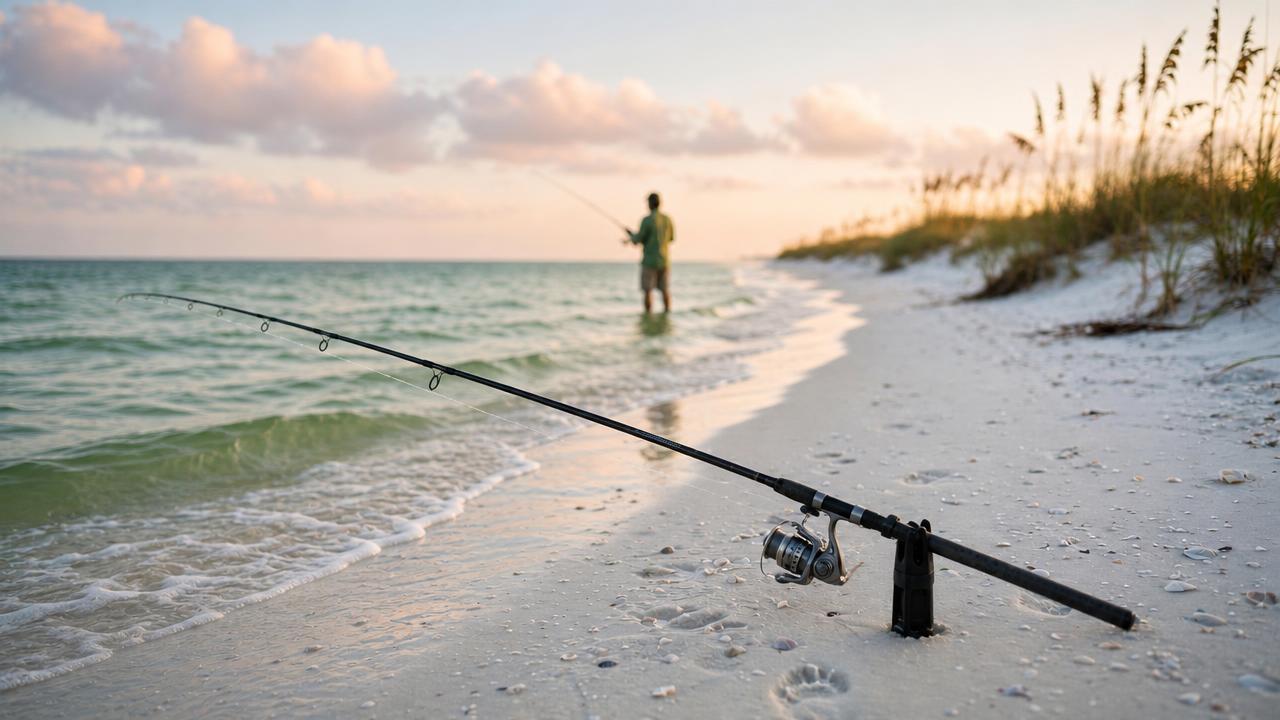
The Florida Panhandle gives you four kinds of shoreline water on the Gulf of America (formerly the Gulf of Mexico), and you do not need a boat for any of them: open beach, passes and jetties, piers, and bay shorelines. Each one holds different fish and rewards a different rig. This guide starts with how to read the water in front of you, moves to the species you are likely to meet and the bait that fits them, and closes with the license, rule and beach safety checks that apply on the sand.
Most of the practical detail comes from the Florida Fish and Wildlife Conservation Commission (FWC). Where a tip comes from Panhandle tackle shops or charter guides, the text says so. Treat those as local observations to test on your own beach, because sandbars and cuts move after every storm.
Pick your water
- Open beach. FWC lists snook, pompano, red drum and sharks among the fish you can catch from Florida beaches, and says a longer surf rod helps you reach the surf where many of them school. It also recommends a sand-gripping weight, such as a pyramid or sputnik sinker, if you fish with weights.
- Passes and jetties. FWC's Panhandle location lists include the Destin East and West Jetty. Local sources tie sheepshead to jetties, bridges and docks, and Pensacola charter guides report big redfish moving through Pensacola Pass in the fall.
- Piers. FWC lists the Pensacola Beach Gulf Pier, Navarre Beach Fishing Pier, Okaloosa Island Fishing Pier, M.B. Miller County Pier and Russell-Fields Pier among popular Panhandle fishing locations. FWC says piers open up species such as king mackerel, cobia, black drum and sheepshead, and its pier tips call for line of at least 30-pound test and a weighted rig with natural bait like shrimp to catch a variety of fish off the bottom.
- Bay and sound shorelines. FWC describes flats you can wade or fish from shore for red drum, spotted seatrout and flounder. It suggests the incoming tide, starting several hours before high tide, when fish gather closer to shore, and says outgoing tides give you a chance as schools leave the flat. Watch for jumping mullet and diving birds.
FWC's Where to Saltwater Fish page lists popular spots county by county, with commonly caught species and the seasons FWC associates with them. Its fishing pier finder maps public piers.
Read the beach: bars, troughs and cuts
On an open Gulf beach, fish rarely spread evenly along the sand. Panhandle tackle shops describe the same layout: one or more sandbars running parallel to shore, a deeper trough between the bar and the beach, and gaps, called cuts, where water pours back out. Here is how local shops say to use each feature:
- Troughs. Half Hitch, a Panhandle tackle shop, calls troughs the highways fish use to travel the beach. Panhandle Salt, a Perdido Key surf fishing shop, suggests the first trough, roughly 20 to 40 yards out, for whiting and resident pompano.
- The outer edge of the bar. Panhandle Salt puts pompano, roaming redfish and bigger drum on or just beyond the bar.
- Cuts and rips. Half Hitch ranks a rip current as the top spot for pompano and other species, with troughs next. Holes between two points can hold fish too. Points themselves tend to be better for fast open-water fish such as Spanish mackerel, cobia and jack crevalle than for pompano.
You can spot these features from the dune. Darker water means deeper water, and a gap in the line of breaking waves usually marks a cut. The same signs mark a rip current: South Walton's beach safety page lists darker surf, murky brown water, and waves breaking farther out on both sides. Cast to a rip from the sand and keep your feet out of it.
Look for bait as well. FWC says Florida pompano feed on mollusks and crustaceans, especially sand fleas (mole crabs), which live in the wash zone of sandy beaches. A Florida Sportsman writer who rakes them says tiny V-shaped marks in the receding wash show where a colony sits. Where there are fleas, pompano and whiting have a reason to be nearby. Birds working, bait dimpling the surface and other anglers hooking up in one stretch are all worth following. Panhandle Salt suggests moving 50 to 100 yards after 10 to 15 minutes without a bite.
Timing: tide, light, wind and water color
- Tide movement. Half Hitch says fish bite throughout the day, but the best times are when the tide is rising or falling. Warm months favor early morning and late afternoon that coincide with a tide change. NOAA notes that many Gulf areas have a single high and low tide a day, so a tide table on its own may give you one window, not two.
- Cold fronts. Half Hitch's winter advice is to fish the days leading up to a front, when temperatures are a little warmer, the wind is southerly and there is some wave action. FWC notes that colder water can make fish more lethargic, so slow your presentation in the cooler months.
- Wind and water color. Panhandle Salt treats chocolate-milk water and a strong onshore wind as a scouting or short-session day. Florida Sportsman's surf writer skips muddy water and heavy seaweed and moves to another beach if the water looks wrong. If the water is very clear and calm, Panhandle Salt suggests smaller terminal tackle and fishing the low-light hours harder.
- Your own notes. FWC advises keeping detailed notes of successful days (tide, moon phase, time, water temperature) because that record shows where each species tends to gather on your beach.
What you are likely to catch
Pompano, whiting, redfish and black drum make up the core of Panhandle surf fishing according to the local shops above, with bluefish, ladyfish, Spanish mackerel and sharks as regular company. Seasons vary by year and water temperature, so treat these as starting points.
- Florida pompano. FWC's Panhandle location lists show pompano in spring. Local guides also describe a second run in fall, with Coastal Worldwide, a Pensacola Beach charter outfit, putting it around October and sometimes early November. FWC says local movements follow the tide and seasonal movements follow temperature. Panhandle Salt describes their bites as strong, steady head-shakes followed by fast runs.
- Whiting (Gulf kingfish). Panhandle Salt describes tap-tap bites in the first trough, and Half Hitch lists whiting among its main surf targets. Check FWC's unregulated species page for current harvest rules before you keep any.
- Redfish. FWC lists red drum as a year-round Panhandle species. Panhandle Salt reports bigger fish and heavier thumps from the bar edge and deeper cuts, and Coastal Worldwide describes the fall run of large redfish through Pensacola Pass. Redfish have size and bag rules that FWC updates, so check the current rule before you keep one. Whatever you decide, the best handling is to leave the fish in the water as much as you can.
- Black drum and sheepshead. FWC lists black drum in spring and summer and sheepshead in late winter and spring in the Panhandle counties. Black drum eat heavy bottom bait. Sheepshead hold around pilings, bridges and jetties, which makes piers and jetties the shore options.
- Spanish mackerel, bluefish and ladyfish. FWC lists Spanish mackerel from late spring through early fall in the Panhandle, and the NOE Outdoors Pensacola report describes them as one of the easier fish to look for when glass minnows and other small baitfish are around. Half Hitch recommends a lighter 6 to 7 foot rod with pompano jigs and spoons for cruising or surface-busting fish.
- Flounder and spotted seatrout. These are bay and sound fish more than surf fish. FWC lists flounder in spring and fall in the Panhandle, and both have rules that change by season and region, so check FWC's current rules (see below).
Rigs and bait that fit the surf
A simple starting rig
FWC's first-time angler guidance describes a basic saltwater setup: a #1 circle hook about 2 feet below a slip sinker and swivel, with the lightest weight that holds the bait in place against current and waves. It recommends needle-nose pliers to crimp the barb down so fish release easily. For the surf, Half Hitch and Panhandle Salt describe a longer step up:
- Rod and reel. A surf rod of about 8 to 12 feet, medium to medium-light action, with a large spinning reel (Half Hitch suggests around an 8000 size). Half Hitch suggests 15 to 25 pound mono or 30 to 50 pound braid.
- Dropper rig. A two-hook rig with a swivel at the top and a snap at the bottom for the sinker. Florida Sportsman describes leaders of 34 to 40 inches, with 4 to 6 inch snoods about 18 to 20 inches apart. Two hooks put two baits at slightly different depths, and anglers sometimes hook two pompano at once.
- Small float or bead above the hook. Half Hitch says it acts as an attractor and lifts the bait off the bottom so small crabs steal it more slowly. Panhandle Salt skips floats if the water is very clear.
- Sinker. Pyramid or sputnik styles dig into the sand. Panhandle Salt suggests 3 to 4 ounces, and a Florida Sportsman surf writer on the Atlantic side uses as much as 5 ounces. The right size is the lightest one that stays put in the wash.
- Hooks. FWC recommends non-stainless, non-offset circle hooks for natural bait, because fish are more likely to be hooked in the mouth. Be careful with treble hooks and other multi-point hooks when fishing natural bait, because FWC species rules can restrict harvest with them. Check the rule page for your target (links below). FWC also advises against multi-hook rigs for release fishing because they are harder on the fish.
Bait choices
- Sand fleas. FWC lists them as pompano food. Florida Sportsman calls them a bait that nearly any beach fish will eat, and says live ones hold the hook better than blanched, frozen ones. If you collect your own, check FWC's current rules for mole crabs first.
- Shrimp. FWC calls live or frozen shrimp an excellent all-around saltwater bait, and frozen squid a good alternative because it stays on the hook. Panhandle Salt recommends thumbnail-sized pieces for clear Gulf water, since big chunks mean more missed bites and more crab thefts.
- Synthetic baits. Local shops and Florida Sportsman writers mention scented synthetic bait strips, often tipped with a small piece of real bait. Treat them as an option to test, not a replacement for fresh bait.
- Heavier baits for drum and reds. Panhandle Salt pairs a single-dropper or fishfinder rig, a 3/0 to 4/0 circle hook and crab pieces, large shrimp or cut bait with a heavier rod and 20 to 30 pound line, cast to the deepest water you can reach or a visible cut.
Two rods, two distances
If you run more than one rod, vary distance until a pattern shows. A common setup from Panhandle Salt is one rod in the first trough and one at the outer bar. Florida Sportsman suggests watching how far the angler who is catching fish is casting and matching it. Wait 10 to 15 minutes, then change distance or move.
Piers and jetties: what changes
- FWC says to use heavy line (at least 30-pound test), tie down your rod and do not leave it unattended.
- FWC says to bring a fish onto the pier only if you plan to keep it. For big fish, use a pier net or sling, and if you cannot lift a fish safely, cut the line as close to the fish as possible, which may mean walking it to shore.
- For sheepshead, FWC explains that barnacles scraped off bridge pilings can be used as chum from a pier. Never scrape them from private docks without the owner's permission. Chumming rules differ between piers and beaches, so read FWC's feeding sharks and other fish page first.
- FWC's bird-safety guidance for piers asks for barbless single hooks, bright line and quick-sinking bait, and tells you never to feed birds. If one is hooked, reel it in, remove the hook and release it.
A first-morning plan
- Check the surf forecast, wind and tide the night before. Choose a beach where the water color looks clean and the wash is not choked with seaweed.
- Arrive at first light if you can. Walk the waterline and look for V-marks from sand fleas, birds and cuts in the waves.
- Set one rod short in the first trough and one at the outer bar edge, with small, fresh bait on a dropper rig and a sinker that holds without dragging.
- Give each spot 10 to 15 minutes. Change the distance first, then your spot on the beach.
- Record the tide, time, water color, bait and distance for every bite. After a few trips, that record is more useful than any general advice.
Land and release fish well
- Wet your hands, hold fish horizontally and never hold one by the jaw, gills or eyes (FWC).
- Carry a dehooking tool or pliers and line cutters. If a fish is gut-hooked, cut the line close to the hook while the fish is still in the water (FWC).
- Release fish head first. Do not drag them up the sand.
- When wading, shuffle your feet so stingrays have time to move off. If you hook a ray, keep it in the water, stay clear of the tail and cut the line close to the hook if you cannot dehook it safely.
- If you hook a sawfish or a giant manta ray, both federally protected, FWC says to keep it in the water, cut the hook or the leader as close to the hook as possible and release it without delay. Do not try to remove the hook, and never gaff, lift or drag a manta. See FWC's sharks page for details.
- FWC's shark guidance says to avoid shark fishing near swimmers or crowded beaches, and from March through October, when sea turtles nest, to use only amber or red light when you fish from shore at night.
Before you cast: license, rules and beach safety
Rules change, so confirm current details on the official page the day you fish.
License
- Florida offers a free shoreline license for residents who saltwater fish only from land or from a structure attached to land. Whether you need a license, which type, and which exemptions apply depends on your residency, age and where you fish, so confirm on FWC's shoreline fishing page and its "Do I need a license or permit?" page before you go.
Shore-based shark permit
- If you plan to target or keep sharks from shore, including from jetties, bridges and piers, FWC requires its free Shore-based Shark Fishing permit and an online Shark-Smart course. Some other shore setups can trigger the permit too, so read the age and gear details on FWC's sharks page before you go.
- Many sharks are prohibited from harvest. FWC says to keep them in the water with the gills submerged, release them without delay, and treat unknown catches as prohibited. If removing the hook would slow the release, cut the hook or leader as close to the hook as possible.
Species rules
Size limits, bag limits, closed seasons and gear rules differ by species and by region, and FWC changes them. This article does not list them, so open the page for your target on the day you fish and check it before you keep a fish:
- Florida pompano
- Red drum (redfish)
- Flounder
- Spotted seatrout
- Sheepshead
- Black drum
- Spanish mackerel
- Whiting, ladyfish, jack crevalle and other unregulated species
- Hook-type rules (for example, limits on treble or other multi-point hooks with natural bait) and chumming rules apply to some species and locations. They are on the species pages above and on FWC's feeding sharks and other fish page.
- Red drum rules can also apply in areas next to your fishing spot, such as a parking lot, so read the red drum page.
Browse every species on FWC's recreational regulations page.
Access
- Gulf Islands National Seashore covers Perdido Key, Fort Pickens and Santa Rosa areas in Florida. Park rules can limit where and when you can fish, such as at designated swim beaches and on some piers, and they change. Check the park's Fishing in Florida page and its alerts before you go.
- FWC asks shore anglers to avoid areas and times with many swimmers and not to crowd other anglers.
- For county and city beaches, piers and parks, check that agency's page or the posted signs.
Beach safety
- Flags. Beach flag systems are set locally. In South Walton, for example, double red flags mean the water is closed to the public, and entering the Gulf then can bring fines. Check your beach's flag page and the signs before you wade.
- Forecast. The National Weather Service posts rip current risk for the Tallahassee area and Mobile area beaches. Use whichever covers your stretch.
- If a rip catches you. Stay calm, because rip currents do not pull you under, and do not try to swim straight in against the current. Swim along the shoreline until you are out of the pull, then angle back toward shore. If you cannot reach shore, face the beach and call or wave for help. Read the NWS rip current survival guide before you need it.
- Red tide. FWC's red tide status page reports sampling, fish kills and respiratory irritation, and the Northwest Florida section is updated regularly. Check it before you drive to the coast. FWC runs a Fish Kill Hotline for reports.
Plan the trip with Hookwise
Once you know the beach and the rules, use Hookwise to pick your window. The Hookwise tools include the Bite Window Predictor, Moon Phase Optimizer and Weather Shock Adapter, all built for quick checks on your phone. The trip planner helps you organize a trip around species, weather and timing, and the fish guide covers the species you plan to target. For other kinds of water, see the Hookwise field guides.
Sources
Fishing guidance
- FWC: Saltwater Fishing Tips (beach, pier and flats fishing)
- FWC: Where to Saltwater Fish (Panhandle locations and seasons)
- FWC: First Time Angler (saltwater rig and bait basics)
- FWC: Florida pompano species profile
- FWC: Mole crab (sand flea) profile
- FWC: Fish Handling and Gear
- Half Hitch Tackle: Panhandle surf fishing guide (local tackle shop)
- Panhandle Salt: Perdido Key surf fishing game plan (local surf shop)
- Coastal Worldwide: Pensacola fishing season by season (local charter outfit)
- Florida Sportsman: Great baits and rigs for surf fishing in Florida
- Florida Sportsman: Sand Flea 101
- Florida Sportsman: Pompano fishing, reading the water
- NOE Outdoors: Pensacola inshore and surf fishing report
- NOAA: Types and causes of tidal cycles
Rules, access and safety
- FWC: Saltwater Shoreline Fishing Information
- FWC: Do I need a license or permit?
- FWC: Sharks and Shore-based Shark Fishing
- FWC: Feeding sharks and other fish (chumming)
- FWC: Recreational regulations by species
- FWC: Red Tide Current Status
- National Park Service: Fishing in Florida, Gulf Islands National Seashore
- National Weather Service: How to survive a rip current
- National Weather Service: Beach forecast (Tallahassee area)
- National Weather Service: Beach forecast (Mobile area)
- Visit South Walton: Beach safety and flag warnings