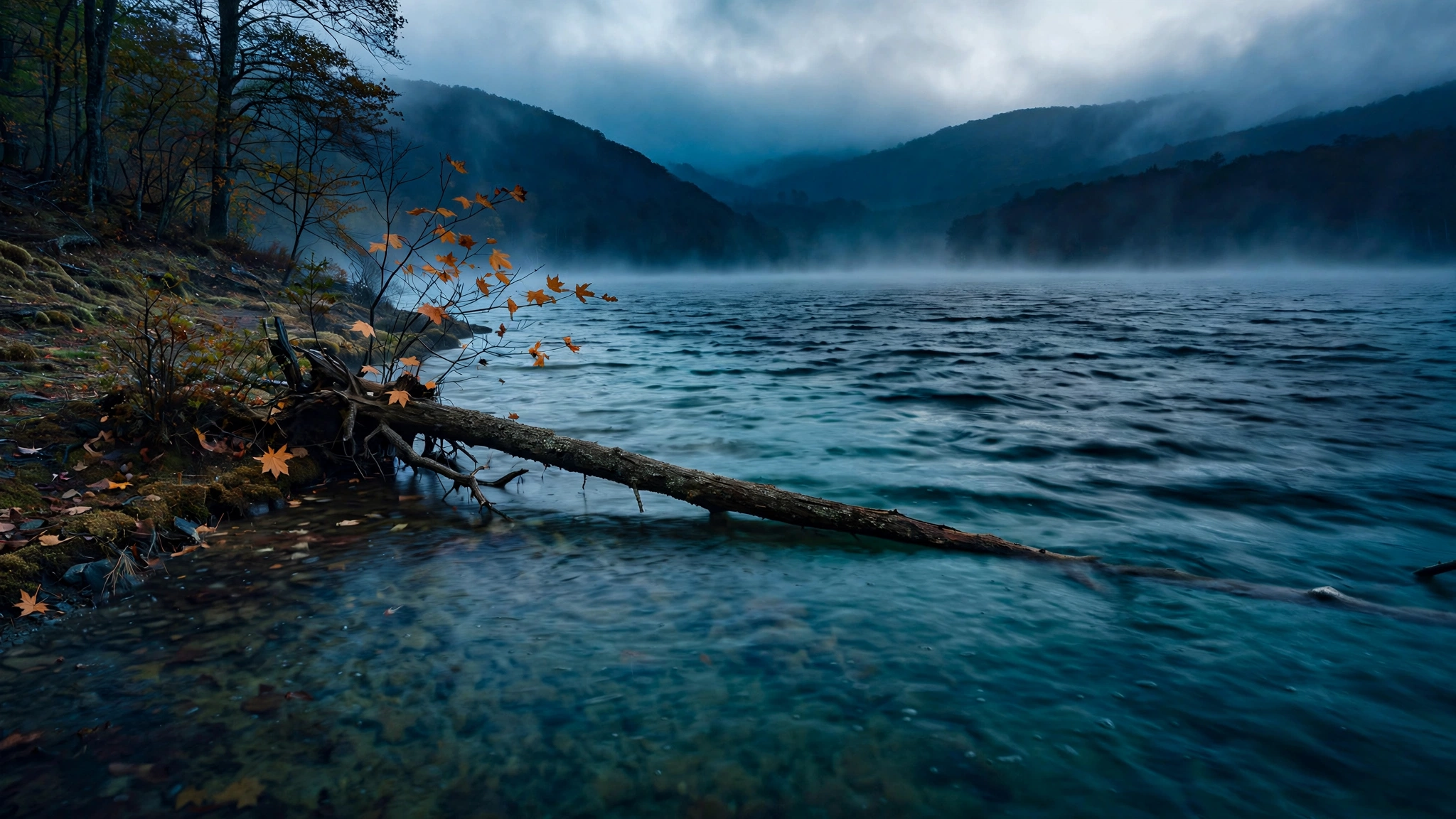
You fished a spot all summer, and it produced. Then the nights cooled, the wind picked up, and the same water looks different: cloudy, littered with bits of debris, maybe a little sour on the nose. Anglers call this fall turnover. It is a real process with a well-documented cause, and it is one of the few seasonal changes you can partly read with your eyes.
This article separates two kinds of information. Sourced facts come from university extension, state wildlife agency, and research-lake publications. Practitioner advice comes from tournament angler Mike Iaconelli's columns on Bassmaster.com. His tactics are one experienced angler's approach, not controlled studies, and they concern bass. Use them as a list of things to test on your own water.
What fall turnover is
Water is densest at about 39°F (4°C), and it gets lighter at both warmer and colder temperatures, according to the Clean Lakes Alliance. That single fact explains the whole cycle.
In summer, many deeper lakes separate into layers. The IISD Experimental Lakes Area describes three:
- The epilimnion: the warm surface layer that touches wind and sunlight and holds the most dissolved oxygen.
- The metalimnion: the transition zone. The thermocline, the point of sharpest temperature change, sits inside it.
- The hypolimnion: the cold, dense bottom layer, cut off from the air. It holds the least oxygen and can run out of it entirely while the lake stays layered.
In fall, the surface cools and gets denser. The temperature gap between layers shrinks, the thermocline weakens, and wind can finally churn water from top to bottom. Nebraska Extension's explanation of fall turnover puts it plainly: surface oxygen mixes down, and nutrients and decomposing material from the bottom mix up through the lake.
Why it is good for the lake and hard on the angler
IISD calls turnover the event that replenishes dissolved oxygen in the deepest water. The Clean Lakes Alliance adds that once a lake turns over, oxygen is available through the whole lake again. Georgia's Wildlife Resources Division describes a reservoir after mixing as having high oxygen from top to bottom, with dissolved metals settling out and the water clearing within a few days (Lake Lanier Turnover Facts).
The mixing also has costs. Nebraska Extension notes that some lakes smell unpleasant during fall turnover, and that if turnover happens too quickly, oxygen can drop low enough to cause a fish kill. The Clean Lakes Alliance explains that the bottom water of late summer is rich in nutrients, so turnover can feed late-season algae and cyanobacteria blooms.
The fishing difficulty comes from practitioners, not from the science above. Iaconelli writes that the bite during turnover is tough, that bass are scattered, that deep fish tend to suspend, and that shallow fish move tight to cover. That is his observation from his own fishing. The agency and extension sources describe the water chemistry and say nothing about how bass feel about it, so treat "turnover shuts the bite down" as a common angler's expectation and not a measured rule.
Does your water turn over?
Not every body of water follows the same schedule, and the word itself is used loosely. Georgia's wildlife agency says "lake turnover" is often used incorrectly for one phase of a longer annual cycle, and that for Lake Lanier, a Southeastern reservoir, full mixing generally happens around Christmas. IISD lists six mixing patterns, including lakes that mix twice a year, lakes that mix once, and lakes that mix irregularly or often. In northwestern Ontario, where IISD's research lakes sit, mixing happens in spring and fall.
Depth matters too. The Clean Lakes Alliance says layering is common in lakes deeper than about 20 feet, and that shallow lakes mix often and rarely stratify. A shallow pond can behave very differently from a deep reservoir. Our guide to summer pond oxygen covers what stratification means in small ponds and when fish distress calls for help from a local fisheries professional.
So the useful questions are about your lake: Is it deep enough to have layered this summer? Has the surface been cooling over recent weeks? Has wind been working on it? A "yes" to all three makes mixing plausible. Your state fish and wildlife agency or a local extension office can tell you more about the specific lake.
How to tell whether the water is turning
Iaconelli says you can usually see it. In shallow lakes, he describes debris floating in the water that obviously spent summer on the bottom. In deeper lakes, he describes turbid water with a lot of floating particles, and he calls the color a "nasty looking gray-green pea soup." Georgia's account adds a related clue from the river below a large reservoir's dam: as the deepest water loses oxygen, metals and sulfides dissolve and can give the river a rotten-egg smell and distinctive fall colors in late September or early October.
Take these as clues to compare, not a diagnosis. Murky water can also come from rain runoff, wind-stirred shallows, or an algae bloom. A plain way to use the observation is to note where the water looks different, since Iaconelli adds that large lakes rarely turn over everywhere at once.
Practitioner tactics worth testing
These come from Iaconelli's two columns, Coping with the Fall Turnover and Fishing the Fall Turnover. They are one angler's methods for bass, and your water may not match his.
- Move away from the worst water. On big lakes and reservoirs, he says turnover does not happen everywhere at once. If the upper end looks turned over, he runs toward the dam, and the reverse. On a small lake with no clean water to run to, this option disappears.
- Try shallow cover. He says there is less mixing in the shallows, so bass living no deeper than about 5 feet are not nearly as affected, and some deep fish move up to escape. In his second column, he flips and pitches to wood with a slow, gentle fall, or skips a plastic stickbait under docks.
- Use the wind and moving water. He says wind and waves beating on a bank speed up mixing and make conditions more to a bass's liking, and that current in feeder streams, creek arms, and causeways reduces the effect of turnover. Wind on open water also makes boating harder. Check the local forecast and wear a life jacket.
- Look for isolated ladder cover. This is a long dock or a large fallen tree that lets a fish travel between shallow and deep water. He says it works best when the cover stands alone. A bank lined with long docks spreads fish out.
- Cover water without expecting much. He describes this as a power-fishing situation, using searching lures such as crankbaits, spinnerbaits, and jerkbaits, and says he does not expect a lot of bites but gets enough to make it worthwhile. Of the shallow fish near cover, he writes, "These fish will bite, but I can't say they're actively feeding."
A simple way to test one idea at a time
Here is a method that follows from the sources. It is our suggestion, not a tested protocol.
- Write down the starting facts. Date, wind direction, water color in two or three spots, and the recent weather. Notes like these let you compare trips.
- Pick one variable. Cover and wind-blown banks both appear in the practitioner advice. Choose one, hold your lure presentation steady, and fish it long enough to learn something.
- Change one thing next. If the first bank gives you nothing, change the location or the presentation, not both. The same approach is laid out in our guide to bass fishing after a cold front.
- Record what you saw, separate from what you think it means. "Murky water on the north arm, clearer near the dam" is an observation. "Bass left the north arm" is a guess.
Fall also brings cold fronts, so turnover and a weather change can hit in the same week. When two things shift at once, you cannot easily say which one changed the bite.
How long does it last?
The sources disagree, which is the honest answer. Iaconelli says turnover is over in "no more than a week or so" in one column and "a week or two" in another. Georgia's agency describes a slower de-stratification process for a Southern reservoir, with full mixing around Christmas and metals settling out within a few days afterward. Timing depends on the lake, the region, and the weather, so no fixed date applies to every lake. Watch your own water instead of a calendar.
When to stop fishing and call someone
Fish gasping at the surface, or dead fish, are a sign of a serious oxygen problem. Nebraska Extension notes that a turnover that happens too fast can cause a fish kill. If you see it, stop fishing there so you do not stress the fish further, and contact your state fish and wildlife agency, the pond or lake owner, or a local extension office. Our fishing disclaimer reminds readers to verify local conditions, access, and rules before any trip.
What these sources do not tell you
- The cited tactics are for bass. Other species may respond differently, and none of the sources tests that.
- The practitioner advice does not come from controlled experiments, and Hookwise has not field-tested it.
- No source here says turnover will make fishing worse or better on a particular day, and none predicts catches.
- Local fishing rules, access, and safety conditions are yours to check for your water.
Keep learning
Turnover is a reminder that the water under your boat changes through the year, and that temperature and oxygen are separate measurements. Browse all eight Hookwise field guides for more source-linked methods, or use the trip planner to organize your next outing.
Sources
- Clean Lakes Alliance, Lake Turnover. Water density, layering, turnover timing in two-mixing lakes, oxygen, and nutrient release.
- IISD Experimental Lakes Area, How and Why Lakes Stratify and Turn Over. Research-lake explanation of the layers, turnover, and mixing types.
- University of Nebraska-Lincoln Extension, Fall Turnover: A Physical Look at Lakes. Extension explanation of fall mixing, odor, and fish-kill risk.
- Georgia Department of Natural Resources Wildlife Resources Division, Lake Lanier Turnover Facts. State agency account of a Southeastern reservoir's annual cycle.
- Mike Iaconelli, Bassmaster, Coping with the Fall Turnover and Fishing the Fall Turnover. Practitioner experience and tactics for bass, not controlled research.