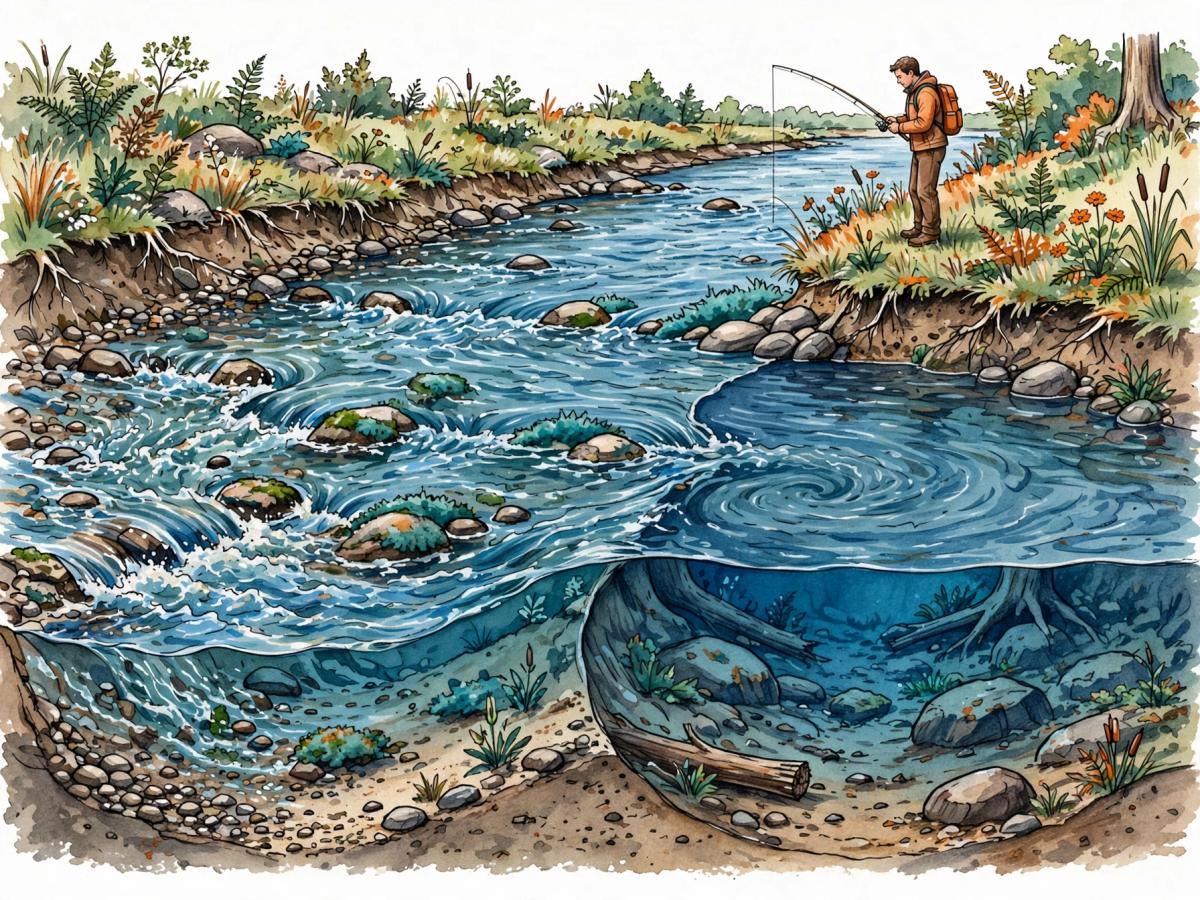
Read Moving Water From a Safe Position
Moving water gives you a map if you learn to read its changes. A river or stream rarely moves at one speed from bank to bank. Shallow broken water, smoother runs, slower pools, current seams, and edges each create a different setting for food and fish. You do not need to wade into the middle to begin understanding that map.
This lesson uses water language as an observation tool. The terms help you describe what you see, but they do not guarantee where a fish is. Species, flow, season, weather, depth, and local access can change the decision.
Learning goal
You will identify common moving-water features, connect current changes to a possible presentation lane, and choose a stable bank position that keeps your casts and next step under control. You will also practice mapping a small piece of water before you fish it.
Name the main shapes
A riffle is a shallow, broken section where water runs over an uneven bottom. The surface often looks textured, and the current can be lively. Riffles may carry food and oxygen, but their shallow appearance does not make them automatically safe to cross or easy to fish.
A run is a more consistent channel of moving water. It often lies between a riffle and a deeper section. The surface may look smoother than a riffle while still moving with purpose. Look for changes in speed, depth, and bottom shape rather than assuming the entire run behaves the same way.
A pool is a slower or deeper area where the surface may appear calmer. The top of a pool can hide depth and current. A calm surface still deserves a careful bank assessment, especially after rain or changing flow.
A seam is the visible or subtle line where two current speeds or directions meet. Foam, leaves, and bubbles can reveal it. A seam may carry food along one side while giving fish a quieter lane nearby. Casts should respect the actual current you see, not only the label you give it.
An edge is a boundary between two conditions, such as fast and slow water, shallow and deep water, shade and sun, rock and sand, or water and bank cover. Edges often deserve a first look because they concentrate a change. They still remain clues rather than guarantees.
Read speed, depth, and direction together
Look at floating material. A leaf that accelerates, stalls, or rotates can show a change in current. Compare its path with another object a few feet away. A seam may be easier to see through foam than through clear water. If the river has recently risen, familiar edges may move or disappear.
Depth changes can show through color, surface texture, visible rocks, or the way a current bends. Clear water can make shallow bottom easy to see, while glare and stain can hide the same feature. Light also changes your view. Move your head or position on the bank before deciding that a section has no structure.
Fish can use different lanes at different times. A fish may feed where food arrives, hold near a current break, or move as conditions change. Your first presentation should test a visible lane you can control. Watch where the line and fly travel, then compare the result with the water's movement.
Position from the bank
A strong bank position gives you a safe stance, a clear casting direction, and a reasonable way to retreat. Look for firm ground, a stable path, and an exit that does not depend on a wet rock or a steep drop. Stand far enough back that your shadow and movement do not require you to lean over the edge.
From there, choose casts that keep the fly in a lane you can see. A short cast to an edge or seam often teaches more than a long cast across several currents. If line lands across different speeds, the faster section can pull it and disturb the drift. Reduce the angle, shorten the cast, or choose a section where you can control the line.
Bank position also means sharing space. Leave room for other anglers, keep hooks away from trails, and avoid casting around blind corners. The best feature in the river is never worth losing your footing or putting another person at risk.
Try this: make a water map
From a stable bank, choose a section you can see without entering the water. Sketch the bank, then mark likely riffle, run, pool, seam, and edge areas. Add arrows for the direction of visible current and circles around two places where the current changes. Note the light, wind, and any food or foam you observe.
Choose one accessible feature and make three short practice observations. First, watch a floating leaf or bubble. Second, place a short presentation along one side of the feature. Third, move your feet only if the ground remains stable and compare the view. Write down whether the line followed one speed or crossed several. The exercise is complete when you can describe what the water did, even if no fish responds.
Water, hooks, and local rules
Moving water deserves a conservative plan. Check weather, flow warnings, local access, and posted closures before you go. Wet rocks, undercut banks, slippery vegetation, and rising water can turn a familiar place into a different one. Keep a route back to stable ground and tell someone where you are fishing when appropriate.
Wading is optional and should stay within your skill, equipment, and current conditions. A wading staff, properly fitted footwear, and an exit plan do not make hazardous water safe. Never step into water you cannot assess, and avoid crossing a current simply to reach a promising feature. Keep hooks pointed away from yourself and other people, and check local rules for licenses, seasons, tackle, access, and harvest.
Recap
Riffles, runs, pools, seams, and edges are ways to describe changes in moving water. Compare speed, depth, surface clues, and current direction before choosing a lane. Start from a stable bank, keep casts short enough to control, and treat every feature as a clue. Safe access comes before a better angle, and local conditions decide whether entering the water belongs in the plan.
Test Your Knowledge
Ready to see how much you've learned? Take this quick 4-question quiz to complete the lesson.
Take the Quiz to Finish
Complete the quiz above to unlock the lesson completion.