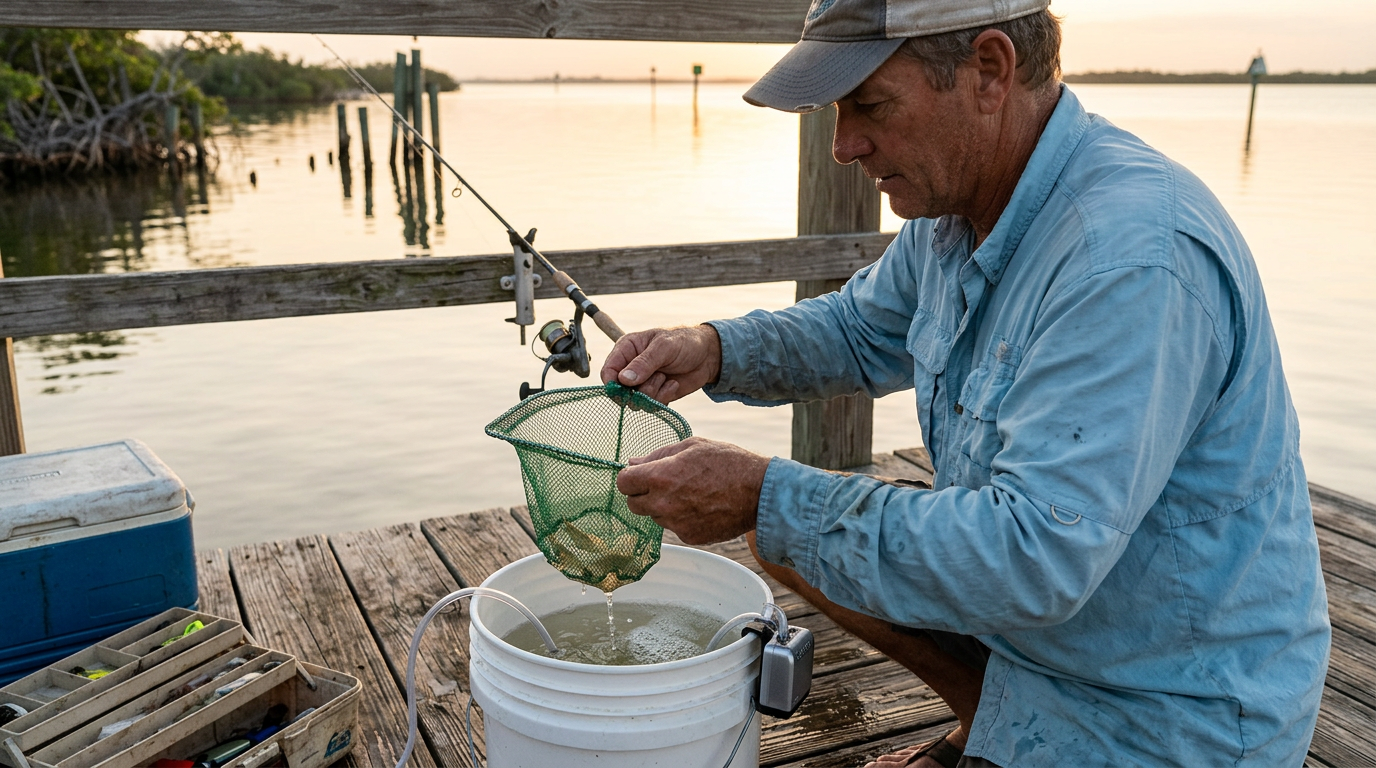
Let's talk about the bait bucket, because a lot of fishing gets decided there before the first cast. You pay for a couple dozen shrimp or spend an hour throwing a cast net for pinfish, you get to the dock feeling good, and twenty minutes later half of them are belly up or sitting listless on the bottom. A frisky bait kicks, flutters and gets noticed. A tired one hangs there. Most of us blame the bait shop or bad luck, but the science on this is pretty plain, and nearly all of it comes down to the water in the bucket.
That bucket is a very small, very crowded body of water, and it behaves like one. Oxygen goes down, waste goes up, and the temperature swings faster than it ever would out in the bay. Once you understand those three things, keeping bait lively gets a lot easier. It also matters more than it sounds, because the bait you drop is the bait the fish see. And if you plan to release your catch, hook choice and how you fish the bait matter too. Our piece on catch and release in Florida talks about ways to reduce deep hooking and handle fish with care.
Where the trouble starts: too many bait in too little water
Louisiana Sea Grant puts it in a way that sticks with you. Eight pounds of live fish or shrimp only displaces about a gallon of water, so it looks like nothing. But to keep that eight pounds healthy while hauling it, they say you need at least eight to ten gallons of clean water. Their numbers are guidance for hauling live bait, not a formula for every bucket, but the direction of the lesson holds. The more bait you pack into a given amount of water, the faster the oxygen drops and the faster the waste builds, and their density chart shows that it gets bad quickly rather than slowly.
So the first and cheapest fix has nothing to do with gadgets. Don't carry more bait than you will fish in the next few hours, and give what you carry some room. A bucket with a dozen shrimp in it is in a very different spot than the same bucket with four dozen.
The waste you can't see or smell
Fish and shrimp in a crowded bucket use oxygen and produce waste. Fish give off ammonia through their gills, and waste can build up in the water around the bait. The University of Florida's extension service says ammonia is the most important water quality problem for fish after oxygen, and the tricky part is that it is colorless and odorless even at levels that hurt them. You cannot tell it's building up by looking. A fish under stress from ammonia gets worse at handling everything else, from crowding to being scooped with a net.
Two things make it worse, and both show up on a Florida dock. UF/IFAS explains that the toxic form of ammonia, the un-ionized kind, is about a hundred times more toxic than the other form, and the share of ammonia in that toxic form goes up as the water gets warmer and as the pH rises. Louisiana Sea Grant's chart shows much the same pattern: at a given pH, warmer water generally has more of the harmful form. A bait bucket sitting in a hot sun on a summer dock is working against you on both counts. Even a starved animal gives off some ammonia, but the extension researchers point out that more food in means more ammonia out, which is one reason commercial bait handlers hold bait without feeding for a day or two before moving it, and longer in cold weather.
Here's a detail that surprises people. Running an aerator helps with oxygen and with carbon dioxide, but Louisiana Sea Grant says it does not remove ammonia. The things that do help are plenty of clean water, cooler water, not overcrowding, and pulling out dead bait quickly so it doesn't rot and add to the load. A dead shrimp in the bucket is not just a dead shrimp. It is a slow contribution to everyone else's bad day. Some water conditioners are made to bind ammonia and neutralize chlorine, and Louisiana Sea Grant notes they can help, but they are an extra and not a substitute for room and fresh water.
Cool water is on your side, until it changes too fast
Temperature is the next piece, and this is a good time of year to think about it. Cooler water holds more oxygen than warm water, and it slows down a bait animal's metabolism, so it breathes less and makes less waste. Louisiana Sea Grant lists cooling the water as one of the ways to keep bait healthy, but cooling it too quickly can harm or kill bait. On a warm day, shade and an insulated container help keep the bucket from heating up. If you need to cool it, do so gradually and keep an eye on the water temperature rather than dumping ice straight in.
That brings us to a part that gets overlooked, which is temperature shock. Small bait animals don't like being rushed from one temperature to another. Louisiana Sea Grant says a sudden change of more than about ten degrees Fahrenheit can harm or even kill small fish or shrimp, and another Louisiana Sea Grant factsheet puts the caution at about five degrees. Either way, the message is that gradual changes are safe and sudden ones are not. Their guidance for bait coming out of a holding tank is to temper it, which means to let the water in the container slowly even out with the water it's going into, at least twenty minutes for every ten degrees of difference.
Now think about what a Florida cold snap does to that rule. A bait shop tank may be sitting in a warm building, you load the bucket, and then you set it on a dock in a stiff north wind on a morning when the air is far below what the water has been all fall. A small amount of water in a thin plastic bucket takes on the air temperature fast. Louisiana Sea Grant even mentions that cold winter air and wind chill can shock bait when it's moved in nets. The same bucket that was a little too warm in July can be a little too cold and too fast in January, so winter is a time when bait can be lost without an obvious reason. A bucket set in the shade out of the wind, with a lid when the weather turns, gives you a steadier temperature to work with.
What goes into the bucket matters too
If you can, fill the bucket with water from where you're fishing, or from the same water the bait was held in when you bought it. Louisiana Sea Grant's advice is to get as close as you can to the same temperature and salinity, and if you can't match them right away, add small amounts of water a bit at a time until they meet. Their tips factsheet says changes of more than about five degrees or ten parts per thousand of salinity can cause temperature shock and osmotic stress, which is a fancy way of saying the animal's body struggles to cope with the difference between the water inside it and the water around it.
Tap water is a trap. Chlorine is hard on bait, and some water systems use chloramine, which breaks down more slowly than chlorine, so a conditioner that only handles chlorine may not be enough. Be careful with ice too. Louisiana Sea Grant warns that ice made from chlorinated drinking water can cause problems as it melts, because some bait species are very sensitive to chlorine. One simple workaround is to keep the ice in a sealed bag or a frozen bottle so the melt stays out of the bucket. That's common sense more than something out of the research, but it fits what they say about keeping chlorine out.
The little things count as well. Louisiana Sea Grant says to use a dip net instead of grabbing bait with your hand, and to wet your hands before you handle bait, because the slime coat protects bait just like it protects the fish you're after. They also mention that insect repellent and sunscreen on your hands can build up in a small amount of water and affect your bait over time. Louisiana Sea Grant prefers round holding tanks to square ones, because bait tends to huddle in corners, which crowds them right where the water is least mixed. Keep the bucket out of direct sun, and remove the dead ones when you see them.
A simple way to run your bucket
Put all of that together and it becomes a habit more than a procedure. Start with the right amount of bait, not the biggest amount. Get the bucket water close to what the bait is used to, and let a big difference even out slowly instead of dumping bait into a different temperature. Keep the water aerated, shaded and, in warm weather, a bit cooler without overdoing it. Pull out the dead and weak ones. In winter, protect the bucket from the wind and from sudden swings between a warm car, a cold dock and the water. And when you do fish it, use a hook and a technique matched to the bait and the species, so your lively bait gets a chance to do its job.
None of this is magic, and bait still dies sometimes. Some of it arrives already stressed from being crowded in a trap or a net, and Louisiana Sea Grant notes that stressed bait is more vulnerable to disease in the first place. The point is that a good share of those losses are things you can influence with a little thought.
Check the rules before you collect or move bait
Florida has rules about bait, and they're worth a look before you start throwing a net or bringing bait from another water. FWC's freshwater rules say that no live nonnative fish, other than variable platys and fathead minnows, may be transported to or between waters for use as bait, that live goldfish and carp may not be used as bait, and that black bass and peacock bass can't be used as bait at all. Freshwater shrimp and golden shiners are allowed, and there are limits on net size and on how bait can be taken. Any game fish caught in a bait net must be released right away. The freshwater methods of taking bait page has the details and is worth reading in full. That page covers fresh water, so saltwater bait rules for pinfish, shrimp and cast nets are a separate check on FWC's saltwater pages.
The other rule that is easy to forget is what you do with the bait left over at the end of the day. FWC says the release of nonnative fish and wildlife is illegal in Florida, and the state's rules make it unlawful to release or introduce a species that isn't native without a permit. Their Don't Let It Loose page lays out the law. So don't dump leftover bait somewhere it doesn't belong, and if you aren't sure whether a bait species is native to the water you're standing on, ask before you pour it out. Check the current FWC regulations for your water and your kind of bait, because rules differ between fresh and salt water and can change.
Where to read more
If you collect your own bait, the Hookwise classroom has a Live Bait and Foraging track with lessons on handling and storing bait, matching bait to the water and following the collection rules. It makes a good next stop after this piece.
If you want to go deeper, these are worth your time. Louisiana Sea Grant's tips for keeping your live bait alive is a short, clear read, and their longer presentation on harvesting, hauling and holding live bait for coastal fishing has the density, temperature and oxygen numbers behind everything above. For the ammonia side, UF/IFAS has a good plain-language publication, Ammonia in Aquatic Systems. Keep in mind that these sources come from bait handlers and fish farms and from Louisiana, so treat their numbers as a guide for what moves things in the right direction, not as exact targets for a five-gallon bucket on a Florida dock. The chemistry of oxygen, temperature and ammonia works the same everywhere, though, and it's the part you can use today.