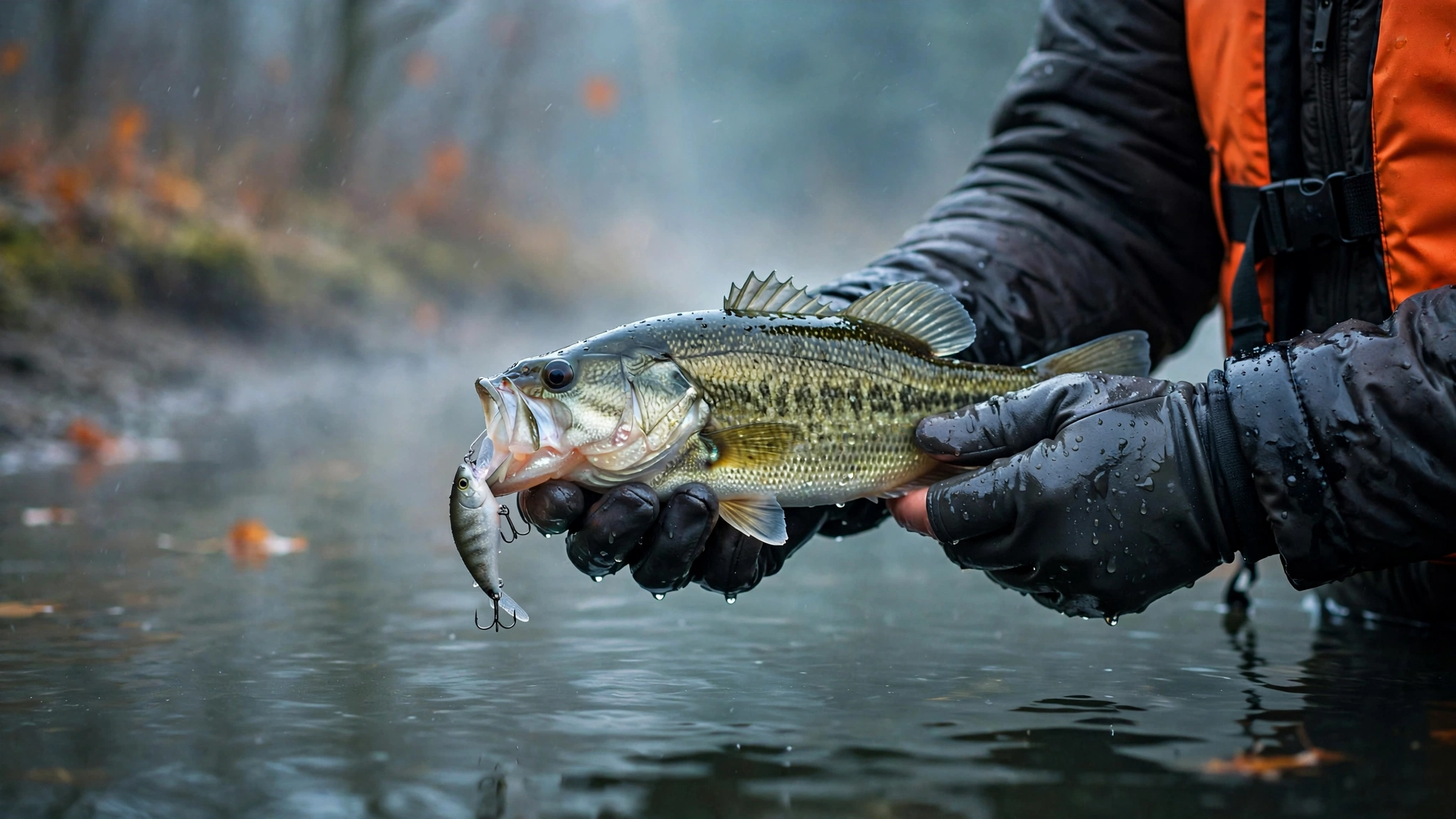
November is when bass fishing changes character. The water keeps cooling, the days keep shortening, and the fish you found along a grass edge a month ago may be somewhere else entirely. Fishing outlets are publishing their late-fall bass guides this month, and a few simple habits (follow the food, read the water temperature, slow down as it drops) can save you hours of casting at empty water.
This guide is built for anglers at any level. If you are newer to bass fishing, use the starter plan below. If you have years behind you, skip to the temperature bands and the notes on shad. Everything here is a starting hypothesis to test on your own water, not a promise of where fish will be. The last section covers the other half of a good November trip: staying warm, dry, and safe.
The short version
- Find the baitfish first. In many lakes and reservoirs, fall bass follow shad and other forage as it moves from deep water toward creeks and shallower areas.
- Treat water temperature as a clue. It helps you choose a lure and a pace, but anglers disagree on how much it drives fish movement, so confirm with what you see.
- Slow down as the water falls. A retrieve that works at 65°F can be too fast when the water is in the 40s.
- Change one thing at a time so you know which adjustment mattered.
- Dress for the water, not the air, and wear a life jacket.
Why bass behave differently in November
Bass have two jobs in late fall: eat well before winter and settle toward their winter areas. Bassmaster Elite Series angler Jeff Gustafson describes the first as the stronger pull, saying the fish "want to fill their bellies" before winter (Bass Resource). His advice for anglers who feel lost: find their food and you will find them.
For many bass lakes, that food is shad. Wired2Fish's November 2026 lure roundup notes that baitfish migrations matter a great deal in fall, as large schools of shad and other forage move from deep to shallow, and that matching the size and look of the local baitfish becomes a bigger deal. That is the "match the hatch" idea in practice: if the bait is small and silver, a small, silver-looking lure is a sensible place to begin.
One honest caveat: the experts do not fully agree on what triggers fall movement. Gustafson believes the shortening day matters more than water temperature, and the Kentucky Department of Fish and Wildlife Resources also calls the amount of sunlight a better barometer for the start of good fall fishing than the heat left in the water (KDFWR). Check available daylight and water temperature as clues for your first few casts, then let the bait and the conditions on your water guide your next adjustment.
Use water temperature as a starting clue
These bands come from Gustafson's fall guide on Bass Resource, and they are a practitioner's framework, not a scientific rule. Gustafson fishes out of western Ontario, so shift them for your region and for largemouth versus smallmouth.
- 70s: Bass are active. Topwaters, spinnerbaits, swim jigs, and crankbaits can draw strikes even at a healthy pace. Look around cover along likely migration routes such as long points and creek channels.
- 60s: Bass do not slow much yet. Horizontal presentations such as vibrating jigs, spinnerbaits, and crankbaits stay effective. Wired2Fish's Southeast writer calls shallow-running crankbaits a favorite once water drops below 65°F.
- 50s: Gustafson calls this the peak of fall fishing, when the urge to feed is strongest. Moving baits such as crankbaits still work, and he says to fish a bladed jig a little slower. Fish begin to group up, so finding the right spot matters more than covering every bank.
- 40s and colder: Bass are likely on or near their winter areas, in tighter groups and close to the bottom. The fishing can still be good if you find them, but the presentation shifts to slow and often vertical.
Find the shad before you pick a lure
You do not need a boat full of electronics to start. Look for baitfish flickering at the surface, birds working over open water, and small fish scattering near the bank. If you have sonar, scan creek arms, secondary points, and the edges of channels for balls of bait, then fish near them. Wired2Fish's fall outlook describes using electronics to find where shad are suspended in cool weather and notes that, in the example lakes it covers, bass can sit under those bait pods and feed in the warmer part of the afternoon. It also points to birds as a useful sign of bait on larger waters (Wired2Fish).
Bank anglers can use the same idea on a smaller scale. KDFWR notes that in its example lakes, bass often move to the bank for a week or two when the water slides toward the mid-60s in November, which suits a lure that covers shallow water quickly. It also mentions boat ramps, which often have a scoured hole at the end, as an overlooked spot at that time of year. That is a Kentucky observation, so treat it as something to look at on your own water, and only where access is allowed and the footing is safe.
Match the lure to the bait and the chill
Think in categories first, then in brands. These are the lure types the sources return to, with the situations they describe:
- Shallow-running or flat-sided crankbaits for bass near wood, rock, and other cover while the water is still falling through the 60s and 50s.
- Wakebaits and topwaters early in the month, while bait is still high in the water. Wired2Fish notes the topwater bite fades as temperatures drop, and a wakebait fished along or just below the surface can still draw bites.
- Smaller bladed jigs around sparse cover and open water, where bass chase small schools of shad. The same writer favors quarter-ounce sizes in fall for their smaller profile.
- Jigs near rock and bank cover as it gets colder. Pro Trey McKinney, quoted in the same roundup for Illinois waters, falls back to a jig when it gets very cold because bass keep eating crawfish.
- Slow, vertical or near-bottom presentations once the water reaches the 40s, as in Gustafson's approach of placing a shad-shaped soft plastic just above the bass he sees on sonar.
If you are new, you do not need all of these. Start with one shallow crankbait for covering water and one jig for slowing down, and keep the plan simple.
Slow down as the water falls
Bass are cold-blooded, so their activity follows the water. The Arkansas Game and Fish Commission makes this point when it advises anglers to slow the retrieve enough to match the bass's activity level in cold water (AGFC). The same idea shows up across the sources: faster, wider-ranging baits earlier, slower and tighter presentations later.
KDFWR describes one regional example of the sequence. By Thanksgiving in its Kentucky lakes, bass leave the shallows and suspend near steeper drops and points, where heavy jigs crawled slowly draw strikes in December and tail spinners or blade baits allowed to fall along the sides of points can catch early-winter fish. Your lake will have its own calendar, so use that as a model for what to test rather than a date to follow.
What happens when it gets very cold
Threadfin shad are delicate. The AGFC says they often struggle when water temperatures fall to about 40°F, and that some lakes see die-offs in winter. A biologist quoted by the agency adds that bass will not pass up a free meal, and he suggests anglers keep a lure that imitates a dying shad on hand, such as a spoon or a suspending jerkbait, while slowing the retrieve to match the fish. Wired2Fish also describes prime winter conditions in a southern example when water temperatures stay in the 40s to low 50s, and warns that a sudden warm-up may push fish shallow only briefly. These are regional patterns, and not every lake has threadfin shad.
If a cold front arrives mid-trip, the same logic applies: compare the last productive depth and cover with what you see now. Our field guide to bass fishing after a cold front walks through that comparison one adjustment at a time, and our post on fall turnover explains another reason fish can move this time of year.
A simple plan for your next trip
- Check conditions before you go. Note the water temperature if you can find it (a boat's sonar, a nearby station, or a local report), the wind, and whether a cold front is moving through.
- Pick two lures. One that covers water and one that slows down. Choose sizes that look like the local baitfish.
- Look for bait. Spend your first minutes watching the water and scanning with sonar if you have it, before you cast.
- Start where bait and cover meet. Creek arms, points, wood, rock, and edges are logical places to test.
- Change one thing at a time. If you want to know how deep your crankbait actually runs, our guide to calibrating crankbait running depth shows how to test one lure and setup in known, snag-free water.
- Write a short note. Date, water temperature, bait, lure, depth, and what happened. A few notes will teach you more about your lake than any article.
Cold-weather safety: the part that keeps you on the water
The American Sportfishing Association's 2026 Special Report on Fishing lists crowded spots, the discomfort of being outdoors, not catching fish, unclean water, and gear costs among the reasons people are dissatisfied with time on the water. Discomfort is the one you can plan for.
Dress in layers and stay dry
You do not need freezing temperatures to get dangerously cold. The CDC says hypothermia can happen at cool temperatures above 40°F if a person is chilled by rain, sweat, or cold water, and it lists shivering, exhaustion, confusion, fumbling hands, and drowsiness as warning signs (CDC). For an angler, fumbling hands is a practical signal: if you cannot tie a knot or work a zipper, warm up, add a layer, or end the session.
OSHA's guidance for outdoor workers is a useful template. It recommends at least three layers of loose-fitting clothing: a moisture-wicking inner layer of wool, silk, or synthetic; an insulating middle layer; and a wind and rain shell that can vent. Add a hat that covers your ears, insulated gloves, and waterproof boots, and carry spare dry socks and gloves in a sealed bag (OSHA). OSHA also recommends warm, sweetened fluids and no alcohol.
Dress for the water, not the air
The National Weather Service says warm air does not always mean warm water. Its advice is to always wear a life jacket in and around the water and to dress for the water temperature, not the air temperature. It adds that cold shock can be as severe in 50 to 60°F water as in 35°F water (NWS). The Minnesota DNR explains the sequence after a fall into cold water: cold shock in the first 2 to 3 minutes, loss of use of the arms and legs within about 30 minutes, and immersion hypothermia after that. Its 1-10-1 principle gives a life-jacketed person one minute to control breathing, ten minutes of meaningful movement to self-rescue, and an hour or more of useful consciousness (Minnesota DNR).
A five-minute safety plan
- Check the weather and the water. NOAA's Tides and Currents map shows water temperature at some stations, so confirm one exists near you. For rivers, our guide to reading a USGS river gauge covers checking a station's timestamp and trend.
- Wear a life jacket before you step onto the dock or boat.
- Tell someone your plan: where you are going, who is with you, what you are driving, and when you expect to be back.
- Carry a way to call for help, and know whether you have signal at your access point.
- Choose stable footing. The NWS lists falls from docks, rocks, and jetties among common causes of cold-water immersion. Skip the shortcut across slick rock.
- Set a turnaround point, such as numb fingers or rising wind, before you leave home.
If someone shows signs of hypothermia, call 911 or your local emergency number. Move them to a warm place, gently remove wet clothing, and warm the center of the body first with dry blankets or clothing. Handle them gently and follow the dispatcher's instructions.
Before you go, check local conditions, access rules and fishing regulations for your water.
Keep planning your next trip
Hookwise is free to use. The trip planner and fishing tools can help you turn conditions into a plan, and our getting started page shows beginners where to begin.
Sources
- Wired2Fish: What Lures We're Throwing in November 2026
- Wired2Fish: The South's Hot Winter Bass Fishing Really Starts Brewing in Fall
- Bass Resource: Keep Up With Autumn Bass By Watching The Water Temperature Fall (2021)
- Kentucky Department of Fish and Wildlife Resources: Cooler temps heat up fall bass fishing (2019)
- Arkansas Game and Fish Commission: Lakes likely to bounce back from frozen fish (2021)
- American Sportfishing Association: 2026 Special Report on Fishing
- Centers for Disease Control and Prevention: Preventing Hypothermia
- Occupational Safety and Health Administration: Winter Weather Preparedness (guidance for outdoor workers)
- National Weather Service: Cold Water Hazards and Safety
- Minnesota Department of Natural Resources: Cold Water Dangers