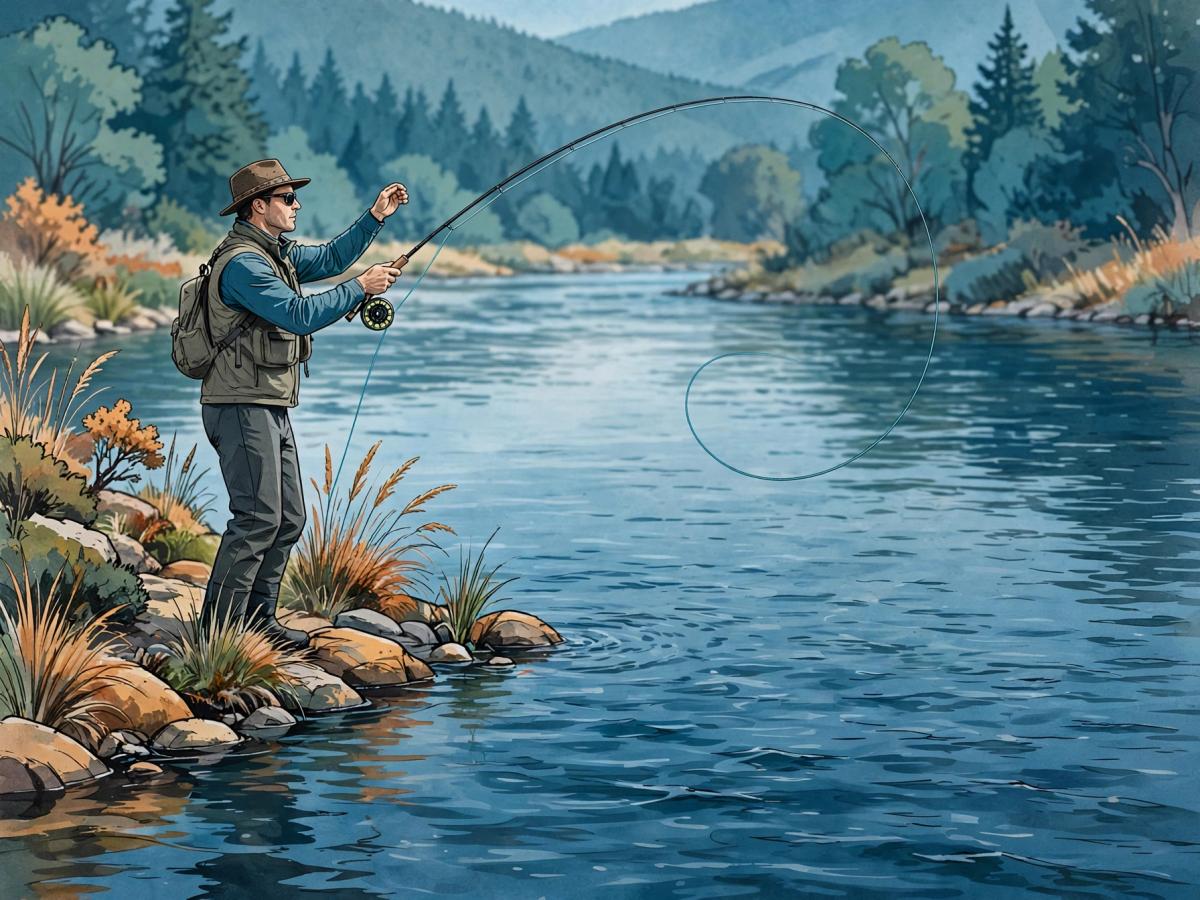
Build a Better Loop
A fly cast becomes easier to improve when you stop treating the loop as a mystery and start treating it as feedback. A narrow loop may tell you that the rod tip traveled on a straighter path. A wide loop may tell you that the stroke opened, the line slowed, or the timing changed. Neither shape is automatically right for every situation. The useful question is whether the loop gives you the control and room your next presentation requires.
This lesson builds on a basic overhead cast. It focuses on false-casting control, line management, open-space practice, and the habits that keep practice productive. You can learn a lot with a familiar rod and line. Specialized tackle is not required for the observations in this lesson.
Learning goal
By the end, you should be able to watch a loop and describe what it is doing, connect timing and rod movement to that result, carry a manageable amount of line with your line hand, and choose a practice space that protects people, hooks, and the rod. You will also have a short practice sequence that helps you find a smoother cast without chasing distance.
See the line before you blame the rod
The fly line carries the cast because it has mass. The rod bends as the line loads it, then straightens as the casting stroke finishes. Your hand does not need to make a large, quick motion. It needs to move the rod through a controlled path and give the line time to respond.
During a false cast, the line travels through the air without touching the water. Watch the back cast and the forward cast separately. If the back loop never straightens before the forward stroke begins, the line has not finished carrying its message to the rod. Starting too soon often makes the cast feel heavy or causes the loop to collapse. A patient pause gives you a better chance to feel the line load.
A useful stroke usually has a smooth acceleration followed by a firm stop. The stop is not a hard jab. It is the moment your hand stops the rod's travel so the rod tip can move the line into a loop. If you continue drifting forward after the stop, the loop can open and lose shape. If you squeeze and punch with your wrist, the rod tip may travel in a wavy path that shows up as a tailing or uneven loop.
Start with the line you can comfortably control. Carrying more line in the air asks for more timing, more room, and more attention to what is behind you. Add line only after the shorter amount is straightening consistently. This keeps the practice question small: what changed when you altered the stroke or pause?
Read tight and open loops as information
A tighter loop has a narrower top and bottom path. It can be useful when you have room to send the line forward with precision, but it also needs a clean back cast and safe overhead space. An open loop has more space between its top and bottom legs. It can be useful when you need to slow the line, carry a larger fly, or soften a presentation, depending on the outfit and conditions.
The goal is not to force every cast into the narrowest possible shape. A loop that looks tidy but travels into a branch is a poor result. A loop that opens slightly to keep a fly away from an obstacle can be a smart adjustment. Let the water, wind, fly, and available space decide what control means.
If the loop collapses before it reaches the target, check three things in order. First, ask whether the line had time to straighten. Second, notice whether the rod stopped firmly enough to direct the line. Third, check whether your casting hand followed a consistent path. Change one item at a time. Trying to add speed, length, and a different hand position together makes the result hard to interpret.
False casting can also create a useful visual check. Look for the loop's direction, its height, and the amount of line that remains under control. If the back loop is low because of a branch or bank, use less line and a safer angle. If the forward loop is high but the back cast is drifting toward another person, stop and change your position. Casting skill includes choosing a safe line of travel.
Let the line hand do its quiet work
The line hand controls the loose line between the reel and your fingers. Pinch the line lightly against the rod grip when you want the rod to load, then release or strip with intention when you want line to move. A tight grip makes small corrections harder and can add fatigue. A relaxed pinch gives you a reference point without turning the hand into a second casting engine.
Before you false cast, organize the loose line so it can slide without catching on grass, rocks, pedals, or your feet. Carry only the amount you can see and manage. When you need more line, draw it smoothly from the reel or guides rather than pulling a tangled pile through the cast. If the line lands in a heap, pause and reset it. Repeating a tangled cast teaches the tangle.
Watch the line hand as you practice. Is it holding too much slack? Is it pulling during the stop? Is it moving because you are trying to rescue a loop that already lost shape? A simple rhythm helps: lift, pause for the line to extend, move forward, pause again, and feed or strip only when you have a reason.
Practice where the cast can breathe
Choose an open area with a clear path behind and in front of you. Remove the fly, or use a practice yarn piece if that suits your setup and local practice space. Keep the leader attached only when you have checked that the area is safe. A grassy area can help you see the line, but it should still be clear of people, pets, roads, overhead wires, and branches.
Begin with a short amount of line outside the tip. Make five controlled back casts and five forward casts without trying to add distance. After each cycle, name one observation: the back loop straightened late, the forward loop opened, the line hand held too much slack, or the rod stopped cleanly. Then change one variable and repeat.
Next, place a marker at a comfortable target. Try three casts with a relaxed grip, three with a slightly longer pause, and three with a slightly shorter stroke. The marker is a reference, not a score. Notice which version gives you a line that unrolls in the direction you intended.
When you add a fly and move near water, make the same safety check again. A familiar practice space may have a different crowd, wind direction, or obstruction on another day. Look behind you before each cast. Keep hooks covered or secured while you walk, and never swing a cast through a person who entered the practice area.
Try this in the field
Set aside ten minutes during your next outing for a loop audit. Start with a small amount of line and a safe open lane. Make six false casts, then stop and write down the loop height, loop width, and whether the line fully straightened behind you. Repeat after changing only the pause. Repeat once more after changing only the line length.
Finish by choosing the version that gave you the most control, not the longest cast. Use that version for your first actual presentation. If fatigue appears in your forearm, shoulder, or wrist, put the rod down and rest. A shorter, calm practice session gives you more useful feedback than forcing another cast while tired.
Safety and local rules
Always make room before casting and account for hooks, line, bystanders, pets, branches, and overhead hazards. Wear eye protection when appropriate, especially when practicing with a fly attached. Use a safe back-cast direction rather than assuming the space behind you will stay clear. Follow local rules about access, bait or fly restrictions, barbless hooks, and species handling. Conditions and tackle differ, so use this loop practice as a way to observe your own setup, not as a universal casting formula.
Recap
- The fly line carries the cast, while the rod loads and unloads in response to a controlled stroke.
- Give the line time to straighten before beginning the opposite cast.
- A smooth acceleration and firm stop create a clearer loop than a rushed wrist motion.
- Tight and open loops are tools for different spaces and presentations, not a simple ranking.
- Carry only the line you can manage, and change one practice variable at a time.
- A safe casting lane is part of good technique.
Test Your Knowledge
Ready to see how much you've learned? Take this quick 4-question quiz to complete the lesson.
Take the Quiz to Finish
Complete the quiz above to unlock the lesson completion.