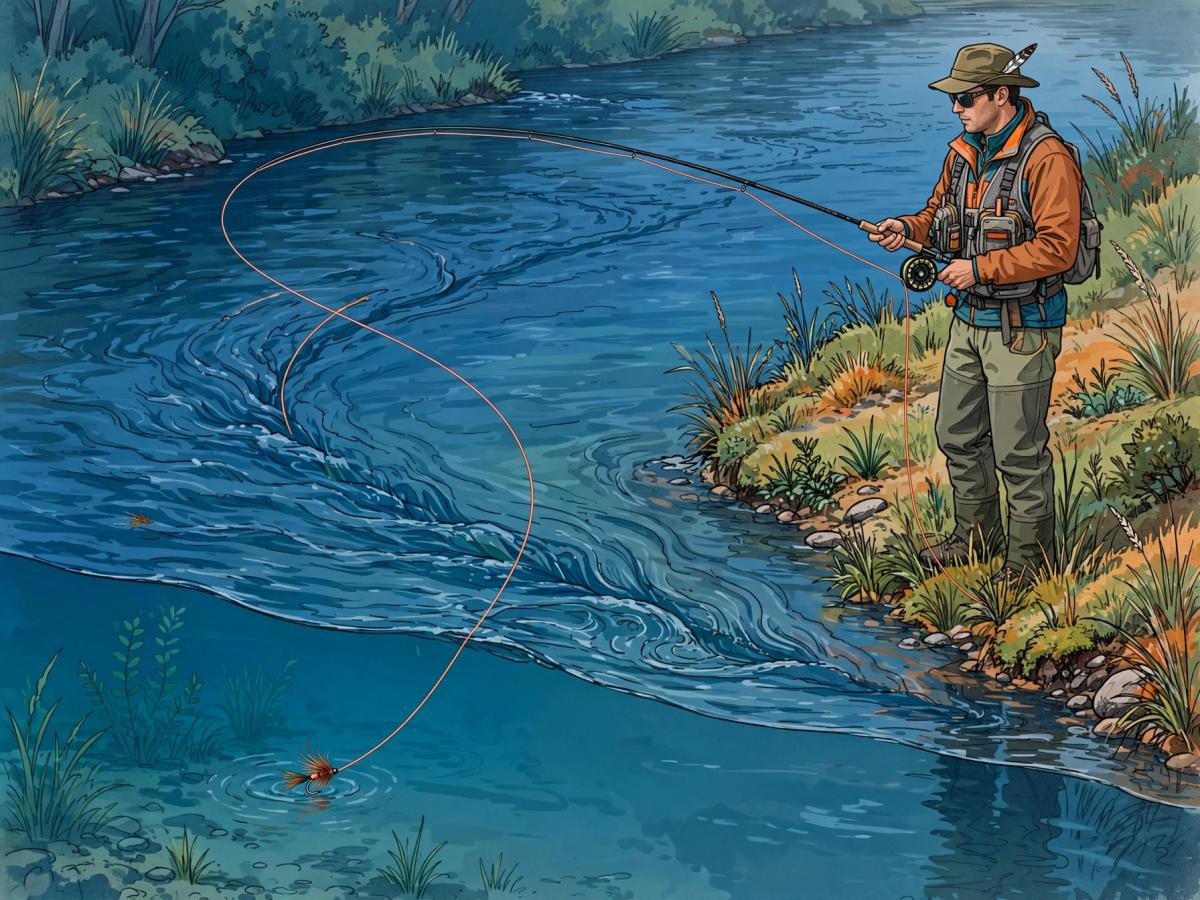
Mending and Line Control
A fly can be the right size and color and still move through the water in a way a fish does not expect. Current acts on the fly line, leader, and fly at different speeds. When one section pulls ahead, the fly may skate, drag, or leave the feeding lane before you have learned anything from the drift. Mending gives you a way to change that relationship after the cast.
Mending is a line-control skill, not a single motion that works identically in every river or lake. The best timing, direction, and amount depend on current speed, depth, wind, line type, and where your fly landed. You can learn the principle without wading. A careful bank position often gives you a clearer first look at the water and a safer place to practice.
Learning goal
By the end, you should be able to identify a current seam, recognize a line belly that is changing the drift, choose an upstream or downstream mend for the situation, and use small line or position adjustments to keep the fly moving naturally. You will also have a bank-first exercise for comparing two drifts without making a risky step into the water.
Find the current that is moving your line
Look at the water between your rod tip and the fly. A seam is a boundary where two speeds or directions meet. It may show as a change in surface texture, a line of bubbles, a soft edge beside faster water, or a quiet lane next to a stronger flow. The fly may be in one speed while the line lies across another. That difference creates tension.
Imagine the line as a leash that crosses several moving sidewalks. The current that reaches the line first can pull it into a curve, often called a belly. As the curve grows, it pulls on the leader and fly. The fish sees a fly that speeds up, drags across a seam, or swings away from the lane you meant to fish.
Watch the fly when you can, but also watch the line. If the line straightens quickly toward the bank, the current may be taking control. If the leader forms a sharp angle before the fly has traveled through the target lane, the connection may be moving the fly unnaturally. These are observations, not proof of why a fish did or did not respond. They tell you which presentation variable deserves a test.
What an upstream mend changes
An upstream mend moves a section of line toward slower or higher water before the current can pull it downstream. The exact motion can be a small lift and roll of the rod, a deliberate sweep of line, or a repositioning that keeps the line above the fly's path. The purpose is to give the fly more time to travel without the line dragging it.
Make the mend with enough line to change the belly, but avoid throwing a large wave that lands on the fish's lane. Early mends often help because the line has less tension and the fly has more drift ahead. A late mend can still rescue a presentation, but it may move the fly or shorten the useful part of the drift. Watch the result instead of repeating the same size mend by habit.
Keep the rod tip and line relationship in mind. If you lift too much line, you may lose contact with the fly. If you lift too little, the current may keep the same belly. A small correction followed by observation is easier to understand than a large correction followed by several more changes.
When a downstream mend or angle helps
A downstream mend can be useful when the line needs to slow in a different direction, when you are managing a crossing current, or when you are setting up a swing rather than a dead drift. It is not a default answer. Move only the line you need to move, and notice whether the fly now travels at the speed of the water around it.
The cast angle changes how much line crosses each current. From one position, the fly may land in the soft lane while the line crosses faster water. From another position, the line may lie in a more consistent speed. Before adding a dramatic mend, look for a safer bank position or a casting angle that reduces the problem at its source.
A reach-style delivery can place line upstream of the fly as it lands. In plain terms, the rod and line are positioned so the current has less immediate leverage over the fly. This can be useful when you have room and can keep the cast controlled. It still needs a clear back-cast area and enough space for the line to land without crossing people, brush, or private structures.
Keep the fly moving naturally
Natural does not mean motionless. A drifting insect, baitfish, or other food item may slow, sink, rise, or change direction. Your goal is to make the fly's movement fit the water you are observing rather than letting a random line belly decide it for you.
Start by choosing one lane. Follow the fly through that lane for as long as you can. If it immediately accelerates, crosses the seam, or swings toward the bank, decide whether a mend, a different angle, a shorter cast, or a small position change addresses the cause. If the drift improves, repeat that one adjustment in a nearby lane. If it does not, record what happened before changing the fly.
Line control also includes slack. Some slack protects a drift from current, while too much slack makes it difficult to detect a take or guide the fly away from a hazard. Keep enough connection to respond without pulling the fly out of its lane. The right amount changes with depth, current, leader length, and the type of presentation.
Bank-first alternatives to wading
You can learn a great deal from the bank. Walk slowly along a legal access point and inspect the water from more than one angle. A small change in position may line your cast up with a seam and reduce the amount of line crossing fast water. A longer reach from shore may solve a presentation problem without putting your feet on slippery rocks.
Use a shorter cast to a closer seam before attempting the far side. This reduces variables and lets you see the effect of the mend. If the water is high, cold, fast, or unfamiliar, stay on stable ground and choose a lane you can fish safely. A fishable drift is useful only when you can maintain balance and control.
If you do choose to wade where it is lawful and appropriate, check the bottom, current, depth, weather, and access first. Wear suitable flotation when the setting calls for it, and never treat a lesson about mending as a reason to enter unsafe water. Many presentations can be improved by moving along the bank or changing the cast angle.
Try this in the field
Find two visible seams from a stable bank. Use the same fly and a similar distance for both. On the first drift, make the cast and watch the line without mending. Note where the belly forms and how quickly the fly crosses the lane. On the second drift, make one small upstream mend as soon as the line lands. Compare the fly's speed, the line's shape, and the length of the useful drift.
Repeat once with a different casting angle if the bank allows it. Write down which change had the clearest effect. The point is not to declare one mend correct forever. The point is to build a habit of seeing the current, making one controlled adjustment, and checking what the fly did next.
Safety and local rules
Keep hooks, line, and back casts clear of bystanders, branches, rocks, and overhead hazards. Stay on stable ground when current, depth, cold, weather, or access makes wading uncertain. Check local rules for access, wading areas, seasons, species, hook requirements, and release or harvest decisions. A safer bank position is a sound technique choice, not a lesser version of fishing.
Recap
- Current can move the line faster than the fly and create drag.
- A seam is a useful place to compare speeds, surface texture, and line behavior.
- An upstream mend can reduce a downstream belly, while other angles or mends may fit different presentations.
- Early, small corrections are easier to read than large, late motions.
- Bank position and casting angle can solve problems before you enter the water.
- Line control balances a useful connection with enough freedom for the fly to move naturally.
Test Your Knowledge
Ready to see how much you've learned? Take this quick 4-question quiz to complete the lesson.
Take the Quiz to Finish
Complete the quiz above to unlock the lesson completion.