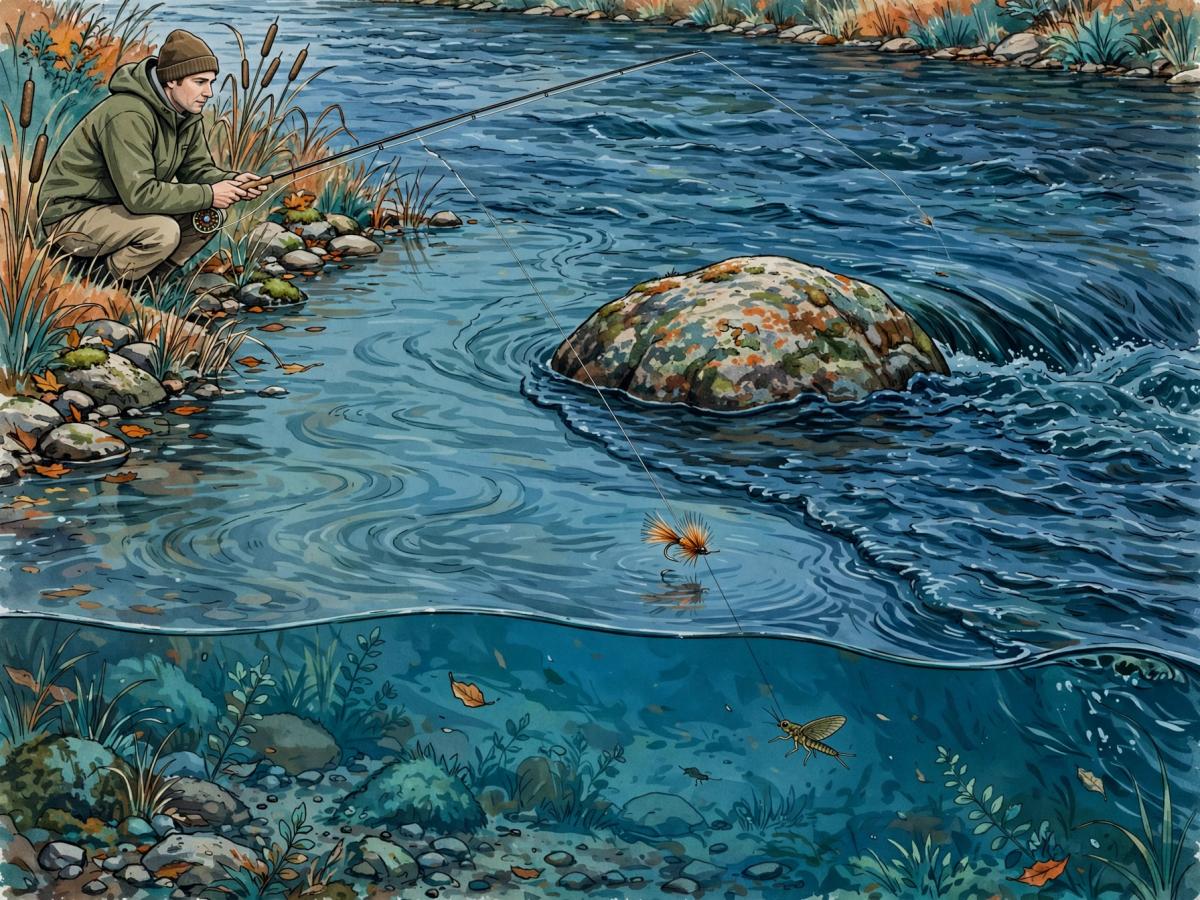
Presentation Before Pattern
A fly change feels productive because it is visible. You open a box, choose a different shape, and have a new question to ask the water. Sometimes the pattern matters. Often, the first useful question comes earlier: did the fly arrive at the right depth, travel at a believable speed, and stay in the feeding lane long enough for a fish to see it?
Experienced fly fishing asks you to separate what the fish may be responding to from what you can control directly. You may not know the exact food item or the fish's preferred depth. You can inspect the drift, the line, the angle, and the amount of time the fly spends in a likely lane. That makes presentation a practical place to begin.
Learning goal
By the end, you should be able to compare surface and subsurface clues, look for drag in a drift, choose a single presentation variable to adjust, and use the fish's response to decide whether the next test should be another presentation or a pattern change. You will practice keeping the fly constant long enough to learn from it.
Ask how the fly arrived
A fish sees a fly inside a moving environment. The water may carry real food near the surface, along a seam, through the middle of the current, or close to the bottom. Your artificial fly joins that environment with a leader and line attached. If the connection makes the fly accelerate, skate, or rise at the wrong time, a perfect-looking pattern can appear unconvincing.
Before changing the fly, watch the presentation as if you were drawing a path on the water. Where did the fly enter? What direction did it travel? Did it remain in the lane, and for how long? Did the line form a belly that pulled it? Did the fly sink, suspend, or stay on top? These questions turn a disappointing cast into information.
A drift can be too short because the cast landed across several current speeds. It can be too fast because the line or leader gained tension. It can be too deep because the fly or added weight continued to sink after it entered the lane. The correct response depends on the presentation you intended, so name that intention before you adjust it.
Surface clues and subsurface clues
Surface activity can include visible insects, dimples, sips, splashes, or fish moving just beneath the film. Look at the rhythm and location of that activity. A single splash may be a disturbance with no useful pattern. Several similar rises in one lane give you a reason to study the speed, light, and food at the surface.
Subsurface clues are quieter. You might notice a bulge in the water, a flash, a swirl, a change in the current, or a fish responding below the surface without showing its mouth. You may also see drifting food along the bank or in a seam. These observations suggest a depth or lane to test, not a guarantee that one fly or one depth will work.
If the water is clear and calm, move carefully and observe from a low profile. If the water is broken or stained, use the line and surface texture as additional feedback. The same fly can present differently when light, wind, current, or water level changes. Treat the conditions as part of the presentation rather than background scenery.
Build a drag-free drift
A drag-free drift is a useful goal for many dead-drift presentations. It means the fly travels at a speed and direction that fit the water around it instead of being pulled by a faster line. You may create more time with an upstream mend, a different angle, a shorter cast, or a reach-style delivery that places line away from the fly. The best option depends on the water and space available.
Keep the correction proportional. Too little line control leaves the original problem. Too much line movement can disturb the lane or pull the fly in a new direction. Watch the fly and line after the correction, then decide whether the drift improved. A longer drift is not automatically better if the fly is moving unnaturally.
For subsurface work, depth and speed interact. A fly that reaches the suspected lane too late may need a different angle or sink time. A fly that drops below the useful lane may need less time, a different line position, or a change in the presentation. Avoid treating depth as a number you must guess perfectly. Use the water, the fly's movement, and any fish response as a series of clues.
Change one thing before changing everything
Use a simple order when a presentation is not producing useful feedback. First, check the angle and line control. Next, consider the fly's speed and drift length. Then consider depth. After those checks, decide whether a pattern change would answer a new question about size, profile, color, or food type.
This order is not a universal rule. A fish may be keyed to a particular food, and local regulations or conditions may limit what you can use. The point is to make the change explainable. If you change distance, depth, fly, and retrieve together, a fish response tells you very little about why it happened.
When you do change the pattern, keep the presentation as similar as possible for the next few casts. This gives the new fly a fair comparison. If the response improves, record the conditions and the presentation that accompanied it. If the response does not improve, you have still narrowed the question.
Observe the result, including no result
A refusal can be useful. A fish following and turning away may suggest an issue with speed, depth, drag, or pattern. A fish that never sees the fly gives you less information than a fish that tracks it, but the lane may still be wrong. Avoid turning one observation into a permanent rule.
After a few controlled presentations, move your position or choose a nearby lane if the water allows. A fish may be feeding elsewhere, the light may have changed, or the visible activity may not represent the whole reach. Keep your expectations proportional to the evidence. The goal is a better next test.
Try this in the field
Choose one fly and one visible lane. Make two similar casts without changing the pattern. On the first, allow the line to land naturally and watch for drag. On the second, make one small angle or mend adjustment. Compare the speed, depth impression, and length of the drift.
If the presentation improves, repeat it once. If it does not, change only one more variable, such as distance or depth, and observe again. Change the fly only after you can state what the previous presentation did. Write a short note with four parts: intended presentation, visible clue, one adjustment, and result.
This exercise trains patience without requiring you to ignore the fly box. Pattern selection still matters. You are giving it a clearer job by first making the presentation understandable.
Safety and local rules
Keep casts and hooks away from people, branches, overhead wires, and unstable banks. Watch your footing while you look at the drift, and do not step into water to reach a presentation that can be tested from shore or a safer angle. Follow local rules for flies, hooks, seasons, access, and species handling. Water conditions can change quickly, so stop when visibility, footing, weather, or current makes the next cast unsafe.
Recap
- A fly's arrival, depth, speed, and time in the lane are part of its presentation.
- Surface and subsurface clues can suggest a lane without proving a perfect match.
- Drag-free drift is a useful goal when the line is pulling the fly unnaturally.
- Change one presentation variable at a time before replacing every fly.
- A fish response, a refusal, and a quiet drift all provide different amounts of information.
- Pattern changes become easier to evaluate when the presentation is controlled.
Test Your Knowledge
Ready to see how much you've learned? Take this quick 4-question quiz to complete the lesson.
Take the Quiz to Finish
Complete the quiz above to unlock the lesson completion.