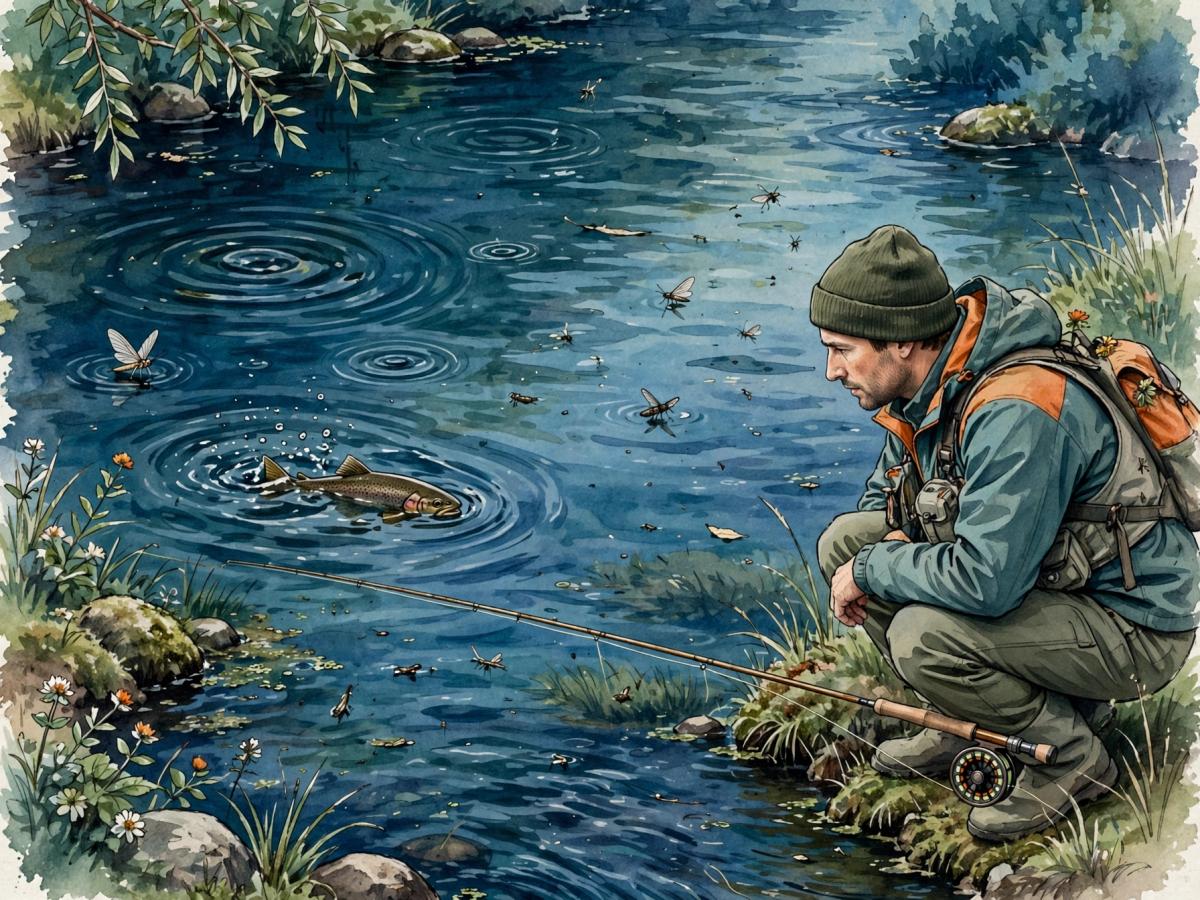
Read the Rise, Choose the Next Move
A rise can look like a clear instruction. A splash appears, a ring spreads, and the hand reaches for a fly that seems to match. Sometimes that quick response works. A more reliable habit is to slow down long enough to ask what the water and fish actually showed you.
Rise forms are clues about where and how a fish took food. They are not a complete dictionary. Wind, current, depth, species, and the angle of your view can change what the same response looks like. The goal is to gather a few connected observations, then choose one next move that you can evaluate.
Learning goal
By the end, you should be able to describe a rise without pretending it gives a perfect answer, inspect nearby food and water speed, and select one adjustment based on the evidence in front of you. You will practice separating observation from interpretation and using a fish response to refine the next presentation.
Start with the shape and rhythm
A gentle sip may leave a small ring and little surface disturbance. A splash may show a more forceful take or a fish moving through broken water. A swirl or bulge may indicate activity below the surface. These descriptions are useful when they stay connected to place and timing. A single rise does not tell you the whole feeding pattern.
Watch for repetition. Are rises happening in the same lane, at the same depth, or near the same bank feature? Do they appear on a regular rhythm, or did one fish rise once and disappear? Is the water smooth enough for you to see the surface clearly? Write down what you saw before naming the insect or changing the fly.
Your viewing angle matters. Looking upstream, across a seam, or from a high bank can make a rise appear more dramatic or more subtle. A fish may take below the surface while the current carries bubbles across the same area. Let the water's movement be part of the description.
Inspect the food without forcing a match
Look at the surface, shoreline, and nearby vegetation. You may see insects on the water, in the air, or caught in bank growth. You may notice small baitfish, nymphal shucks, or other food clues. Use a small sample or close observation when it is safe and lawful, then return your attention to the water.
Matching the most obvious food can be useful, but it is not a requirement to claim certainty. The fish may be feeding on a different stage, using a different depth, or responding to movement rather than exact appearance. Choose a broad starting hypothesis: surface food, drifting subsurface food, or a moving target. Then make a presentation that tests that hypothesis.
Size, profile, color, and behavior can all matter. So can the way a fly enters the water. If the fish refuses a fly that looks close, inspect the drift and speed before assuming the color is wrong. If the fish responds below the surface, ask whether your fly reaches the depth and pace you intended.
Let water speed shape the choice
Water speed changes the time a fish has to see, follow, and take a fly. A fish beside a fast seam may feed in a softer pocket. A rise in a smooth tailout may require a quieter approach and a longer, controlled drift. A visible rise in a strong current may be easier to reach from a different bank angle than from a straight cast across the flow.
Look for the relationship between the rise and the current. Is the fish feeding at the top of a seam, inside the seam, or in the softer water beside it? Is the fly lane long enough for a controlled presentation? Can you make the cast without dragging line across another speed? These questions help you choose a target that matches your actual control.
If your first cast lands too close, too far, or across several speeds, do not treat the fish's lack of response as a verdict on the fly. Move your feet on stable ground, shorten the cast, or change the angle. A safe position often creates a better test than a more complicated pattern.
Choose one measured adjustment
Use a simple sequence after observing a rise. First, protect the presentation by checking your approach and line. Second, adjust the drift angle or length if the fly is moving too quickly. Third, adjust depth if the clues point below the surface. Fourth, consider a pattern change that answers a specific question about food, size, or profile.
This sequence leaves room for judgment. A fish may be feeding on a short window, the light may change, or local rules may limit a fly choice. The lesson is about making your next move legible. If you change everything, you may catch a fish without knowing what to repeat. If you change one thing and observe, you build a more useful understanding of that water.
When a fish refuses, pause before casting again. Give the lane time to settle, check where the line landed, and decide whether the fly dragged. When a fish takes, notice what the presentation looked like just before the response. Keep the observation modest. One fish response supports a next experiment, not a universal rule.
Respect the fish's space and the water's limit
Approach slowly and use the bank, vegetation, and available shade to reduce disturbance when appropriate. Avoid stepping through shallow feeding lanes or crushing bank growth just to reach a rise. A rise that disappears after repeated casts may be a signal to move on and return later.
If access is crowded, private, or restricted, choose a legal place where you can fish without conflict. The best decision may be to observe the rise and leave it alone. Learning to read a fish includes learning when the situation does not support a safe, considerate presentation.
Try this in the field
Spend fifteen minutes watching a safe, legal stretch before changing flies. Record three observations for each rise you can see: the surface form, the water speed or lane, and any nearby food clue. If the rise repeats, choose one presentation adjustment, such as a shorter cast, a different angle, or a small mend.
Make two careful presentations with the same fly. After each, note whether the fly stayed in the lane and how the water responded. If the fish refuses, change one variable only. If no fish responds, move to a nearby lane or wait for another observation before changing patterns. The exercise is complete when you can explain why you made the next move.
Safety and local rules
Keep your footing and back-cast lane in mind while watching the surface. Protect your eyes from hooks and line, and give other anglers space. Do not step into moving water or onto unstable banks to reach a rise. Check local rules for seasons, access, fly and hook requirements, species handling, and any restrictions on collecting or disturbing natural food. Water and weather can change while you are watching, so stop when the setting becomes unsafe.
Recap
- Rise forms are useful clues, not perfect instructions.
- Repetition, location, water speed, and nearby food make a single rise easier to interpret.
- A visible food match still needs an appropriate depth, speed, and drift.
- Change one measured variable before changing every fly.
- One response can guide a next test without becoming a universal formula.
- Safe access and respectful observation are part of reading the rise.
Test Your Knowledge
Ready to see how much you've learned? Take this quick 4-question quiz to complete the lesson.
Take the Quiz to Finish
Complete the quiz above to unlock the lesson completion.