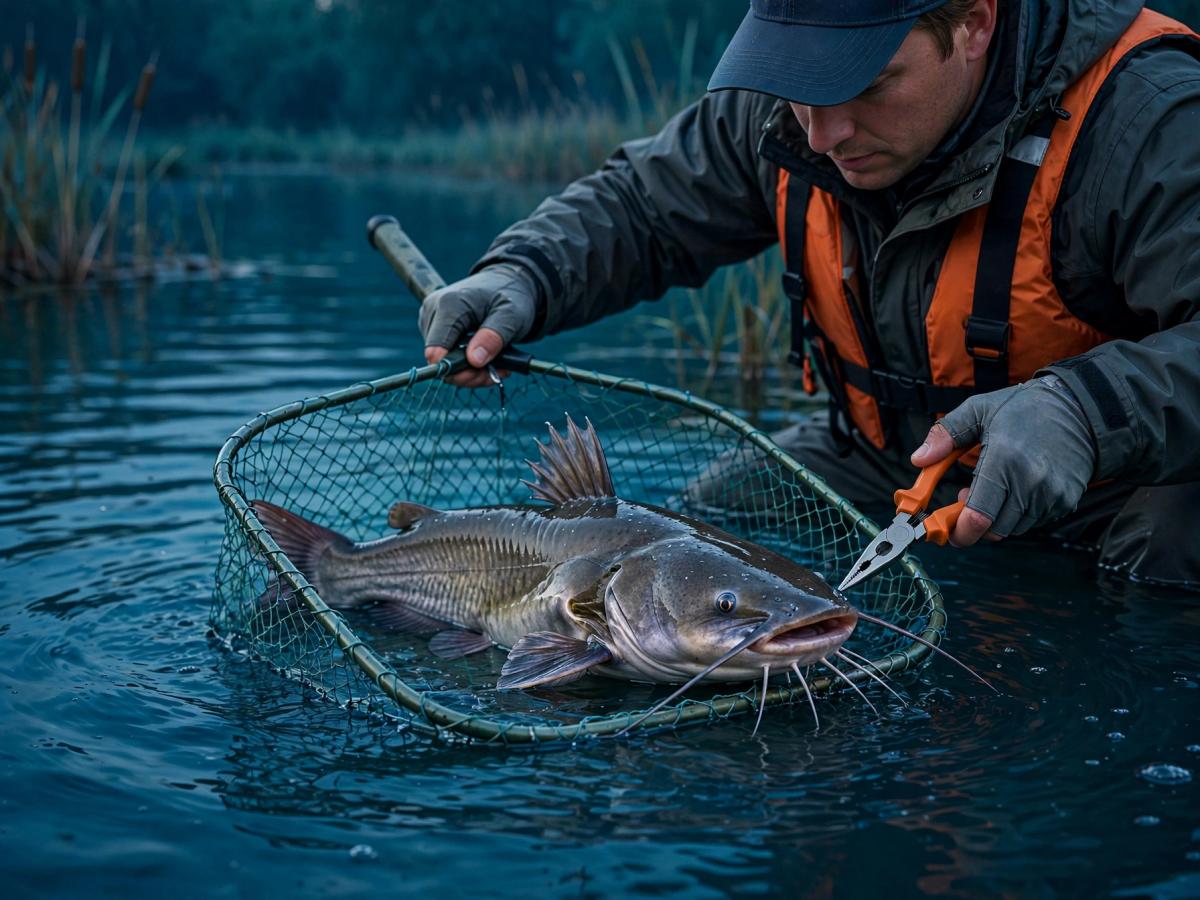
Make the landing calm and close to the water
A larger catfish makes every part of the landing more consequential. The fish has more weight and movement, the spines are still sharp, and a hook can turn quickly when the angler is tired or excited. Responsible handling starts before the fish reaches the bank. Prepare the landing area, net, tools, and release or lawful harvest plan while the water is still quiet.
This lesson does not teach cleaning or promise a trophy outcome. It teaches a calm sequence for a fish that may be larger than the angler expected: keep the fish in control, protect your hands from sharp spines, remove the hook with tools, support the fish close over the water, limit air exposure, and follow the current rules for release or legal harvest. Stop when the fish, the bank, or the equipment makes the next step unsafe.
Learning goal
By the end, you should be able to:
- Prepare a landing zone and tools before a larger fish arrives.
- Use a landing net and keep hands away from dorsal and pectoral spines.
- Support a fish close over the water while limiting unnecessary air exposure.
- Decide when to release, seek help, or follow a lawful harvest process without improvising risky handling.
The safest handling method depends on the species, size, condition, equipment, bank, and local guidance. A careful angler chooses the plan before the exciting moment.
Prepare the system before the bite
Keep a suitable landing net where you can reach it without stepping toward the edge. The net should be large enough for the fish you may encounter and manageable in the water you are fishing. Place long-nose pliers or another hook-removal tool beside the landing area, not buried under tackle. Clear loose hooks, line, bags, and rocks from the space where you will work.
Decide where the fish will remain while you remove the hook. A shallow, stable margin or a supported net in the water may be safer than lifting the fish onto dry ground. If the shoreline is too steep, slippery, crowded, or narrow to land a fish without a struggle, move to a better position before casting or choose a different session.
Talk through the sequence with a partner if one is present. One person can manage the net while the other handles the rod and tools, but both people need to know where the hooks and spines are. A partner is not a substitute for a safe position or a clear plan.
Net first, hands later
Keep the fish under controlled tension and guide it toward the net when it is ready. Do not drag a large fish across gravel, grass, or a dry bank. A net reduces the need to reach, lift, or chase a moving fish. Once the fish is inside, keep the net supported in the water or on a stable, wet surface while you secure the next step.
Avoid swinging a fish upward by the line. The line, knot, hook, and rod were not designed to turn a large fish into a hanging weight, and a sudden drop can injure the fish or the angler. Keep the net handle and the fish close to the water. If the fish surges, let the net and water absorb movement rather than trying to pin it with a bare hand.
A fish in a net is still capable of moving. Keep the hook point and spine locations in your mind before reaching. If the fish is tangled, the net is too small, or the landing area no longer feels stable, pause and ask for help or return the fish to the water while you reset.
Keep hands away from sharp spines
Catfish can have sharp dorsal and pectoral spines that can puncture skin and make a rushed grip dangerous. Keep fingers away from the spines and do not press a hand over a fin to force it flat. Do not place a thumb or palm inside a mouth as a substitute for a safe hold. A species-specific hold should come from current, qualified guidance for that fish, and the actual condition of the landing.
Use pliers or a suitable hook-removal tool to keep hands away from the hook. Do not reach into a mouth or pull forcefully when the hook is deep, tangled, or under tension. If the hook cannot be removed safely, keep the fish supported in the water and seek appropriate local or professional help. A damaged tool or poor angle is a reason to stop, not a reason to increase force.
Protect your own hands and eyes while working. Keep other people back from the hook and fish. If you are cut or punctured, stop handling and get appropriate first aid. The fish's welfare and the angler's safety are part of the same landing decision.
Support the fish close over the water
For a legal release, keep the fish in the water as much as possible. Remove the hook while it is supported by the net or by a safe hold that you understand for that species. If a brief lift is necessary, keep the fish close over the water so a slip does not create a hard fall. Support the body rather than letting the fish hang from the jaw, line, or one hand.
Only use a two-handed support when you have cleared the hook and spines, have stable footing, and know that the hold is appropriate for the species and size. If any part of that plan is uncertain, leave the fish supported in the water and return it without a photo. A photograph is optional. A quick, controlled release matters more.
Limit air exposure to the shortest time needed for lawful handling. Do not carry the fish away from the water, pose it on dry ground, or keep lifting it while searching for equipment. Prepare the landing area first so the fish is not waiting while you solve a problem.
Follow the rule for release or legal harvest
Check the current official regulations before the trip for species identification, size and possession limits, seasons, protected waters, release requirements, and any method rules that affect your plan. If release is required, return the fish to the same water promptly and calmly. Do not move it to another waterway or place it in an unapproved container.
If legal harvest is permitted and that is your choice, follow the current local method and limits. This lesson does not teach cleaning. Keep the decision within the rules and your ability to carry it out safely. If the fish is outside the limit, protected, or difficult to identify, follow the release guidance and seek help rather than improvising.
Intermediate field exercise: rehearse the landing
Before your next lawful session, rehearse the sequence without a fish:
- Place the net where you can reach it from stable ground.
- Place pliers or the hook tool where the working hand can find it without searching.
- Identify the water-supported landing area and the step-back space.
- Point out the dorsal and pectoral spine zones and the hook path to your partner.
- Practice securing the hook and moving the empty net without crossing another person's line.
- Say the release or lawful harvest decision out loud, including the rule you checked.
During the real session, note which part of the plan worked and where you became rushed. If the fish is larger than your equipment or your safe hold, keep it in the water and get help. You do not need to turn every catch into a photograph or a difficult lift.
Safety and local rules
Use stable footing and keep your body away from steep, slippery, or undercut banks. Never step into moving water or kneel at the edge to reach a fish. Secure spare hooks and line before handling. Keep tools sharp enough to work cleanly, but store them closed or pointed away from people when not in use.
Follow current rules for access, equipment, bait, species, size, possession, release, and harvest. If local guidance differs from this general lesson, the current official guidance controls. Stop when the fish is thrashing beyond control, the hook is unsafe to reach, the net fails, the bank shifts, or the weather and light no longer support a calm landing.
Recap
- Prepare the net, tools, landing area, and rule-based end plan before the bite.
- Keep a larger fish in the water and avoid dragging, swinging, or hanging it from the line.
- Keep hands away from sharp dorsal and pectoral spines and use tools for hooks.
- Support the fish close over the water and limit air exposure.
- Release or harvest only according to current local rules, and stop when handling is unsafe.
Test Your Knowledge
Ready to see how much you've learned? Take this quick 4-question quiz to complete the lesson.
Take the Quiz to Finish
Complete the quiz above to unlock the lesson completion.