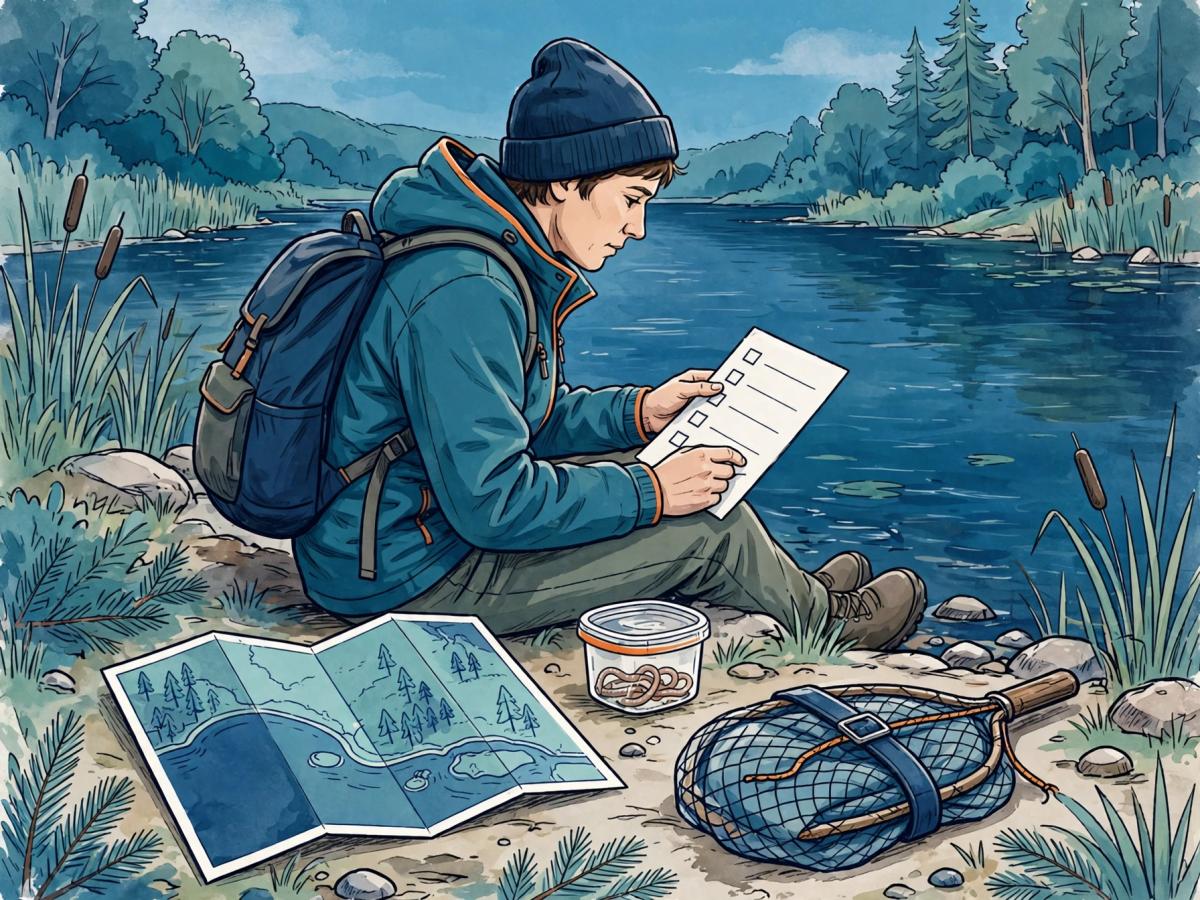
Start with permission, not a bucket
Collecting your own bait can feel like part of the fishing day, but the first step is not finding a worm, minnow, or insect. The first step is finding out what you are allowed to collect and where you are allowed to be. Bait collection rules can change by location, species, season, method, water body, and the purpose of the trip. A method that seems ordinary in one place may be restricted somewhere else.
This lesson gives you a planning habit rather than a universal rulebook. Current official information should decide what you collect, how you collect it, how you transport it, and what happens to it at the end of the day.
By the end of this lesson, you will be able to:
- Identify the rule questions to answer before a collection trip.
- Separate permission to access a place from permission to collect organisms there.
- Build a short pre-trip check that protects fish, habitat, and future access.
Why local rules matter
Bait is part of the living community around a water body. Rules may address which organisms can be collected, how many can be possessed, which tools can be used, and whether collected bait may be moved to another water body. They may also address transport containers, release, disposal, private property, protected areas, and invasive-species prevention.
The important point is that these questions are connected. You can have permission to stand on a shoreline and still need separate permission to collect. You can legally possess a type of bait in one place and still be unable to move it somewhere else. You can collect a small amount and still use a method that is not permitted there.
Changing conditions matter too. Agencies, land managers, and local authorities update rules, notices, and closures. A memory from a past season is useful as a prompt to check again, not as current proof. Make the current source part of your fishing plan.
Find the right source
Start with the official fish and wildlife, natural resources, fisheries, or land-management source for the place you plan to visit. Read the current guidance for the exact water or region when that level of detail is available. Posted signs and access notices also matter, especially on managed shorelines. If the shoreline is private, ask the owner before entering or collecting anything.
Look for answers to these questions:
- Is the place open for the activity you have planned?
- Is collecting bait allowed there, and are there limits or approved methods?
- Are the species you are considering legal to possess and use as bait?
- Can bait, water, plants, mud, or equipment move between water bodies?
- What are the rules for unused bait at the end of the trip?
- Are there seasonal notices, health advisories, closures, or special permissions?
If the source is unclear, pause the collection plan. Choose a permitted alternative or fish without collecting. A slower decision at home is easier than trying to interpret a rule while standing beside the water.
Permission has more than one layer
Treat access, collection, and transport as separate decisions. A public shoreline may permit fishing while restricting digging, trapping, net use, or removal of plants. A private shoreline may allow a guest to fish but not to collect anything. A protected place may ask visitors to observe rather than disturb the habitat.
Do not assume that a familiar method is harmless or accepted. Hand collection, dip nets, traps, lights, or other tools can have different rules in different places. The lesson is not to memorize a preferred method. It is to verify the method before you use it.
If another person is with you, share the rule check. One person carrying a current link, note, or screenshot is helpful, but both people should understand the boundaries. Keep any permit, permission, or required documentation available in the way the local authority expects.
Make a no-surprises collection plan
Write a small plan before leaving. Include the water body, access point, source you checked, legal collection method, amount you actually need, container plan, transport boundary, and end-of-day plan. Keep the amount modest. More bait is not automatically better, and collecting extra organisms creates more care and disposal decisions.
Add a stop rule. You will stop if the location is crowded, the bank is unstable, the weather changes, the water is unsafe, the method is unclear, or you cannot tell whether a specimen is legal. You will also stop if collecting starts to damage vegetation, disturb a bank, or turn into hurried handling.
A useful plan makes the respectful choice easy when the day becomes busy. If you already know what you need and where you will keep it, you are less likely to take too much or move something without thinking.
Field exercise: make a rule card
Before your next trip, make a one-page rule card for one specific water body. Write the date you checked the information and the official source. Then record:
- The access permission you have.
- The organisms you are considering, if any.
- The collection methods the current guidance allows.
- Any possession, transport, or movement limits you found.
- The approved end-of-day plan for unused bait.
- The person you will contact if the guidance is unclear.
Read the card before you pack a container or net. If one answer is missing, leave that part of the plan out. The goal is not to prove that you can collect bait. The goal is to arrive with a plan that respects the place.
Safety and local-rule reminder
Use current official rules and permissions for every location. Do not enter private or protected places without the required permission. Avoid unstable banks, deep water, slick rocks, roads, and conditions that exceed your ability. Never use destructive or hazardous collection methods. Do not move organisms, water, mud, or wet equipment between waters when current guidance prohibits it. When rules or conditions are uncertain, stop and choose a safer, clearly permitted option.
Recap
- Check current official rules before collecting.
- Treat access, collection, possession, transport, and disposal as separate questions.
- Collect only what is legal, needed, and safe to handle.
- Make a stop rule for unclear guidance, unsafe access, and habitat damage.
- A good bait plan protects the water before it helps a fishing plan.
Test Your Knowledge
Ready to see how much you've learned? Take this quick 4-question quiz to complete the lesson.
Take the Quiz to Finish
Complete the quiz above to unlock the lesson completion.