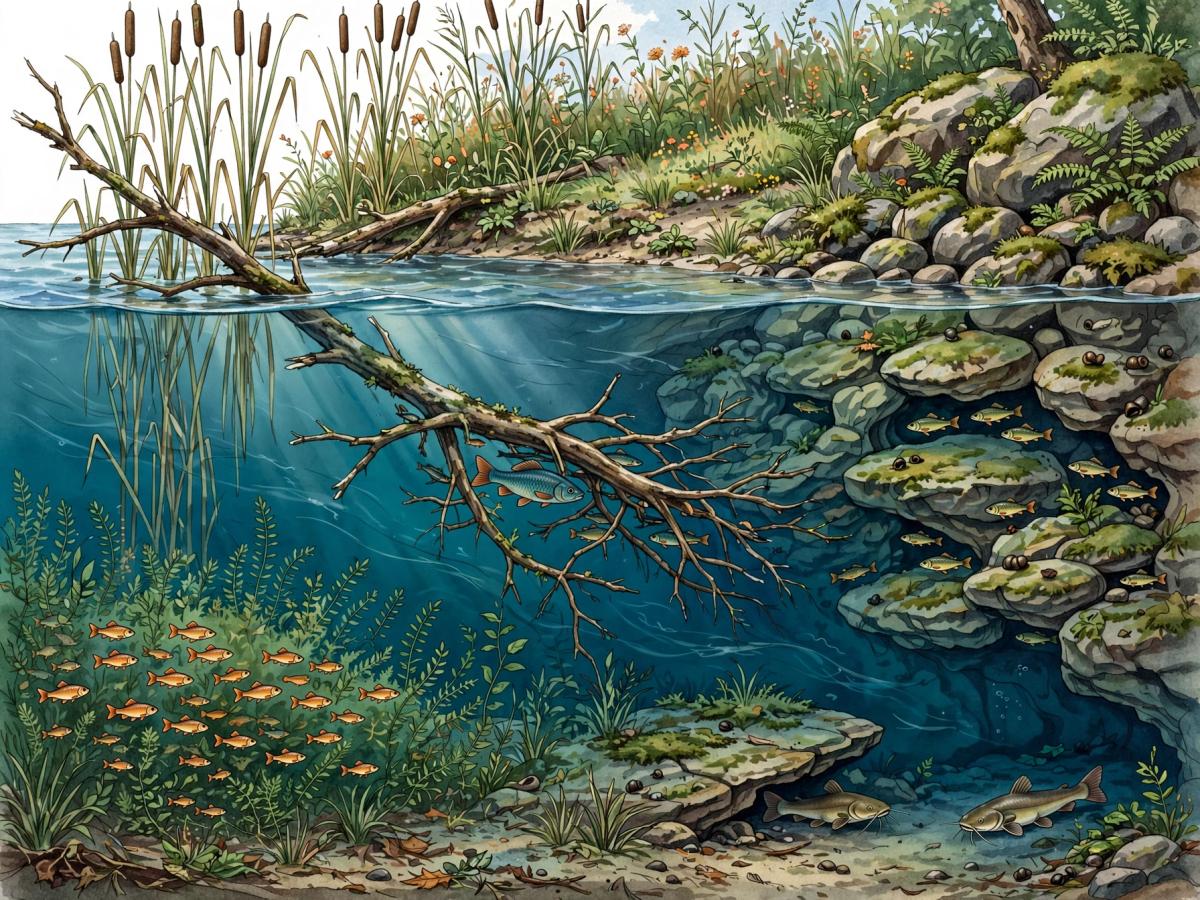
Notice the places that change the water
A shoreline is full of small transitions. Reeds meet open water. A branch reaches across a quiet pocket. A rock line drops into deeper water. Shade crosses a sunny surface. These features can change cover, depth, current, temperature, and access to food.
They are useful places to investigate, but none of them guarantees a fish. The aim is to notice how a feature changes the water, then make a safe, simple comparison.
Cover is a place to investigate
Reeds, weeds, branches, rocks, and fallen timber can give small animals somewhere to live and can break up the open water. Fish may use those areas for different reasons, including shelter, feeding, or relief from moving water. The reason can change with species, season, water level, clarity, and weather.
Look at the edge of a feature instead of casting only at its most obvious center. Note whether the water beside it is shallow or deep, clear or cloudy, still or moving. An edge gives you nearby conditions to compare. If the feature is dense, leave room for a safe hookset and landing plan before you cast.
Depth gives fish options
Depth is more than a number. A shallow shelf, a drop-off, a channel, and a flat bottom each change how light, temperature, cover, and food meet. You may be able to see the transition from shore, or you may notice it through a change in the surface, bottom color, or the way your presentation moves.
A fish can use different depths at different times. One species may hold shallow around cover while another stays deeper. The same fish may shift when the sun, wind, water level, or available food changes. Start by finding a transition you can describe, then test a simple presentation near it.
Shelter and current
In moving water, a rock, branch, bank bend, or seam can divide faster water from quieter water. In still water, shade and cover can change visibility and give small prey a place to gather. Watch the surface and shoreline for lines where the water moves differently.
Approach current edges with respect. A calm-looking pocket may sit beside water that is deeper or faster than it appears. You do not need to stand in the water to learn from it. Observe from a secure position, and let your equipment and skill set the boundary.
Use edges to make a fair comparison
An edge is helpful because it gives you two conditions close together. You can try the near side of a weed line, then the open side. You can compare the shallow side of a drop-off with the first deeper water. You can watch a presentation travel beside a branch without forcing it into a snag.
If the first area is quiet, that does not prove the feature is empty. It may mean the fish are using a different depth, the food is elsewhere, or the conditions have shifted. Keep the conclusion modest and move to the next safe comparison.
Try this: draw a small feature map
From a safe bank or watercraft position, sketch three nearby features. For each one, write:
- What you can see: reeds, weeds, branches, rocks, shade, a drop-off, or a current edge.
- What may change there: depth, cover, current, light, or access to food.
- One safe place to cast and one place to avoid because of snags, people, or unstable footing.
Choose one feature with a clear edge. Make a few casts that let you learn how the water changes around it. Notice where your presentation travels, where it catches, and whether the water gives you a reason to compare another depth or angle.
Safety and local guidance
Branches, rocks, and weeds can hide hooks and unstable footing. Look behind you before casting, keep a safe distance from other anglers, and handle hooks carefully when a presentation snags. Never lean over an unstable bank to reach a feature. Check current local rules for access, seasons, harvest, watercraft, and protected habitat. Do not wade or approach current, drop-offs, or deeper water beyond your skill and equipment.
Quick recap
- Cover, depth, shade, and current edges are habitat clues worth observing.
- Fish behavior can vary by species, season, weather, water, and available food.
- Edges make useful comparisons, but no feature guarantees fish.
- A safe position and a clear landing plan come before a promising cast.
Test Your Knowledge
Ready to see how much you've learned? Take this quick 4-question quiz to complete the lesson.
Take the Quiz to Finish
Complete the quiz above to unlock the lesson completion.