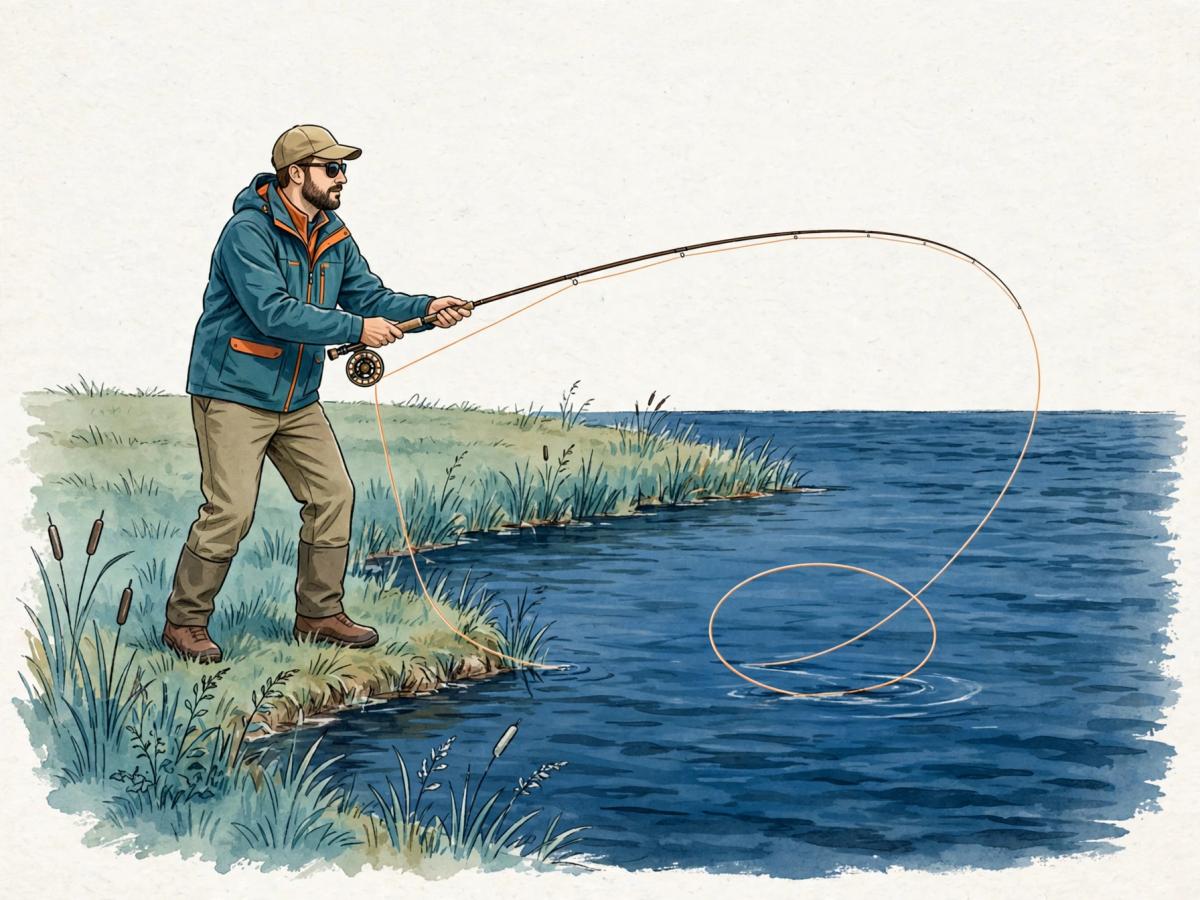
Your First Roll Cast
A roll cast gives a beginner a useful way to move line when a back cast has little room. It works with a line anchor on the water or grass, so you can practice the idea without needing a large casting field or an advanced overhead loop. The goal of a first session is a calm, controlled loop that travels a short distance.
A roll cast is a sequence, not a strength test. A relaxed grip, a smooth lift, an anchor in front of you, and a clear stop will teach you more than a hard forward snap. The cast will change with rod, line, wind, and surface, so use the exercise to learn what your outfit is doing in the conditions you have.
Learning goal
You will learn how to inspect a practice area, create a small anchor, form a D-shaped loop behind the rod, and send the line forward with a smooth stroke. You will also learn when to stop and reset instead of forcing a poor cast.
Start with the space
Before a line moves, look around. Scan behind you, beside you, overhead, and down at your feet. A roll cast uses less space behind the rod than an overhead cast, but the line and fly still travel. Branches, fences, parked vehicles, power lines, pets, and other people all matter. Wind can move a line into a person or into a tree even when the cast feels small.
For your first practice, remove the sharp fly, cover its point, or use a soft practice yarn where appropriate. Keep the line short and choose a stable lawn or open bank. Tell anyone nearby which direction you will cast. Stand with both feet balanced and leave yourself a clear path to step away from the water if conditions change.
Build the anchor
Bring a short length of line in front of you. The line may rest on the water or grass. That part touching the surface is the anchor. It gives the rod and line a point of resistance so the rod can load and send the line forward.
Lift the rod slowly until the line behind the rod forms a loose D shape. The straight section that remains on the surface should stay connected to the rod tip. You do not need a giant loop. A compact loop with a clean anchor is easier to feel and repeat. If the line jumps free before the forward motion begins, lower the rod and reset with less line or a slower lift.
An anchor is useful only when it stays in front of you and away from your feet. A line stuck behind your legs can become a trip hazard and can pull the cast off to one side. Keep your rod tip and line path visible as you learn.
Make the forward stroke
Once the D loop is formed, move the rod forward in one smooth motion. Let the rod load against the anchor, then stop the rod firmly in front of you. The stop gives the loop a direction. Think of moving the rod along a straight path and stopping, rather than sweeping it in a wide circle or punching the air.
The line should roll out over the surface. Stop the stroke before the line has completely straightened. That gives you a chance to feel the cast and bring the line back into position without letting the fly or tippet snap toward you. If the line falls in a pile, try a smaller amount of line, a slower lift, or a clearer anchor. Change one variable at a time so you can tell what helped.
The grip stays relaxed. Hold the rod securely enough to guide it, with the thumb supporting the handle, and avoid squeezing through the whole motion. Tension in your hand and shoulder often makes the stroke abrupt. A quiet body and a clear stop make it easier to notice the rod loading.
A simple practice progression
Begin with the rod tip low and only a short section of line outside the tip. Practice lifting to form the D loop, then lower and reset without making a forward cast. This teaches the shape and the anchor.
Next, add the forward stroke. Watch the line rather than chasing distance. A successful first roll cast has a recognizable loop, a safe direction, and a controlled finish. Distance can come later.
When that feels repeatable, add a little line. If the loop loses shape, return to the last length that worked. Wind and surface texture will change what counts as a good anchor. A rough surface may hold line differently than still water, and a crosswind can push the loop sideways. Observation is part of the cast.
Try this: three quiet minutes
Choose a safe practice space and set a timer for three minutes. For the first minute, create and release a D loop without casting. For the second, make short forward roll casts and stop before the line straightens. For the third, change only one variable, such as line length, rod-tip height, or the smoothness of the lift. Write down what the line did after each change.
End the exercise while your movements still feel controlled. If you feel fatigue in your shoulder, lose track of the line, or see people enter the casting area, stop and reset. A short, attentive practice is more useful than repeating a motion after your safety margin has disappeared.
Water, hooks, and local rules
A roll cast reduces the space needed behind you, but it does not remove hook risk. Check the full casting area every time. Keep a covered or hookless practice end on the line until your direction and stop are reliable. Never cast toward a person, animal, road, or occupied path. Eye protection can add a useful layer when the setting allows it.
If you are practicing beside moving water, stay on stable ground and identify an exit before you begin. Wet rocks, undercut banks, and rising water can change a safe stance quickly. Wading is not required for this cast. Check local access, license, seasonal, and hook regulations before fishing, and follow any posted instructions at the site.
Recap
A roll cast uses an anchor on the surface and a D loop behind the rod. Lift smoothly, keep the anchor in front, drive the rod forward with a relaxed stroke, and stop before the line straightens. Start with a short line and a hookless practice end. If the loop fails, reset and change one variable instead of adding force. Safe space and stable footing are part of the cast.
Test Your Knowledge
Ready to see how much you've learned? Take this quick 4-question quiz to complete the lesson.
Take the Quiz to Finish
Complete the quiz above to unlock the lesson completion.