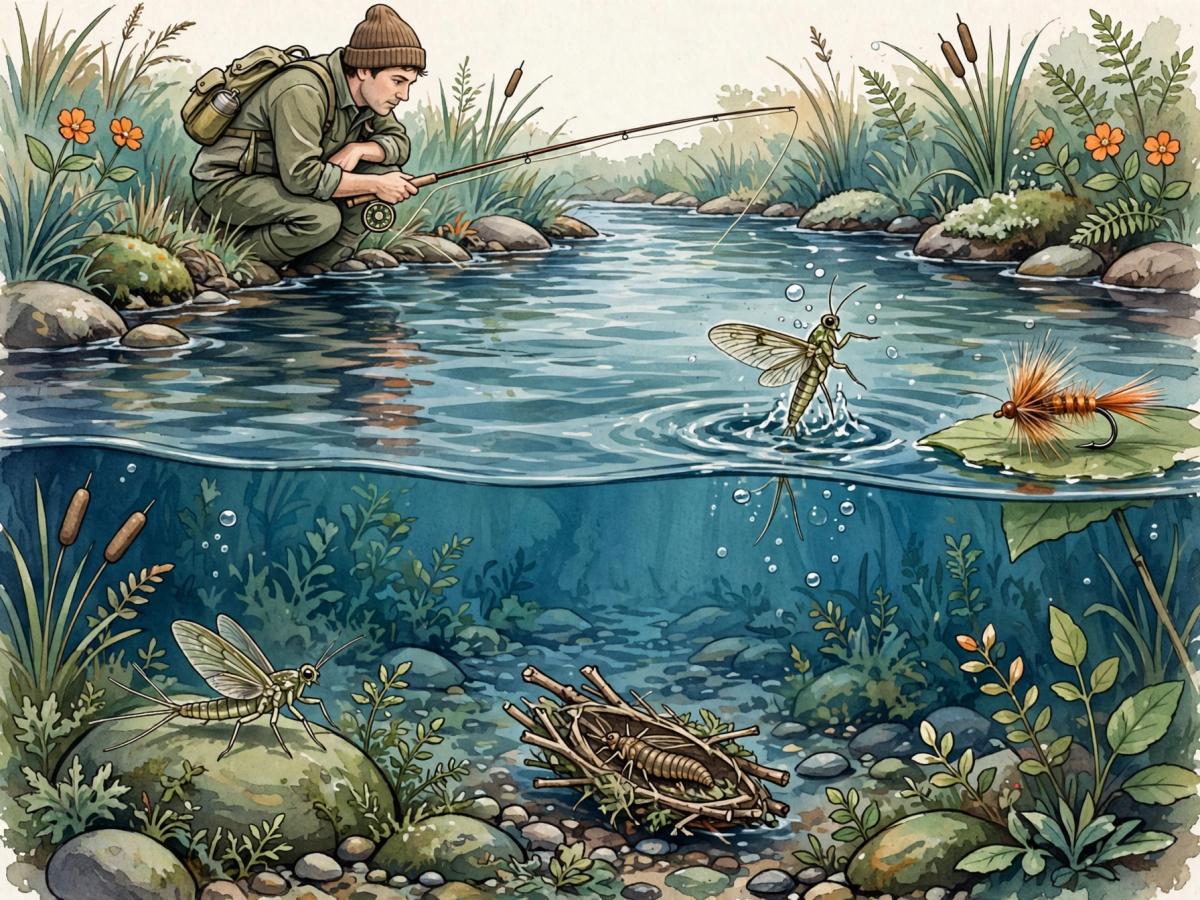
Observe the Food Before You Choose a Fly
Fly selection gets easier when you begin with the water instead of a fly box. A few quiet minutes of looking can reveal whether food is moving on the surface, drifting below it, or showing itself along the edges. Those clues help you choose a general presentation without chasing the idea of a perfect hatch match.
Fish feed in different ways across species, waters, seasons, and weather. A fly that makes sense in one reach can be a poor fit a few steps away. The useful skill is building a short observation, making a reasonable first choice, and watching what happens next.
Learning goal
You will practice scanning the water, identifying broad food clues, choosing among surface, subsurface, and moving presentations, and changing one part of the plan at a time. The goal is a thoughtful first decision that can adapt to what you see.
Give the water a quiet look
Arrive with your fly still in the box. Stand back from the edge and let your eyes adjust. Look at the surface, the margins, the rocks, the stems, and any foam or floating debris. Notice where current moves faster, where it slows, and where a seam carries material from one lane into another.
Watch for rises, dimples, flashes, drifting insects, empty cases on rocks, and small creatures moving in shallow water. A single splash can have many explanations. Treat it as a clue, then look for a pattern before you build a whole plan around it. The absence of visible surface activity also tells you something. It does not prove that fish are inactive or that food is absent below the surface.
Light changes what you can see. Low sun can make surface insects easier to spot in one direction and harder in another. Glare can hide movement. Polarized eyewear may help in suitable conditions, but it does not replace moving slowly and looking from more than one angle.
Read the small clues
Food clues come in several sizes. On the surface, you may see an insect riding the film, a spinner trapped in a current line, or a small pop as a fish feeds. On rocks and bank vegetation, you may see shed skins, cases, or insects preparing to move. Beneath the surface, you may notice minnows, small crustaceans, or other forage near cover.
Look at broad features first. Is the food tiny or substantial? Is it moving with the current, swimming, or drifting? Does it stay on top, travel just below the film, or hug the bottom? Color can help, but light and wetness change how a food item appears. Size and behavior often give you a more useful starting point than trying to name an insect from a distance.
Use clues as evidence, not a demand for exact imitation. Water can contain several food sources at once. Fish may select one food in the morning and another after light, flow, or temperature changes. A general presentation that reaches the right lane and speed may matter as much as a close visual resemblance.
Choose a broad presentation
A dry fly stays on or near the surface. It becomes a reasonable starting point when you see surface insects, rises, or a presentation that needs to remain visible on top. Watch how the fly sits and how the current carries it. Drag from a poor line angle can make a convincing pattern move unnaturally.
A nymph or other subsurface fly travels below the surface. It can fit a situation where food is drifting beneath the film, where the water is deeper, or where no surface rise gives you a clear target. Depth and speed matter. A subsurface fly that moves too quickly may look unlike the food you observed.
A streamer offers a moving presentation that can suggest a small baitfish, leech, or other swimming food. It can make sense when you see forage, flashes, or a need to search more water. The retrieve and angle become part of the presentation, so watch the fly rather than assuming one speed fits every place.
These are broad families, not universal rules. Start with the family that fits the strongest clue, then observe the response. If the first choice produces no useful information, change one variable such as depth, speed, angle, or fly size. Changing the whole box at once makes it hard to learn what the water told you.
Presentation carries the message
The fly is only one part of the message. A trout or other fish may encounter the fly at an odd angle, with unnatural drag, or outside the feeding lane. Before swapping patterns, ask whether the fly traveled where the food was and at a plausible speed.
Position yourself where you can control the line without standing on the edge or casting over another person. An upstream or cross-stream presentation may help you keep the fly moving naturally, but the best angle depends on current, access, and your skill. Keep the first casts short enough to see the fly and line. A visible, controlled drift teaches you more than a long cast you cannot manage.
Try this: the ten-minute food scan
At a safe bank, spend two minutes looking before you cast. Write three observations: one surface clue, one subsurface or shoreline clue, and one current or light detail. Choose a broad presentation family and explain why you chose it in one sentence.
Fish or practice for five minutes while changing nothing except your attention. Watch the fly, line, and water. Then change one variable, such as moving the presentation deeper, slowing the retrieve, or changing the cast angle. Spend the final three minutes comparing what you saw. The exercise works even without a fish. You are practicing a decision loop: observe, choose, watch, adjust.
Water, hooks, and local rules
Keep your eyes on your line and fly when moving around the bank. Hooked flies can catch clothing, branches, and skin. Choose a casting area with room behind and beside you, and protect your eyes when appropriate. If you inspect insects or shoreline food, keep your hands clear of hooks and return living material to its place.
Check current rules before fishing. Some waters restrict bait or fly types, barbs, seasons, access, or species harvest. Follow posted boundaries and respect private property. Stay on stable ground unless your equipment, experience, and conditions support another choice. Wading is optional, and a better observation from the bank is safer than a risky step into moving water.
Recap
Begin with the water, not the fly box. Watch the surface, margins, current, insects, and forage. Use broad clues to choose a dry, subsurface, or moving presentation, then pay attention to depth, speed, and angle. Exact imitation is not required for useful learning. Change one variable at a time, and let local rules and safe access set the boundaries of the experiment.
Test Your Knowledge
Ready to see how much you've learned? Take this quick 4-question quiz to complete the lesson.
Take the Quiz to Finish
Complete the quiz above to unlock the lesson completion.