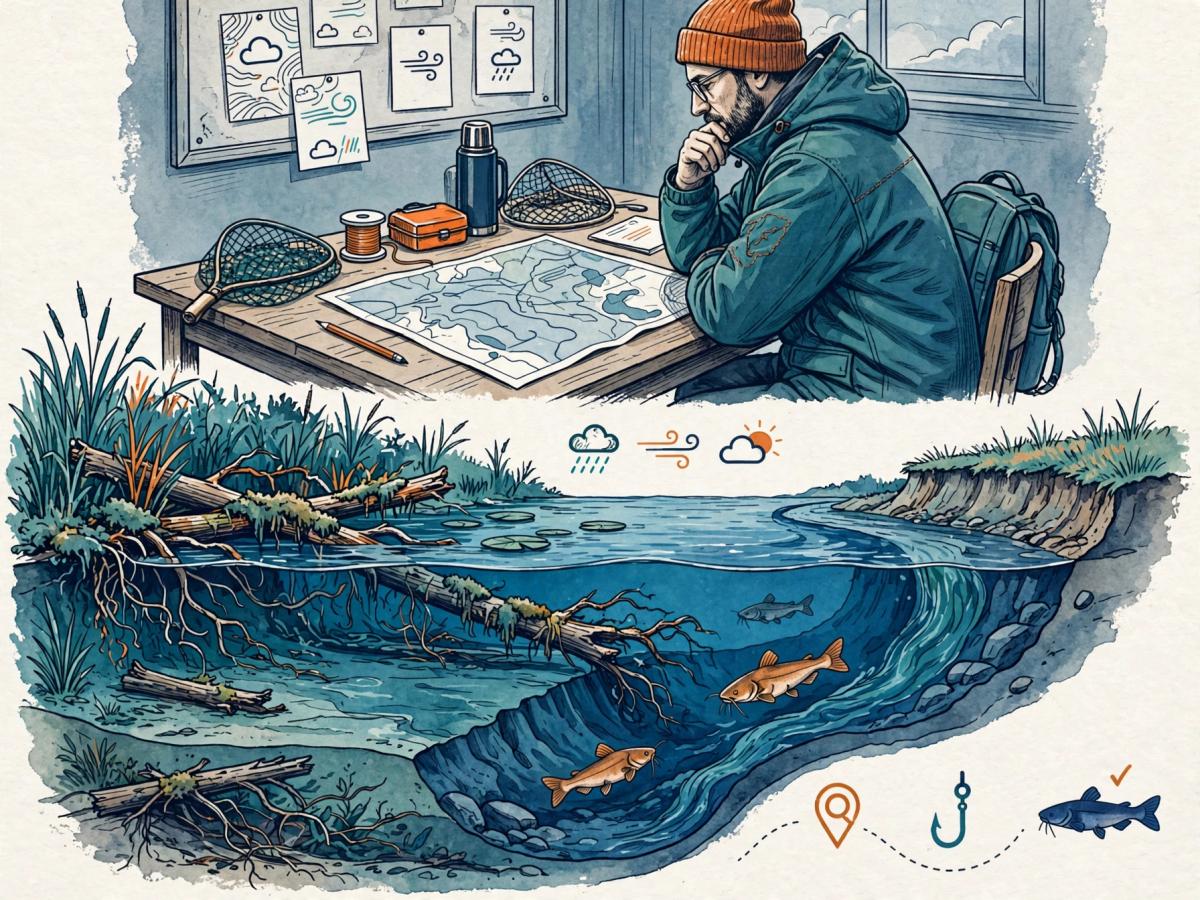
Build a pattern, not a promise
A catfish session becomes more useful when you can explain what you are testing. Instead of collecting a list of famous spots, build a small pattern from the water in front of you. You might be testing whether a depth change near a current edge is worth fishing during a particular water level and time of day. You might be comparing a quiet flat with nearby cover after a weather change. The point is not to predict every fish. The point is to make one reasonable decision, observe what happens, and improve the next decision.
Intermediate fishing begins when separate clues start working together. A deep place by itself is only a description. A depth change, a manageable current seam, signs of available forage, a recent water-level change, and a safe casting position form a more useful question. Conditions can change quickly, and the same feature can fish differently across species, seasons, and water bodies. Treat every pattern as a working explanation that needs a fair test.
Learning goal
By the end of this lesson, you should be able to write a short catfish pattern with four parts:
- The habitat clue you can describe or observe.
- The condition that makes the clue worth testing now.
- The presentation and casting angle you can manage safely.
- The observation that would strengthen, weaken, or change your idea.
You will also know which parts of a plan belong to current local fishing, access, bait, and harvest rules rather than to a general lesson.
Start with a map in layers
Depth is a transition, not a magic number
Look for a change from shallow to deeper water, a channel edge, a shelf, or a depression that you can identify from a map, visible water movement, known structure, or lawful electronics. A transition can give fish another depth option as light, temperature, water level, and forage change. It does not guarantee that fish are using it today.
Write down the shape of the change instead of chasing a number. For example, you might note that the near bank drops away from a firm flat into deeper water, or that the channel appears closer to one bank than the other. If you cannot verify depth safely, keep the description broad. Do not wade or climb to get a better look at an uncertain edge.
Current creates choices
In moving water, notice where faster water meets slower water, where an eddy turns, or where a bend changes the flow. An outside bend may have a different bottom and current than the inside of the same bend, but the feature is a clue rather than a rule. Water level, recent rain, obstructions, and discharge can change the seam you thought you saw.
A good pattern includes what you can fish from a safe position. The most interesting current line is not a useful target if reaching it puts you on an undercut bank or near hazardous water. Keep your casting angle and exit route in the pattern from the beginning.
Flats, cover, and shelter add context
A flat can offer feeding room, a travel route, or a place fish use at one stage of a changing condition. Wood, rock, vegetation, shade, and a cut in the shoreline can provide shelter or alter flow. Cover also creates snags, so the decision is a balance between a meaningful clue and a rig you can retrieve without pulling hard against an unseen obstruction.
Ask what connects the feature to the rest of the water. A flat beside a channel is a different question from an isolated flat. A log near a current edge is a different question from a log in still water. You do not need to label a spot as the answer. Describe how two or three features meet, then choose the safest angle that lets you observe the result.
Weather, water, forage, and time complete the picture
A recent rain, falling or rising water, a temperature shift, cloud cover, wind, and changing light can affect where food and fish are found. The effect depends on the water body and species. Use these conditions to decide which clue deserves attention, not to make a promise about a bite window.
Look for signs of available forage without disturbing the place. Small fish near cover, insects at the surface, birds working an area, or food moving with the current can all be observations. They do not tell you exactly where a catfish is. Record what you saw, when you saw it, and how certain you are. A note that says forage was present near the seam is stronger than a conclusion that fish must be there.
Time can be part of the pattern because light, activity, temperature, and angler access change through a session. A short daylight test is often easier to observe and end safely than a long session that runs into poor visibility. If a local regulation or access rule limits hours or methods, that rule decides the plan.
Turn clues into one test
Use a sentence that can be checked:
With [water or weather condition], I will test [habitat connection] from [safe position] using [legal, manageable presentation], then record [specific signals].
For example, you might test a reachable current edge beside a deeper channel after a modest water-level change. Your first question could be whether the bait stays in place and whether the line remains readable. If the bank becomes unstable, visibility falls, or the current changes sharply, safety ends the test regardless of the fishing theory.
Give the first test enough time to produce information, but do not force a fixed duration when conditions make the position unsafe or the bait cannot be kept in place. Notice whether the sinker holds, whether debris changes the line angle, whether bait remains present, and whether the water looks different from your first observation. Those signals help you decide what to change.
Change one meaningful variable at a time when possible. You might change casting angle while keeping the bait and time window similar. You might move a short distance to a safer position that still represents the same habitat connection. If you change location, bait, depth, and timing all at once, a result tells you less about the original idea.
Intermediate field exercise: the pattern card
Before your next lawful session, make a one-page pattern card. Include:
- The water body, date, broad weather, and water-level condition if known.
- The species or size range you are considering, without assuming a catch.
- Two habitat clues, such as a depth transition beside cover or a current seam near a flat.
- One forage or food observation, with the time and place you noticed it.
- Your first safe position, casting angle, legal bait choice, and observation window.
- A Plan B that uses a stable, accessible position rather than a more hazardous feature.
- The observation that would weaken the pattern, such as no matching depth, no forage sign, a changed current, or bait that cannot remain in place.
Run one focused test. Write down what the rod and line did, what the water did, and what you changed. A quiet session still gives you evidence if the notes separate observation from assumption. If you return another day, compare conditions before copying the old plan.
Safety and local rules are part of the pattern
Check current official rules before you fish. Confirm the license, season, species and size limits, creel or possession limits, permitted methods, hook and line limits, bait collection and transport rules, access permissions, and release or harvest requirements for the water you plan to use. Rules can differ between nearby waters and can change after the information in an older lesson was written.
Use public or permission-based access only. Keep hooks, lines, and tools controlled around other anglers, pets, and bystanders. Choose stable footing and a route you can leave without climbing an undercut bank or stepping into moving water. Tell someone where you are going and when you expect to return, especially when the shoreline is isolated. Stop when storms, rising water, darkness, fatigue, or poor visibility make the plan harder to manage.
Recap
- A pattern is a testable explanation, not a guaranteed location.
- Combine depth, current, cover, forage, weather, and time without treating any one clue as universal.
- Describe the safest fishable connection between features.
- Change one meaningful variable when you can so the result teaches you something.
- Keep local rules, lawful access, stable footing, and a clear exit inside the plan.
Test Your Knowledge
Ready to see how much you've learned? Take this quick 4-question quiz to complete the lesson.
Take the Quiz to Finish
Complete the quiz above to unlock the lesson completion.