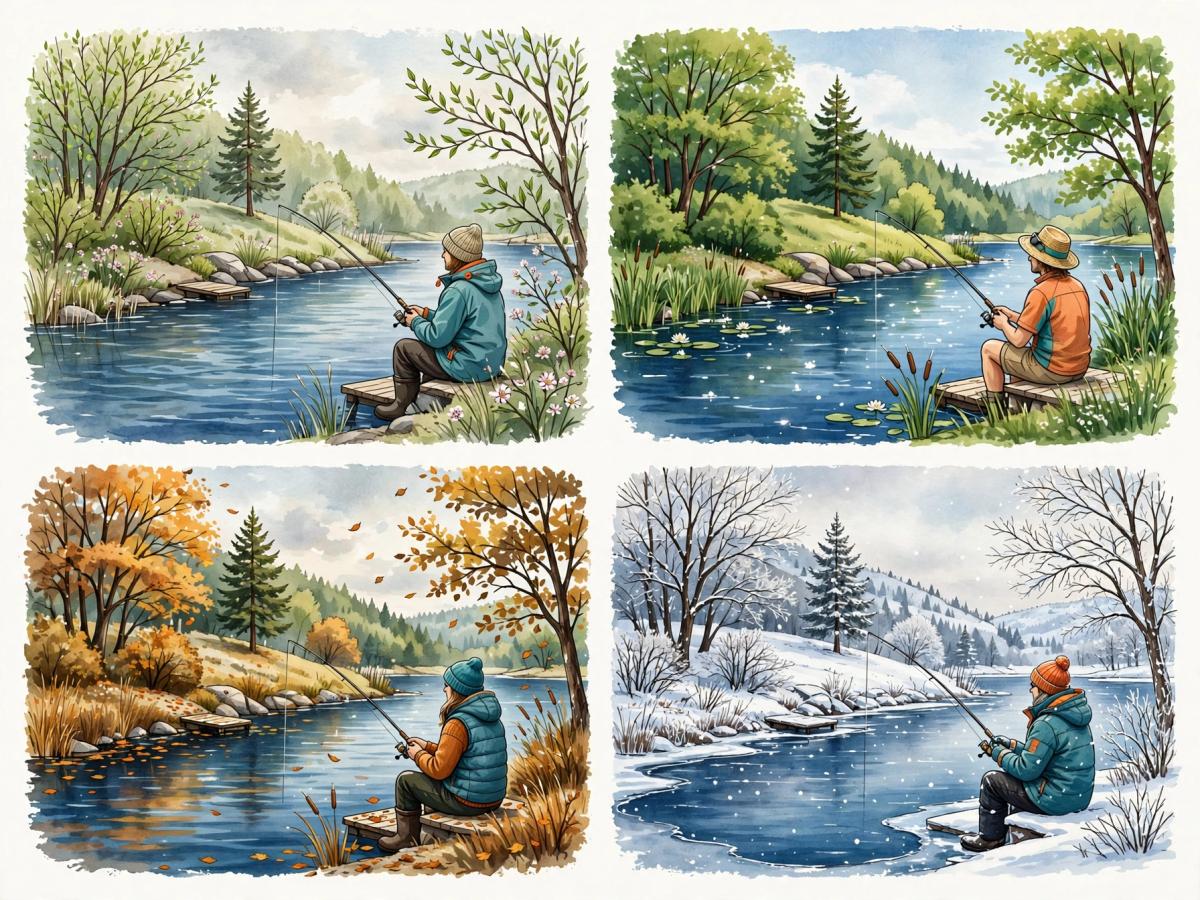
Seasonal Fishing: Start With the Conditions
A season can give you a useful starting point, but it cannot make the decision for you. The same month can bring different water levels, light, wind, and temperatures from one place to another. Even two nearby waters can fish differently because their depth, vegetation, inflow, shade, and fish species are different.
That is good news for a beginner. You do not need a perfect calendar. You need a repeatable way to notice what is changing, choose a reasonable first presentation, and make one small adjustment when the water gives you new information.
Learning goal
By the end of this lesson, you will be able to describe a seasonal condition without treating it as a guarantee, make a simple first plan, and record observations that can improve your next trip.
Start with the calendar, then look at today
A calendar tells you which broad part of the year you are entering. It does not tell you exactly what the shoreline will look like or how fish will respond. In early spring, one sheltered bank may be warming while another stays cold. In summer, a shaded pocket may feel different from an exposed flat. In fall, a windy bank can change faster than a protected cove.
Use the season as a question rather than an answer. Ask: What has changed since my last visit? Has the daylight lengthened or shortened? Has the water been warming, cooling, rising, or falling? Is new vegetation appearing, thinning, or breaking apart? Has a weather front passed through? These questions keep you observant instead of locked into a formula.
When you arrive, spend a few minutes looking before you cast. Note water color, surface movement, visible insects or small bait, bird activity, floating leaves, and places where water enters or leaves the area. You are not trying to prove where every fish is. You are choosing an informed first place to begin.
Daylight is a planning clue
Daylight affects how much time you have, how comfortable the shoreline feels, and how clearly you can watch your line. It also changes shade, visibility, and the way a bank warms during the day. These effects can matter without creating one universal best hour.
Early and late light may make some fish more willing to move in certain waters, while bright middle-of-day light may make shade or deeper water worth checking. In other places, wind, cloud cover, water clarity, or recent weather can matter more than the clock. Treat a low-light window as one possible condition to observe, not a promise that fish will be active.
Plan enough time to arrive, set up without rushing, and leave before you lose safe footing or visibility. A short session with a clear plan is more useful than a long session spent changing everything at once.
Water temperature is a changing clue
Water temperature can help you understand direction. A recent warming trend may make some shallow areas more active, while a sharp cold change may slow movement or shift fish away from an exposed edge. The useful observation is often not a single number but whether conditions are warming, cooling, stable, or mixed across the water.
If you have a way to take a reading safely, use it as one piece of information. Do not lean over unstable banks, wade beyond your skill, or risk dropping equipment to chase a measurement. If you cannot measure, compare simple clues such as the feel of wind, sun on a protected bank, recent air temperatures, and whether plant or insect activity is changing.
Different species have different tolerances, and water depth, current, shade, and inflow can create several conditions in one small area. A temperature clue should guide a first test. It should not be used to declare that fish must be in one depth or location.
Vegetation, weather, and the visible shoreline
Vegetation can create food, shade, edges, and shelter. Fresh growth may attract small organisms. Thick summer growth can offer a boundary between open water and cover. Dying plants and falling leaves can change water clarity and where forage is easiest to see. These are reasons to examine an edge, not proof that a fish is waiting there.
Weather changes how you approach the same place. Wind can push surface food toward a bank and make casting harder. Rain can change runoff and water color. Clouds can soften light. A cold front can make a formerly comfortable plan less productive or less safe. Look for what the weather changed, then adjust one part of your plan.
Keep a simple distinction in mind: an observation is what you can see or reasonably record, while an interpretation is your best working idea. “Wind is moving into the north bank and small insects are visible” is an observation. “Fish are feeding there” is an interpretation that still needs a careful test.
Build a three-part seasonal plan
A practical plan can fit on one note:
- Condition: Write the broad season and the two most noticeable conditions, such as bright sun with falling water or overcast sky with a warming bank.
- First choice: Choose one accessible area and one modest presentation that fits the conditions. Keep it simple enough to observe.
- Adjustment: Decide what you will change if the first choice gives no useful information after a reasonable period. You might change depth, distance from cover, retrieve speed, or angle while leaving everything else alone.
This plan keeps a quiet session from becoming random. It also gives you something to learn from when the result is a missed bite, a follow, a visible forage item, or no response at all.
Try this: make a condition snapshot
On your next trip, pause before your first cast and write five short notes: date and time, light, wind, water level or movement, and one visible food or cover clue. Pick one location and make one presentation for ten to fifteen minutes. Record what changed, if anything. Then make only one adjustment and compare the next short window.
The goal is not to fill a notebook with guesses. The goal is to practice separating what you noticed from what you concluded. Over several trips, those notes can reveal which conditions deserve more attention on your water.
Safety and local rules
Check the current regulations for the water you plan to fish. Seasons, licenses, protected species, size limits, daily limits, bait rules, and access restrictions vary by location and can change. A general seasonal lesson cannot replace the official rules for your water.
Before casting, scan behind and above you for people, pets, branches, wires, and other obstacles. Keep stable footing, especially on wet banks, rocks, mud, or leaf-covered ground. Carry water and weather-appropriate layers. Leave when light, heat, cold, wind, or shoreline conditions make the session unsafe. Do not wade or approach water beyond your skill and equipment.
Recap
Seasonal fishing starts with a broad calendar clue and becomes useful when you inspect today's conditions. Watch daylight, temperature direction, vegetation, weather, and visible forage. Choose one accessible first option, record observations, and change one part of the plan at a time. Local rules and safe access always shape the plan.
Test Your Knowledge
Ready to see how much you've learned? Take this quick 4-question quiz to complete the lesson.
Take the Quiz to Finish
Complete the quiz above to unlock the lesson completion.