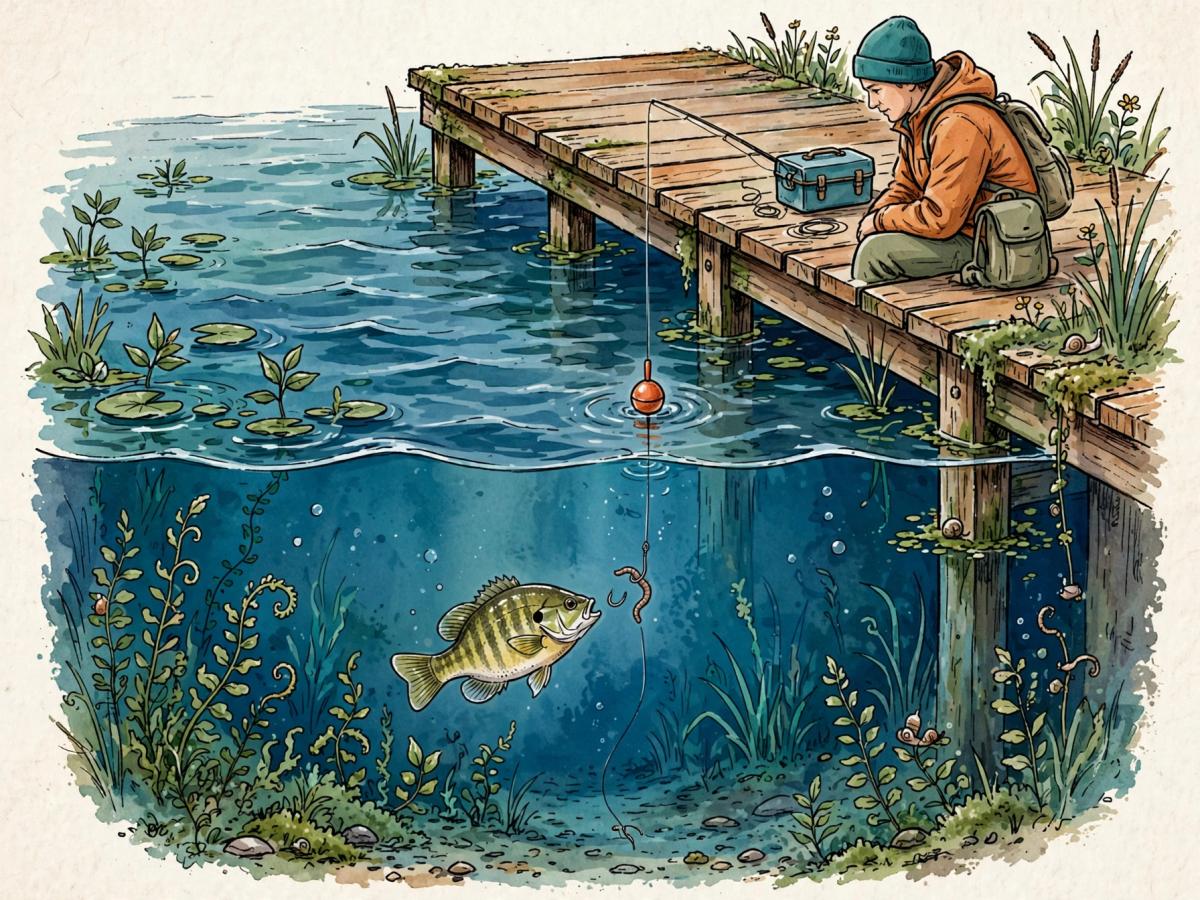
Panfish Fishing: Make a Small Presentation Work
Small tackle rewards attention. A float may lean, pause, slide, or disappear. A small bait or lure may move naturally for a moment and then catch on a weed. The angler who watches closely can learn more from those small changes than the angler who keeps changing equipment without knowing what changed.
A good panfish presentation is not a magic size or a guaranteed pattern. It is a manageable way to show a bait or small lure, notice the response, and adjust one part at a time. Species, water, forage, depth, wind, and local rules still shape the choice.
Learning goal
By the end of this lesson, you will be able to watch a float or line for meaningful movement, make a gentle presentation, match size to what is present, and run a one-change test instead of changing everything at once.
Watch the whole float
A float can move for many reasons. Wind pushes its body and line. Waves lift it. Current drags it. Weeds catch the hook. A fish may pull it sideways, dip it, tilt it, or make it disappear. Learn the difference by watching the movement before reacting.
Start with a calm reference. Let the rig settle and notice how the float sits when nothing is happening. Watch its direction, speed, and return. A repeated movement that changes from the normal drift deserves more attention than a single wave bump.
Keep enough line control to see the float without pulling the bait unnaturally. If wind bows the line, adjust your angle or distance when possible. The goal is not to freeze the float. It is to understand what the water and rig are doing.
Present gently
A small bait can be damaged by a hard cast. A soft entry helps it stay on the hook and keeps the rig from landing in a tangle. Use a controlled cast that fits the space, and land near the edge you want to examine rather than throwing as far as possible.
If you are using a small lure, let it work at a pace you can observe. A gentle lift, pause, or short retrieve can make its movement easier to read. The correct motion depends on the lure, water, species, and conditions. There is no need to add constant action when the fish or water is already moving the presentation.
When a fish takes, avoid a dramatic swing. Small hooks and light line can be pulled out by force, and a hard hookset can send the hook toward people or the angler. Keep the rod controlled and use a firm, measured lift appropriate to the rig and distance.
Match size to what is present
Look for the food and small life you can actually see. Insects, tiny minnows, larvae, and other forage may give you a general size and movement clue. You do not need to copy one organism exactly. You need to avoid presenting something so large or heavy that it no longer fits the situation you are trying to observe.
Water clarity and wind affect what fish can see and what you can control. A small bait may be difficult to watch in waves. A tiny lure may be lost in a strong current. If your setup is impossible to track, simplify or move to a condition where you can learn from it.
Local rules may control bait, lure, hook, or species choices. Matching size never overrides those rules. Use the smallest practical change that helps you test the condition while keeping the hook and bait legal.
Change one thing at a time
When a presentation is quiet, choose one variable. You might adjust depth, move closer to or farther from cover, change the retrieve pace, alter the angle, or swap to a different legal bait or small lure. Keep the other choices steady long enough to compare.
A useful record says: “Same area and depth, slower retrieve for ten minutes,” or “Same bait, float moved lower, two short windows.” That is more useful than “tried everything.” If you make three changes and the float moves, you may not know which change mattered.
One-change testing is not a demand to stay stubborn. If the location is unsafe, crowded, snag-filled, or clearly mismatched to your skill, move. The rule applies to learning, not to ignoring common sense.
Respond to a possible bite
Keep the hookset decision connected to what you see. A short dip that immediately returns may be a wave. A float that travels steadily, pauses against the line angle, or disappears may deserve a controlled response. Fish can mouth a bait and drop it, so rushing is not always helpful.
After a missed response, inspect the bait and hook. It may be gone, fouled, or hidden. Reset carefully and repeat the same presentation once if the area remains safe. Then make one measured adjustment. This approach teaches you whether the movement was repeatable.
Keep the fish close to the water when landing or handling it. Small fish can slip quickly, and a rushed grab can injure both fish and angler.
Try this: the one-change float test
Choose a safe, calm casting lane and set a depth you can manage. Watch the float for five minutes without changing anything, writing down how wind and water move it. Fish a longer short window with the same setup. Then make one change, such as moving the float slightly or changing the angle, and compare the next window.
Record four details: how the float sat at rest, what movement repeated, what you changed, and what happened afterward. If the conditions become too rough to interpret or the hook path becomes unsafe, end the test. A clear decision is more valuable than forcing a result.
Safety and local rules
Keep hooks covered while moving and scan behind and above you before every cast. Use gentle casts around people, branches, docks, and boats. Protect your fingers when checking a small hook, and use a tool when the point is difficult to reach. Do not wade or approach water beyond your skill and equipment.
Check current rules for species, bait, lure, hook, size, daily limits, and access. Some waters restrict particular methods or bait types. Follow the official local source. If a fish is deeply hooked or handling becomes unsafe, stop trying to force the process and follow responsible local guidance.
Recap
A small presentation works best when you can see and control it. Learn the float's normal movement, cast gently, use visible forage as a size clue, and adjust one variable at a time. A possible bite deserves a measured response, not a hard swing. Good observation and safe handling matter more than a complicated setup.
Test Your Knowledge
Ready to see how much you've learned? Take this quick 4-question quiz to complete the lesson.
Take the Quiz to Finish
Complete the quiz above to unlock the lesson completion.