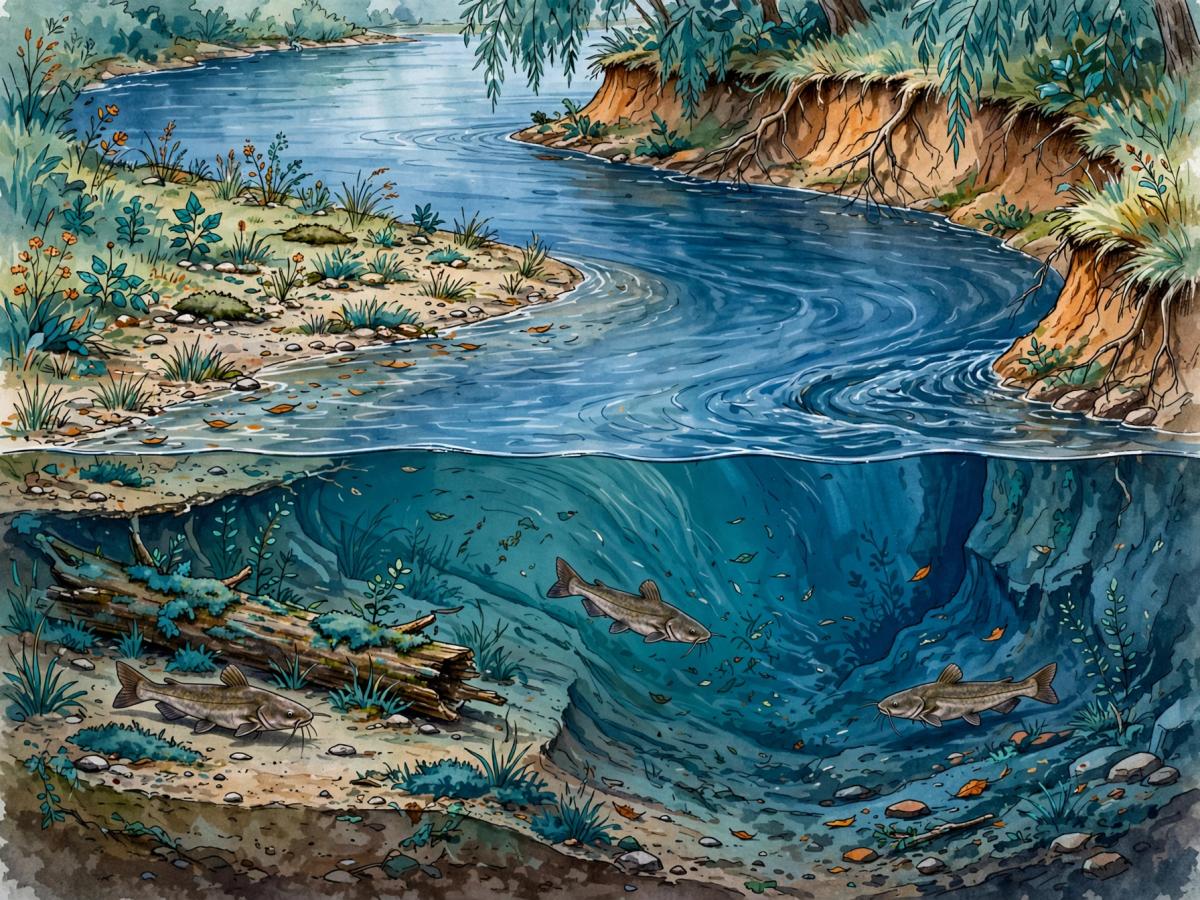
Read the water before you choose a bank
Catfish water can look simple from shore, but a productive-looking feature is never a guarantee. Deeper channels, outside bends, current seams, flats, submerged wood, shade, and safe access can each offer a clue. The clue becomes useful only when you compare it with the species, season, water level, weather, forage, and what you can safely fish.
This lesson is about building a reasonable first read. You will not leave with one magic depth or a guaranteed location. You will leave with better questions for the bank in front of you and a plan for changing one decision at a time.
By the end of this lesson, you will be able to:
- Spot broad habitat clues without treating them as promises.
- Compare depth, current, cover, shade, and access before setting up.
- Use a small shoreline plan that keeps observation and safety ahead of urgency.
Begin with the shape of the water
Stand back from the edge and look at the whole section. Notice whether the bank curves, narrows, opens into a flat, or meets a darker channel. Water color, surface texture, floating material, and the line of the far bank can suggest a change in depth or movement. These signs are starting points. They do not tell you which catfish are present or where they must be.
Use a map, posted information, or a safe high point when available. Compare what the map suggests with what the water shows today. Water levels, flow, vegetation, and fallen material can change the shape of an accessible area. If the current picture does not match the old one, trust the current conditions and adjust the plan.
Do not walk closer simply to see more. A stable observation point often gives you enough information to choose a cast without putting your feet on a slick edge.
Deeper channels and outside bends
A deeper channel can be a useful clue because it gives fish another part of the water column to use as conditions change. From shore, you may notice darker water, a sharper bank drop, a channel line on a map, or a place where the bottom appears to fall away. Use those clues to decide where to test, not to assume that every deep spot holds catfish at that moment.
On a river, an outside bend may have different depth and current from the inside of the curve. The water can press against one bank, carry material, or create a change in bottom shape. The same bend can become difficult or unsafe when flow rises. Keep the observation and casting plan on the bank side you can leave without crossing unstable ground.
A deep feature also changes how you manage a rig. You may need to know where the line is, how the sinker is resting, and whether the current is pulling the presentation into cover. If you cannot feel or observe the setup well enough to respond, choose a simpler position.
Current seams, flats, and transitions
A current seam is a visible or felt line between water moving at different speeds or directions. It may form beside a slower pocket, an opening, a point, or a change in shoreline shape. Floating leaves and foam can help you see the surface movement from a safe place. Surface movement does not show every underwater current, so leave room for surprises.
Flats can be shallow sections beside deeper water, calmer areas, or broad edges that change with water level and season. They may be worth observing when conditions make them accessible, but a flat is not automatically a feeding zone. Ask what else you can verify: Is the water changing? Is bait visible? Is there a safe casting angle? Can you retrieve without dragging through people, branches, or unstable footing?
Transitions are often more useful than labels. Instead of saying, this is a flat, ask where the flat meets depth, shade, current, or cover. Then test one part of that transition and record what happened.
Wood, shade, and shelter
Submerged wood, overhanging shade, rocks, vegetation, and undercut banks can create shelter or change current. They can also catch hooks, line, and sinkers. Treat them as both habitat clues and tackle hazards.
If you fish near cover, choose a casting direction that gives you a clear retrieval path. Keep enough room to step back from the edge. Do not climb across branches, lean out over water, or place a rig where a snag will pull you toward the bank. The best-looking cover is not worth an unsafe stance.
Shade changes through the day. A shaded bank in the morning may be exposed later, and a shadow on the surface may not extend to the bottom. Observe the light and water together instead of relying on a clock-based promise.
Access is part of habitat selection
A location you cannot reach, fish, monitor, and leave safely is not a useful fishing location. Check the approach, bank firmness, room behind you, nearby people, overhead branches, and the route back to your vehicle or companion. Look for a place where a net, pliers, phone, and tackle can stay within reach without cluttering your feet.
Respect private property, posted closures, boat traffic, and other anglers. Do not assume that a dramatic bend or deep hole is worth entering if the access is not clearly permitted and stable. Shore-based fishing works best when your body and your equipment can stay under control.
Field exercise: make a habitat sketch
Choose one permitted bank in daylight. From a stable position, sketch a simple map with the shoreline, any visible depth change, current direction, flat, cover, shade, and a safe casting zone. Mark one area you will avoid because of unstable footing, snags, private access, or another hazard.
Pick one starting position and write why. Then choose one change you could make if the first observation does not answer your question, such as moving along the bank, adjusting the casting angle, or testing a different depth. Keep the bait, rig, and safety plan steady while you learn what the habitat shows you.
Safety and local-rule reminder
Use current official fishing rules for the water and species. Fish from permitted, stable access and stay clear of unstable banks, strong current, overhead hazards, boat lanes, and private or closed areas. Do not wade or climb to reach a deeper-looking spot. Leave when weather, water level, footing, visibility, fatigue, or equipment exceeds your ability.
Recap
- Use channels, bends, seams, flats, cover, and shade as clues, not guarantees.
- Compare visible water features with current conditions and safe access.
- Treat wood and structure as both habitat and tackle hazards.
- Choose a position you can fish, monitor, and leave without rushing.
- A useful catfish read begins with the whole bank, not one dramatic feature.
Test Your Knowledge
Ready to see how much you've learned? Take this quick 4-question quiz to complete the lesson.
Take the Quiz to Finish
Complete the quiz above to unlock the lesson completion.