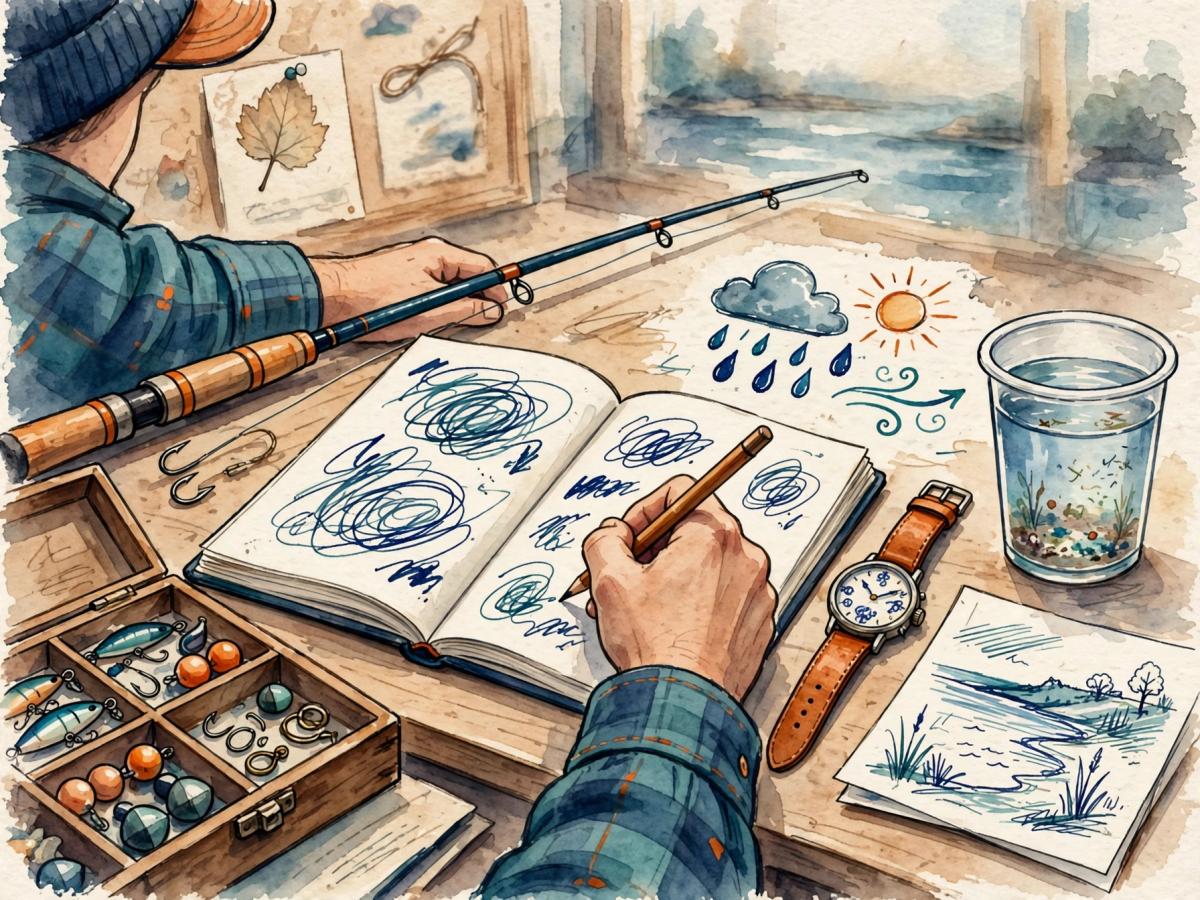
Make your notes useful on the next trip
A fishing note does not need to sound like a report. It needs to help you remember what happened well enough to make a better decision later. The best notes preserve the conditions around a response, include quiet or inconclusive results, and leave room for uncertainty.
A sentence such as great evening on the lake may carry a feeling, but it cannot tell you what to repeat. A note that says light wind, falling shade, small bait along a reed edge, slow presentation beside cover, one follow, and slippery access gives you several questions to revisit. The point is not to build a perfect archive. The point is to keep your next choice from depending entirely on memory.
Learning goal
By the end of this lesson, you should be able to record a trip in a short repeatable format, distinguish observations from assumptions, describe a presentation clearly without relying on brands, include uncertainty and no-response information, and note safety or access details without collecting unnecessary private information.
Record the trip header
Start with the few facts that anchor every other observation: date, approximate start and end time, general place or public access label, and the kind of water or platform. A general place label can be enough. Do not publish private property details, another person’s personal information, or sensitive access information simply to make the note look precise. Your goal is to recognize the setting later, not to create a public map of places that do not belong to you.
Add the conditions that could reasonably affect the trip. Note light, air weather, wind direction or feel, precipitation, water level or tide when relevant, clarity, surface movement, and any temperature clue you actually observed or measured. You do not need to fill every line when a category does not matter or cannot be observed. A blank is more honest than a made-up detail.
Time matters because light, wind, water movement, and activity can change during a short session. Use a few time stamps when the conditions or fish response change. A note that separates the first hour from the last ten minutes can reveal a useful shift that a single end-of-day summary would hide.
Describe water clues, not just the result
Record the features you could see or feel from a secure position. Write about shade, current seams, windward and sheltered edges, weeds, reeds, rocks, branches, depth changes, bottom texture, surface activity, bait, birds, or changes in water level. Describe where the clue was relative to your position rather than writing a confident reason for it.
For example, small bait moved along the outside of a weed edge is an observation. The edge is holding feeding fish is an interpretation. The interpretation may be worth testing, but label it as a possibility. This habit protects you from turning one visible sign into a rule that may fail when the species, season, water, or weather changes.
Include what you did not see. No visible forage, no surface activity, no response after a fair comparison, or no secure way to reach a promising feature can all matter. A no-response note becomes useful when it also includes the conditions and presentation. It helps you avoid repeating the same assumption while still acknowledging that a quiet result rarely proves a fish was absent.
Describe the presentation precisely enough to repeat
A future you should be able to understand the choice without needing a brand name. Record the broad presentation family, the approximate size or profile if relevant, the depth or zone, the direction of the cast, the retrieve pace, pauses, drift, fly line control, or bait position, and how long you gave it a fair look. Include the position you fished from and whether the wind or current changed the way the presentation moved.
Precision does not mean false accuracy. If you did not measure depth, write shallow edge, first deeper water, or near-bottom contact rather than inventing a number. If retrieve speed changed from cast to cast, say variable pace. If the current made line control uncertain, record that uncertainty. Notes can be detailed without pretending to be instruments.
Write the response in neutral language. A fish followed, a hook snagged cover, the line stopped briefly, a swirl appeared two feet beyond the presentation, or nothing was observed after several comparable attempts. If you landed a fish, include the handling and release or harvest decision only to the extent needed for your own learning and current rules. Do not treat one fish as proof that the whole area or approach will produce the same result later.
Keep observed and assumed in separate lanes
A two-part format takes little time and prevents a common memory error. Use headings such as Observed, Possible explanation, and Still unknown.
Observed: At 6:40, a light wind pushed surface debris toward the shaded bank. A small presentation moved beside the outside edge of reeds for six casts. There was one light tap and no landed fish.
Possible explanation: The wind may have concentrated food along the edge. The tap may have come from a small fish, cover, or a missed contact. A slower or deeper pass could be worth testing later.
Still unknown: Whether the response came from the target species, whether the depth was right, and whether the edge remains useful when the light is different.
This structure gives a future trip a starting question rather than a conclusion disguised as memory. You can use confidence labels if they help: observed, likely, possible, or unknown. Keep the label attached to the claim. A likely explanation can guide a next test, but it should not be copied into your notes later as a confirmed fact.
Include the decisions that protected the trip
Safety notes belong beside fishing notes because they shape what evidence you were able to gather. Record wet or unstable footing, limited casting room, boat traffic, changing wind, current, low light, hook hazards, or a route you decided not to use. Write the safe alternative you chose. This makes the next plan more realistic and helps you avoid treating an unsafe position as part of a successful pattern.
Also record access and local-rule checks in a simple way. You might note that the public access was open, a protected area was avoided, the current fishing or boating guidance was checked, or a method was not used because permission was unclear. Do not copy another person’s private information into the note. Use a general place label and keep the record for your own learning.
Use a short format you will repeat
A note that takes five minutes after every trip can outperform a detailed form used once. This eight-line format covers most field sessions:
- When and where: Date, time window, general access label, and water or platform.
- Conditions: Light, weather, wind, water movement, clarity, level, and relevant temperature clue.
- Water clues: Cover, depth changes, forage, current, shade, surface activity, and access.
- First approach: Broad presentation, position, angle, zone, and what stayed constant.
- Response: Contacts, follows, snags, fish landed, or no response after a fair look.
- Change: One meaningful adjustment and what happened after it.
- Uncertainty: What was observed, what was assumed, and what remains unknown.
- Safety and next question: A boundary you noticed, a rule or access reminder, and one question for later.
You can use a paper notebook, a private device note, or another format that remains available in the field. Choose a method that does not require you to handle a phone near water or while a fish needs attention. Finish the detailed note after hooks, tools, fish, and equipment are secure.
Field exercise: write a five-minute field note
After your next trip, set a timer for five minutes and use the eight-line format. Start with the facts you remember most clearly, then mark uncertain details instead of filling gaps with a confident story. Include at least one quiet result or access observation, even if the trip also included a memorable fish.
Then underline three things: one direct observation, one possible explanation, and one next question. If the note contains a statement such as always, never, or the only place fish were, rewrite it as a smaller claim tied to the conditions of that trip. For example, change fish only wanted the slow retrieve to the only response I noticed came during the slower pass in the shaded water at that time.
On your next outing, read the last note before choosing the first approach. Keep what is useful, but treat it as a starting hypothesis. Check whether the conditions are similar enough for the old clue to matter. If they are not, begin a new baseline.
Safety and local guidance
Check current local rules for access, licenses, seasons, methods, collection, harvest, release, watercraft, and protected habitat. Notes should never encourage entry into a closed or private place. Keep devices, hooks, lines, tools, and fish-handling equipment controlled around water and people. Do not write notes while walking unstable banks, casting, operating a craft, or handling a fish. Secure the situation first, then record it. Keep personal and private information out of shared notes, and use a general place label when exact details are unnecessary.
Quick recap
- Record date, time, general place, conditions, water clues, presentation, response, uncertainty, and safety observations.
- Describe what you saw separately from what you think it may mean.
- Include no response and access limits, not only memorable catches.
- Use broad presentation details that can be repeated without relying on brands or false precision.
- Treat a note as evidence for a next question, not proof of a universal pattern.
- Make the format short enough to repeat after every trip.
Test Your Knowledge
Ready to see how much you've learned? Take this quick 4-question quiz to complete the lesson.
Take the Quiz to Finish
Complete the quiz above to unlock the lesson completion.