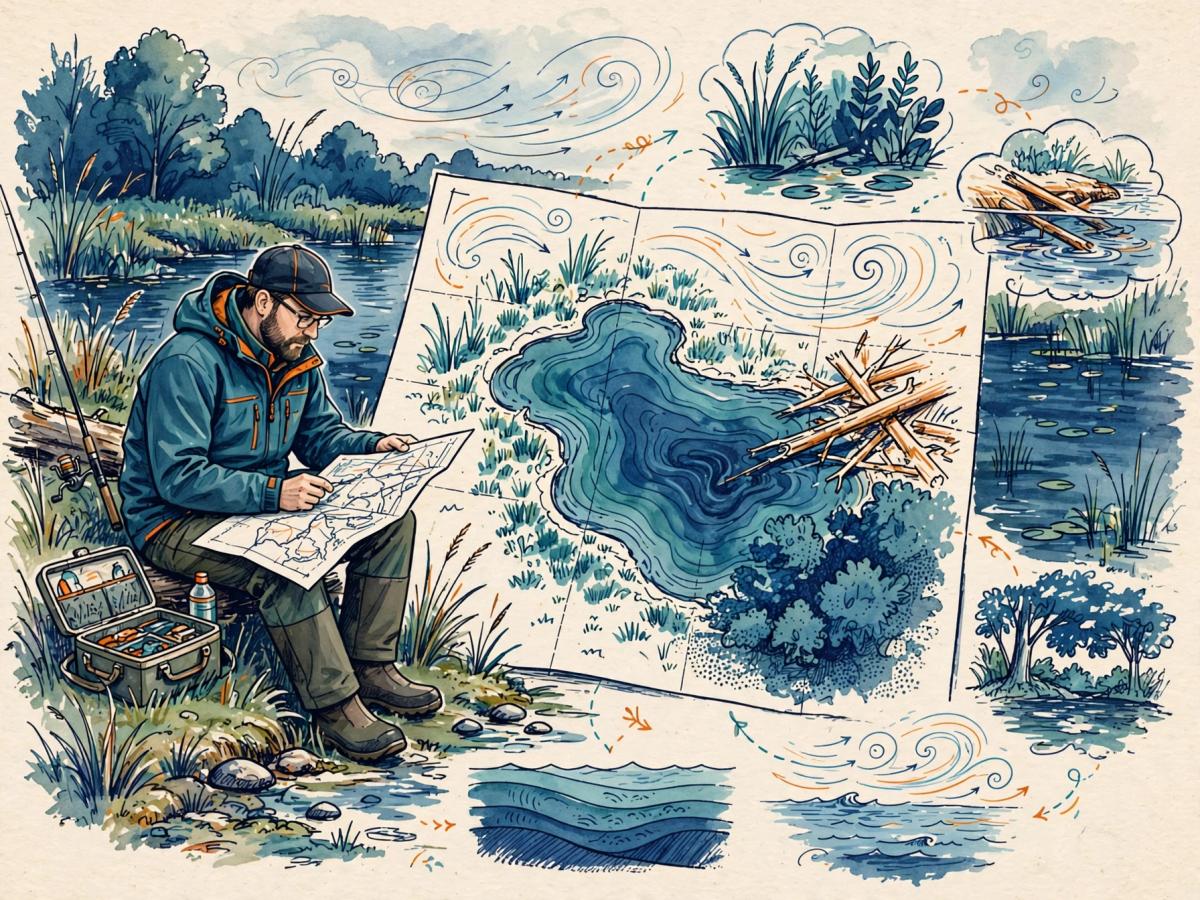
Build a Pattern
A pattern is a working explanation for why a bass decision might fit the conditions. It connects observations such as cover, depth, light, wind, forage, and bites to a location and presentation you can test. A pattern is stronger than a hunch because it gives you something to compare. It is still provisional. Lakes, rivers, seasons, and individual fish vary, and one response does not turn an idea into a rule.
Intermediate fishing becomes more manageable when you stop trying to remember every possible lure choice and start building a small, testable picture of the water. The picture can change as the light moves, the wind shifts, or the first few casts add new information.
Learning goal
By the end, you should be able to separate observations from guesses, combine several conditions into a testable pattern, choose a small set of nearby places to compare, and record the response without claiming more certainty than the outing supports. You will leave with a simple way to turn a bite, a follow, or a quiet stretch into the next useful question.
Name the parts of a pattern
Start with the condition. Note light, wind, water clarity, temperature trend, recent weather, and season. These details do not dictate a guaranteed location. They describe the setting in which your other observations make sense.
Next, note the location feature. It might be a grass edge, a point, a dock line, a rock transition, a drop, a pocket, or a shoreline section that combines more than one feature. Describe what you can see and what the bank or map suggests. If depth is unknown, record that as unknown instead of filling the gap with a confident guess.
Then record the presentation. Include the broad lure family, the depth you intended to cover, the casting angle, and the pace or retrieve. Brand names are not needed for a useful log. The point is to remember what the lure was doing in relation to the cover.
Finally, record the response. A bite, follow, short strike, snag, visible forage, or no contact each tells you a different amount. One bite can show that a fish used one place at one moment. It does not prove that every nearby place has the same conditions.
Turn a hunch into a test
A hunch sounds like, “Bass are shallow today.” A testable version is more specific: “The shaded side of shallow cover may be worth comparing with the nearby open bank because the light is bright and the wind is pushing food toward that edge.” This statement makes room for evidence. You can visit two or three accessible features and compare the same type of presentation.
Use a simple prediction before the cast. What would support the idea? Perhaps you see bait, a cooler shadow, a depth change, or repeated contact around one cover type. What would weaken it? Perhaps the cover is empty, the water has no movement, or a different depth shows more useful activity. Both answers are valuable because they help you decide what to test next.
Keep the test small. Choose one cover type and two or three nearby examples rather than jumping across the entire water body. Make a few controlled casts around each feature. The number of casts should fit your access, time, and safety, not a rigid formula. Compare the conditions around the feature before comparing the results.
Read cover, depth, light, and wind together
Cover gives fish a structure to use, but the surrounding water changes how useful that cover may be. A piece of wood beside a drop is a different scene from the same wood on a flat bank. A grass edge in bright light may present differently from the shaded side of a dock. A rocky point exposed to wind may collect different movement than a protected point nearby.
Look for combinations. Ask whether the feature creates shade, a depth change, an edge, a current line, or a place for forage to gather. Watch how wind moves the surface and any floating material. If the wind makes casting difficult or pushes the boat or line into a hazard, the condition may be useful to observe but unsafe to fish.
Water clarity also changes what you can inspect and how close you may need to work. Clear water can reveal bottom and cover while making your approach more visible. Stained water can reduce visibility while making movement, vibration, or a larger silhouette more relevant to the test. Keep the statement modest. You are choosing a presentation to investigate, not predicting a response with certainty.
Use bites without overfitting
When a bite happens, pause long enough to record the context. Where did the lure enter? How deep was it moving? Was the fish beside cover, on an edge, or in open water? What were light, wind, and water clues doing at that moment? A quick note can prevent the memory from becoming a story about the whole lake.
If a second response appears under similar conditions, the pattern gains a little support. If the next five casts are quiet, that does not erase the first response. It may mean the fish moved, the presentation changed, or the feature had a small productive zone. Compare before you generalize.
No-bite information needs the same care. A quiet bank may mean the fish were absent, the lure missed the useful depth, the angle did not reach the feature, or conditions changed. Record what you know, then choose a different variable to test. Avoid using silence as proof that a cover type never works.
Try this in the field
Before fishing, write one sentence that joins a condition, a feature, and a presentation. For example, you might plan to compare wind-touched grass edges with a slower lure presentation because the surface is moving and the water is warming. Keep the wording connected to what you can observe, not to a guaranteed outcome.
Fish two or three accessible examples of that feature. At each stop, make a similar first presentation, then note the cover, depth impression, light, wind, forage clue, and response. If you get a bite, repeat the presentation near a second example before changing everything. If you get no response, adjust one variable and record why.
At the end, write the pattern in a second sentence: what repeated, what changed, and what you would test next. The result may be “continue checking this combination” or “the evidence is too thin.” Both are useful conclusions.
Safety and local rules
Keep casts clear of people, boats, docks, ropes, property, and overhead branches. Hooks and treble-hook lures need extra room around bystanders and gear. Wear a personal flotation device when using a boat or watercraft, follow navigation and access rules, and check the forecast before leaving. Follow current local rules for bass seasons, size, possession, and release or harvest decisions. A pattern is a fishing tool, not a reason to ignore conditions or regulations.
Recap
- A pattern connects conditions, a feature, a presentation, and a response.
- Separate what you saw from what you think it means.
- Compare several similar features before making a broad claim.
- Cover becomes more informative when you add depth, light, wind, clarity, and forage clues.
- A bite adds context to a hypothesis, while a quiet stretch adds a different kind of information.
- The next test should be clear enough that you can explain why you made it.
Test Your Knowledge
Ready to see how much you've learned? Take this quick 4-question quiz to complete the lesson.
Take the Quiz to Finish
Complete the quiz above to unlock the lesson completion.