Match Presentation to Cover
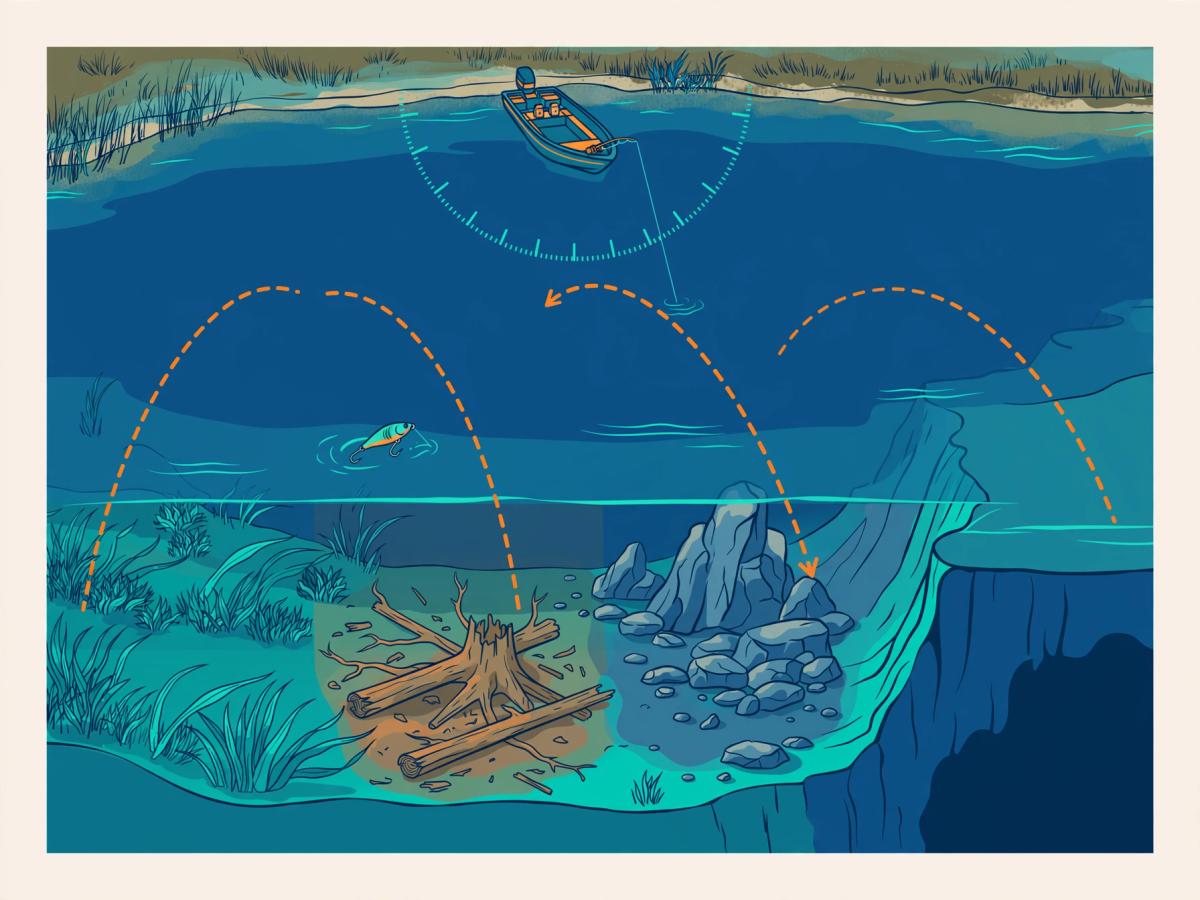
Cover gives a bass angler a useful starting point, but a piece of cover does not come with one automatic lure or cast. Grass, wood, rock, docks, and open edges each create different paths for a presentation. The right broad choice depends on what you can see, the depth you want to reach, the space around the feature, and how safely you can manage the hook.
This lesson keeps the decision brand-neutral. A simple setup that you can cast and control gives you better information than a complicated choice you cannot place accurately. Think in families and functions: a weed-resistant soft presentation for grass, a moving search presentation for open edges, a bottom-contact option for rock, or a controlled compact presentation around wood and posts. Local conditions may call for a different choice.
Learning goal
By the end, you should be able to describe the cover in front of you, choose a broad presentation family that fits the cover and water column, select a casting angle, and adjust your route without forcing a hook into an unsafe or inaccessible place. You will compare angles before switching to a completely different approach.
Read the cover's shape
Start with the part you can see. Grass may have an outside edge, a pocket, a point, a clean lane, or a dense interior. Wood may include a trunk, branches, a stump, or submerged limbs that continue below the surface. Rock may form a wall, scattered stones, a point, or a transition into another bottom type. Docks add shade, posts, cables, boats, and human activity.
The visible feature is only the top layer. Look at the water beside it. Is there a depth change, a shaded side, a wind-touched face, a current line, or open water where a fish could move before returning to cover? You do not need an exact depth reading to make a good first cast. You need a clear idea of what the lure should do when it reaches the feature.
An edge can be as important as the object itself. Grass and open water, shade and sun, rock and softer bottom, or fast and slow water all create a boundary. Casts that cross an edge can answer a different question from casts that stay parallel to it. Decide which part you want to investigate.
Choose a family by function
A weed-resistant or weedless soft presentation may help you work an open lane near grass without exposing a hook to every stem. Keep the movement controlled and watch whether the lure slips, catches, or exits at the edge. Dense grass may demand a different balance of weight and movement than sparse grass. The goal is control, not a claim that one style always works.
A moving search presentation can cover an open edge, a rock transition, or the outside of scattered cover. Choose a path that lets you feel or see the lure's relationship to the bottom and object. If it repeatedly fouls, moves too high, or passes too far from the feature, adjust the angle or pace before assuming the whole family is wrong.
A bottom-contact presentation can help you inspect depth changes, rock, or the base of a feature when that contact can be managed safely. Contact should be readable without forcing the lure into places where it will snag beyond recovery. Use enough control to notice the bottom, then decide whether the next cast should be parallel, across, or along the edge.
A compact presentation can fit beside a post, branch, or shaded pocket when you have room for the cast and the hook. Docks are shared structures, not targets to attack. Keep lures away from boats, ropes, swimmers, property, and other people. When the angle is poor, fish the outside shade or a nearby edge instead.
Let the casting angle do work
A perpendicular cast crosses an edge and can show how the lure behaves from shallow to deep or from open water into cover. A parallel cast keeps the lure near the same depth or edge for longer, depending on the bottom and retrieve. An angled cast can follow a point, slide beside a dock, or bring the lure through a pocket without sending it directly into the densest object.
Choose the angle that fits both the fish question and your control. If you want to know whether the outside grass edge is useful, keep the lure near that boundary. If you want to inspect a drop, make a cast that lets you feel the change without crossing several unrelated features. Start with the open water around cover before forcing the lure into the center.
Wind may make one angle easier to cast and another harder to manage. Sun can make a line or shadow more visible. Current can pull a lure through a seam faster than expected. Treat these effects as part of the presentation. A different angle may improve the test without changing the lure family.
Match the presentation to the risk
Every cover type has a hook-management question. In grass, can you keep the hook protected and still detect contact? Around wood, can you turn the lure away from a limb before it becomes buried? Near rock, can you tell bottom contact from a snag? Around docks, can you keep the cast away from people and hardware?
A lure that reaches the intended cover but cannot be retrieved safely may not fit the situation. Use a controlled distance and a clear landing lane. If a lure is stuck, point people away from the line, loosen tension when appropriate, and use safe recovery methods. Never wrap line around your hand or pull a snag toward yourself.
Presentation also includes what happens after the lure reaches the target. A steady retrieve, a pause, a lift, or a slow bottom crawl each keeps the lure in a different part of the scene. Pick the movement that answers one question, then watch the response. Do not turn a cover decision into a random sequence of motions.
Try this in the field
Choose one stretch that contains two kinds of cover, such as a grass edge beside open water or rock near a dock. Begin with the less obstructed side. Make two casts at one angle and two at a second angle using the same broad presentation family. Note where the lure travels, what depth it appears to cover, how often it contacts the feature, and whether it stays manageable.
Then decide whether the cover calls for a different family or whether the angle needs more work. If you change the presentation family, keep the angle similar so you can compare the function rather than changing every variable. Write down what the cover allowed and what it made difficult.
Safety and local rules
Make room for hooks and line before casting. Docks, boats, ropes, swimmers, and shoreline users require extra awareness. Wear a personal flotation device on a boat or watercraft, keep footing stable on the bank, and follow access and navigation rules. Check local regulations for bass seasons, hooks, lures, size, possession, and release or harvest. Do not enter unstable cover or unsafe water to retrieve a lure.
Recap
- Describe the cover, the water around it, and the depth question before choosing a presentation.
- Think in broad lure families and functions instead of brands.
- Grass, wood, rock, docks, and edges each change hook management and casting angles.
- Parallel, perpendicular, and angled casts answer different questions.
- Change angle or pace before abandoning a presentation family when the cover still fits.
- Safety and access are part of deciding whether a presentation belongs in the scene.
Test Your Knowledge
Ready to see how much you've learned? Take this quick 4-question quiz to complete the lesson.
Take the Quiz to Finish
Complete the quiz above to unlock the lesson completion.