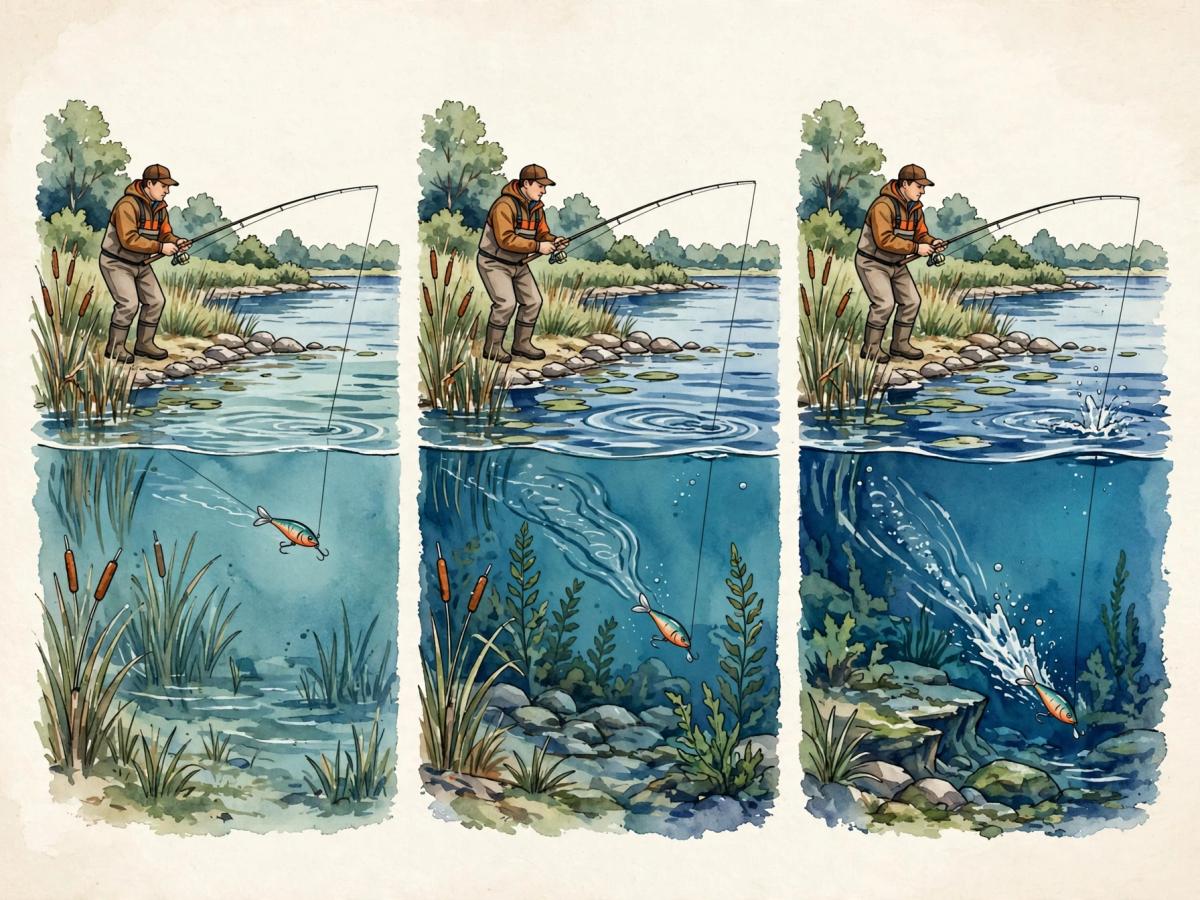
Change Pace, Angle, and Retrieve
When a bass lure is not producing, the fastest response is often to grab a different lure. A better experiment may be closer to your hands. Keep the lure family the same and change its pace, casting angle, or retrieve. This preserves more of the original question and helps you learn how the fish, cover, and conditions are interacting.
One change at a time does not mean fishing slowly forever. It means giving each adjustment enough casts to produce a readable comparison. The right amount varies with water, cover, access, and time. A short, controlled test is often more useful than a frantic sequence of unrelated changes.
Learning goal
By the end, you should be able to establish a baseline retrieve, change one variable deliberately, compare bites and other responses, and recognize when a quiet test calls for a new angle or a new presentation family. You will also practice keeping hooks and line under control while changing speed around cover.
Build a baseline first
Start by naming what the lure is doing. Is it moving steadily above the bottom, contacting rock, sliding beside grass, or pausing near a shaded object? How fast is the retrieve in plain language: slow enough to maintain bottom contact, moderate enough to cover water, or quick enough to trigger a reaction? These descriptions are more useful than a mysterious perfect cadence.
Make a few casts with the same angle, distance, and retrieve. Watch where the lure travels and how it interacts with the cover. If it fouls, never reaches the target, or moves outside the intended depth, fix that basic problem before evaluating the fish response.
A baseline also includes the conditions. Note wind, light, water clarity, temperature trend, and the type of cover. A retrieve that works as a controlled test in open water may be unsafe or unreadable inside branches. Keep the first comparison in a lane you can manage.
Change pace with a reason
Pace changes how long the lure stays near a feature and how much water it covers. A slower retrieve can give you more time to inspect bottom or cover. A faster retrieve can help you search an open edge or learn whether fish respond to movement. Pauses can allow a lure to settle, rise, or remain beside a target, depending on its design.
Use a pace that fits the lure's actual action. A pause may be useful, but its length and effect depend on line tension, depth, current, and the lure. Avoid treating a specific count as a universal formula. Watch the lure when it is visible and feel the line when it is not.
Change pace in a small sequence. Try the baseline, then a noticeably slower version, then return to baseline before trying a faster version. If one pace produces a short strike or follow, repeat it near a similar feature. A single response suggests a question. It does not establish a permanent speed for every day.
Change the angle before changing the whole plan
The same retrieve can behave differently when it crosses, parallels, or approaches cover from an angle. A parallel cast may keep the lure near a grass edge. A cross-edge cast may show how fish respond as the lure moves from open water to cover. An angled cast can keep the lure beside a dock or bring it along a rock transition.
Angle also changes line tension. Wind and current can push the line, while the bank or boat position can restrict your path. If the lure feels different on one side of a feature, check whether the angle is changing its depth or speed before assuming the fish mood changed.
Move only when you have a clear reason and stable footing. On a boat, maintain balance and keep hooks away from passengers. From shore, do not climb unstable banks or enter water to create a better angle. A nearby safe angle often gives enough information.
Read different kinds of response
A solid bite is one kind of evidence. A short strike, a follow, a lure that suddenly feels heavy, a flash, a foul with grass, and no contact are other observations. Record the response with the retrieve and cover context. A short strike may lead you to inspect speed, depth, or hook position. A repeated foul may lead you to change the lane or angle. No contact may mean the lure missed the useful zone.
Avoid adding several adjustments after a response. If the fish follows a steadily retrieved lure and turns away during a pause, repeat the sequence once if the space is safe. If the fish strikes after a pause near a drop, make another similar presentation before changing the lure family. If the response disappears, the conditions or fish position may have changed.
Sometimes a retrieve change is not the right answer. If the lure cannot reach the depth, stays outside the cover, or cannot be cast safely, choose a different family or location. The goal is a readable presentation, not loyalty to a particular lure.
Keep a simple comparison record
A useful note can fit on a phone or small card. Write baseline, one change, feature, and response. For example: “Rock edge, angled cast, steady retrieve, no contact. Same edge, slower pace with short pauses, one heavy feeling at the bottom.” This note gives you a next test without pretending to know exactly what happened below the surface.
Compare similar cover when possible. A pace that works beside one dock may not transfer to a wind-exposed rock point. A response in shallow grass may relate to light and vegetation rather than speed alone. Keep the conditions attached to the observation.
Try this in the field
Choose one cover edge with enough open water for safe casts. Use one lure family and make a small baseline sequence. Note its path, depth impression, and contact with cover. Then change only pace for three controlled casts. Return to the baseline for one cast.
If the response remains quiet, keep the pace and change the angle. Compare a parallel path with a cross-edge or angled path when the cover and access allow it. If a bite or follow appears, repeat the presentation near a second similar feature before changing the lure. End by writing the one variable that seemed most worth testing again and the evidence that supports that choice.
Safety and local rules
Give every hook room when changing pace or angle, especially near docks, branches, boats, and other anglers. Keep hands away from treble hooks and never pull a snag toward yourself. Wear a personal flotation device on a boat or watercraft, maintain balance while moving, and follow access and navigation rules. Check local rules for bass seasons, lures, hooks, size, possession, and release or harvest. Stop when wind, lightning, heat, cold, or water conditions make casting or movement unsafe.
Recap
- Establish what the lure is doing before deciding it failed.
- Change pace to alter time in the zone, and change angle to alter the path and line tension.
- Use a short sequence for comparison rather than switching everything at once.
- Bites, follows, short strikes, fouls, and quiet casts each give different evidence.
- Choose a new lure family when the current one cannot reach or manage the intended cover.
- Keep the test safe, controlled, and connected to the conditions around the feature.
Test Your Knowledge
Ready to see how much you've learned? Take this quick 4-question quiz to complete the lesson.
Take the Quiz to Finish
Complete the quiz above to unlock the lesson completion.