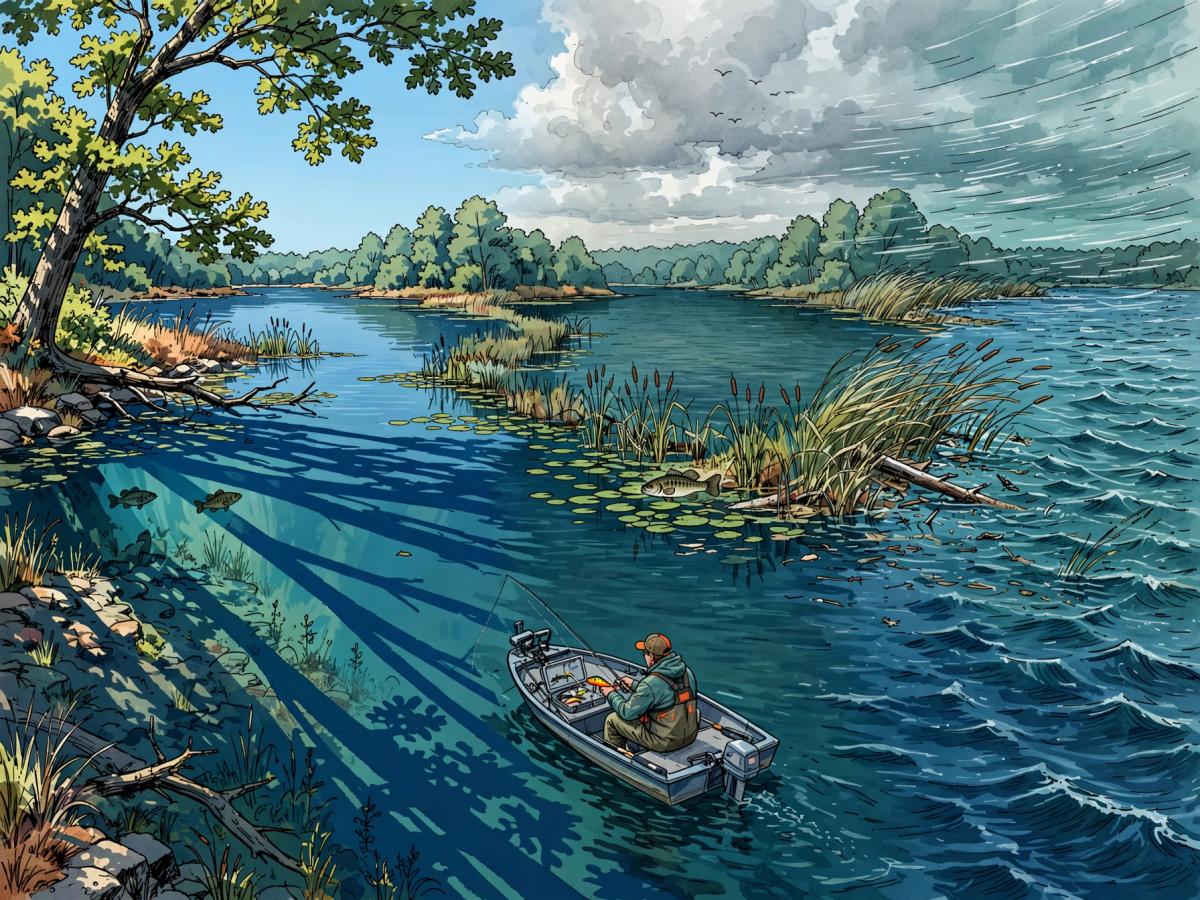
Weather, Light, and Seasonal Clues
Weather and seasons give a bass angler context, not a calendar that guarantees a location. Light changes shade and visibility. Wind changes the surface and can move food. Temperature trends influence activity in ways that vary by species, water body, depth, and recent conditions. Seasonal knowledge becomes useful when it helps you choose what to observe next.
This lesson connects the earlier Hookwise work on seasonal conditions and fish behavior to intermediate bass decisions. The aim is not to memorize a formula for every month. It is to build a flexible starting plan, watch what the water does, and make one clear adjustment when the evidence changes.
Learning goal
By the end, you should be able to combine light, wind, weather history, temperature trend, and seasonal context into a practical first search. You will also know how to distinguish a clue from a guarantee, when a changing forecast should alter the plan, and which safety decisions take priority over a fishing hypothesis.
Treat the season as a question
A season describes a broad set of conditions, but the water may be ahead of or behind a typical calendar pattern. A cool spring day, a warm autumn afternoon, a long stable summer stretch, and a sudden cold change can create different scenes within the same named season. Water level, clarity, forage, current, and access add more variation.
Use the season to ask a starting question. Are shallow areas warming, cooling, or staying stable? Are fish likely to have access to more than one depth? Is vegetation changing? Has recent weather altered the water movement or clarity? The questions point your attention toward observations rather than a guaranteed depth or spot.
Look for transitions. A shoreline that moves from shade to sun, a flat that meets a drop, or a windy edge beside calmer water may show more useful contrast than a uniform bank. The contrast is a clue to compare, not proof that fish will be there.
Read light and shade at the scale of the cast
Light changes what fish can see and what you can see. A dock, tree line, bank, or cloud can shade a small piece of water. The shaded side may look different from the sunlit side, and the difference moves as the day continues. Observe whether shade reaches shallow cover, a depth change, or an edge with forage.
Bright conditions can make you more visible in clear water and may change how you approach a bank. Low light can make a shallow lane easier to fish visually while reducing your ability to see hazards. Use your position and casting angle to protect both the presentation and your safety.
Do not turn shade into a universal answer. A shaded object without depth, food, or a controllable presentation may provide little information. Compare the object with a nearby sunlit or differently oriented feature when access allows. If a response appears, record the light and the feature together.
Let wind add movement without removing control
Wind changes the surface, line, lure path, and boat or bank position. It may move floating material and concentrate attention along an edge, but it can also make casting and hook management harder. A wind-touched shoreline deserves observation when you can fish it safely and keep the lure in the intended lane.
Choose a casting angle that gives the wind less chance to bow the line away from the lure. If the wind is pushing the boat, use safe positioning and maintain balance. From shore, avoid standing where gusts can move you toward water or branches. The useful fishing clue never outranks safe footing.
Record the wind's direction and effect, not only the word “windy.” A gentle crosswind, a strong onshore push, and a gusty wind around cover create different presentation problems. If a bite occurs, note whether it came on the exposed face, the protected side, or an edge where the wind changed the surface.
Track trends instead of one temperature reading
A single temperature reading describes one moment. A trend adds context. Water may be warming through the day, cooling after a front, or holding steady despite a change in air temperature. The response can differ by water body and depth, so use readings as clues rather than promises.
Recent weather matters because the water does not change instantly in the same way everywhere. Rain can affect level and clarity. A cold front can change light and wind. Several stable days can make a different set of features worth comparing. The important step is to connect the weather history to what you can observe at the bank or from the boat.
Start with a reasonable first search, then verify it. If you expect a shallow edge to be worth testing because it is warming, inspect the water, forage, cover, and depth. If those clues are absent, do not force the plan. Try a nearby transition or a different depth while keeping the change identifiable.
Build a weather-aware plan
Before leaving, write three parts: the starting clue, the first accessible feature, and the condition that would make you adjust. For example, you might begin at a wind-touched edge with visible cover, then compare a protected edge if the wind makes the first presentation unsafe or unreadable. This plan keeps you moving without pretending to predict the fish.
During the outing, pause when the light, wind, or water changes. Ask what changed in the scene and which part of the presentation that affects. You may need a different angle, pace, depth, or cover type. Change one item, observe, and keep a short note.
A seasonal clue is strongest when it repeats with other observations. Several features showing the same combination can support a working pattern. One fish beside one object supports a smaller conclusion. Keep the size of the claim matched to the amount of evidence.
Safety comes before the weather hypothesis
Weather is also a direct safety decision. Leave the water or seek appropriate shelter when lightning is present or the forecast creates a serious risk. Dress for cold and heat, carry water as appropriate, and check water level, current, wind, and visibility before using a boat or watercraft. A personal flotation device belongs on a boat or kayak according to the platform and local safety practices.
Changing water levels can make yesterday's bank unstable. Wet rocks, flooded paths, and high current can turn a promising seasonal clue into an unsafe access point. Choose a stable alternative or end the trip. No pattern is worth entering water you cannot safely exit.
Try this in the field
Before your next outing, record the recent weather, light forecast, wind direction, and any available water or temperature clues. Write a starting hypothesis in modest language, such as “compare the shaded side of shallow cover with the nearby open edge.” Bring the same note to the water.
At the first feature, write what is actually present: cover, water color, surface movement, depth impression, and forage clues. Make a controlled presentation. If a condition changes, change one part of your plan and record why. At the end, note which seasonal clue held up, which did not, and what you would compare next time.
Safety and local rules
Check current weather and water conditions before and during the outing. Follow local rules for boat and bank access, personal flotation devices, seasons, size, possession, hooks, lures, and release or harvest. Keep casts away from people and property, and stop when wind, lightning, heat, cold, or water level makes the setting unsafe. Seasonal knowledge supports a decision. It never replaces a safety check or local regulation.
Recap
- Seasons and weather provide context for questions, not guaranteed locations or formulas.
- Light and shade should be read alongside depth, cover, water clarity, and access.
- Wind can move food and alter a presentation while also creating casting and navigation risks.
- Trends and recent weather add context to a single temperature or sky condition.
- Write a starting clue, a first feature, and a condition that would prompt one adjustment.
- Safety and local rules outrank a fishing hypothesis.
Test Your Knowledge
Ready to see how much you've learned? Take this quick 4-question quiz to complete the lesson.
Take the Quiz to Finish
Complete the quiz above to unlock the lesson completion.