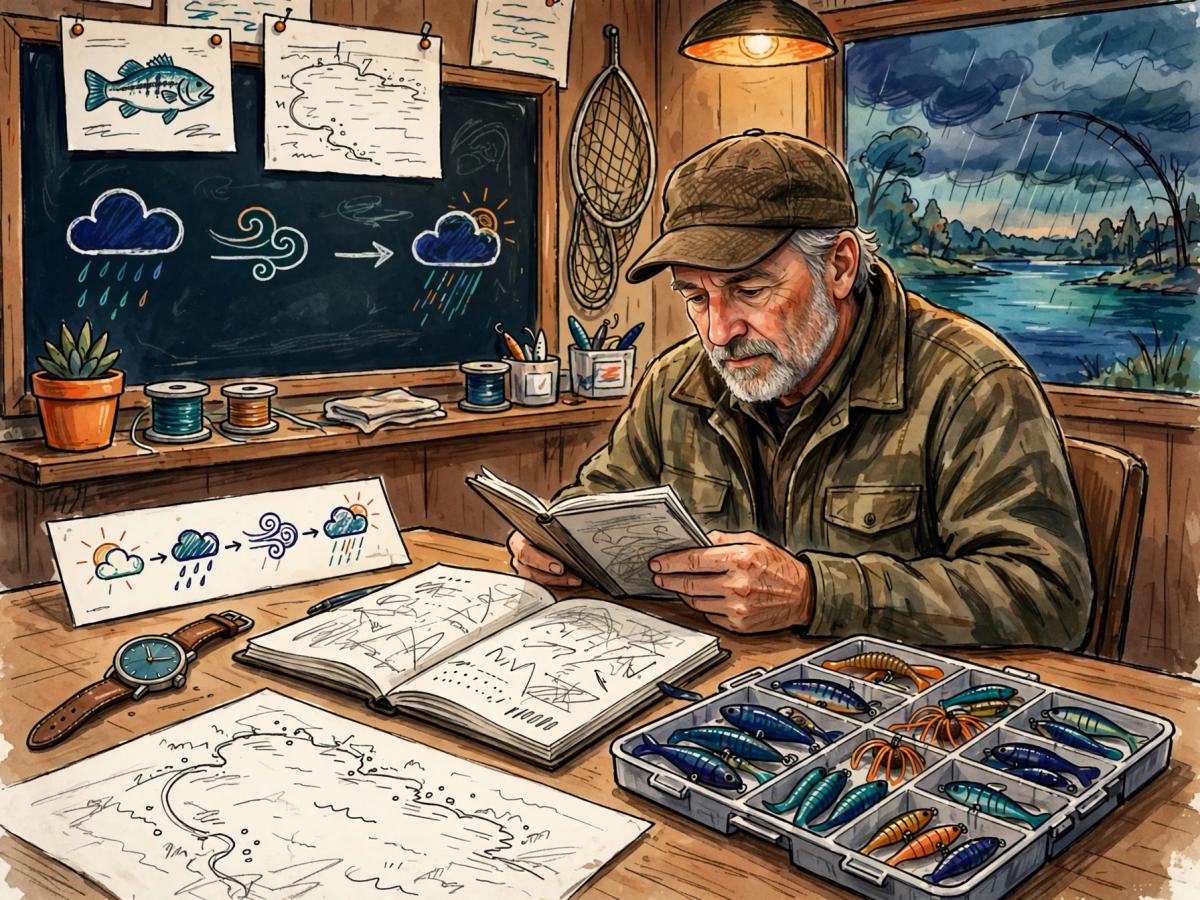
Keep a Useful Fishing Log
A fishing log earns its place when it helps you make a better next decision. It does not need to become a spreadsheet full of numbers or a record of every cast. A useful entry captures the conditions, the feature, the presentation, the response, and the question you want to test next.
The value comes from the connection between notes and decisions. “Caught one” is a memory. “Wind pushed into a rocky edge, water was lightly stained, a steady presentation contacted the bottom, one fish responded beside the transition” is a starting point for a comparison. The second note still does not guarantee a repeat. It gives you more to inspect.
Learning goal
By the end, you should be able to build a compact log entry, separate observation from interpretation, record quiet outings without turning them into conclusions, and use several entries to form a cautious pattern. You will also choose what to share and what to keep private while respecting local access and regulations.
Record the scene before the story
Begin with the basic context: date, approximate time, water body or general area, weather, light, wind direction, water level if relevant, clarity, and temperature information when you have it. You do not need every field on every trip. Record the details that could change the decision you are making.
Next, describe the location feature. Use terms such as grass edge, rock transition, dock shade, point, drop, open bank, or current seam. Add the depth impression or available measurement, but label an estimate as an estimate. Include whether the feature was exposed to wind, shaded, protected, near deeper water, or connected to another edge.
The goal is repeatable language. If you call every shoreline “cover,” the word will not help you compare. Name the part that mattered to the presentation and the part you are unsure about.
Describe the presentation clearly
Record the broad lure family and what it was doing. You might write soft presentation along grass, moving search presentation beside rock, bottom-contact pass across a drop, or compact presentation near a dock edge. Add casting angle, approximate distance, pace, pauses, and intended depth when those details mattered.
Note what the lure actually did. Did it reach the cover, foul with grass, contact rock, move above the edge, or lose contact in wind? The intended presentation and actual presentation can differ. Keeping both in the log shows where the test was strong and where it was limited.
Avoid brands and product rankings in a learning log unless the detail serves a specific tackle question. A broad function travels better across equipment and water. If a line, hook, or rod issue changed the presentation, record the issue directly and follow local tackle or safety guidance.
Record response without inflating it
A response can be a landed fish, a bite, a short strike, a follow, a flash, a foul, a snag, visible forage, or no contact. Write what happened before assigning a reason. “One short strike on the pause beside the rock transition” is stronger than “the fish wanted a pause,” because the first statement preserves the observation.
If you think the fish response relates to depth, pace, shade, or cover, mark that as an interpretation. You can write, “Possible connection to shade and slower pace, needs comparison.” This small label keeps a useful hypothesis from becoming a fact through repetition.
Quiet entries matter. Record where you fished, what you tested, and what the presentation did. A no-bite outing may reveal that the lure never reached the intended depth, the wind made the angle unreadable, or the chosen feature lacked the expected clue. It may also reveal very little. State the limit instead of forcing a conclusion.
Use several entries carefully
Review logs by question, not only by successful fish. You might search for all notes involving a wind-touched edge, a certain depth change, or a particular presentation family. Compare the conditions around each entry. A similar result across different days gives more support to a working idea than one isolated catch, but it still does not create a universal rule.
Look for contradictions. Perhaps the same cover produced a response in low light and a quiet test in bright sun. Perhaps a slower retrieve worked when the water was calm but became unreadable in wind. Contradictions are useful because they show which condition needs to be included in the pattern.
Keep the time and place attached to every entry. Water changes, access changes, and fish move. A note from one month or one level may not transfer directly to another. Use old entries to choose what to observe, not to skip observation.
Make the next test small
End each entry with one next question. “Compare the same rock transition with a slightly different angle.” “Test the outside grass edge before the dense interior.” “Repeat the slower pace on a similar shaded feature.” A good next question is specific enough to guide the first few casts and flexible enough to change if the water disagrees.
Avoid ending with a pile of changes. If your note says to switch lure, depth, speed, angle, and location at once, the next entry will be hard to interpret. Choose the smallest change that addresses the most visible uncertainty.
A log can also protect your time. If several entries show that a particular presentation is difficult to control in a given wind, you can choose a safer angle or another feature earlier. The log becomes a planning tool, not a demand to repeat a failed plan.
Share responsibly
A useful log may include access details or sensitive information. Follow local rules and respect private property, seasonal closures, and shared spaces before sharing a location. A general feature description can support learning without publishing exact access information that should remain private.
Share observations with the same care you use in your own log. Say when and where the note came from, separate what you saw from what you inferred, and avoid presenting one catch as a guarantee for another angler. Good records help people ask better questions while preserving the limits of the evidence.
Try this in the field
Create a five-line note before your next trip: conditions, feature, presentation, response, next test. During the outing, complete one entry after a meaningful response and one entry after a quiet test. Use plain language and mark estimates as estimates.
At home, compare the two entries with an older note from a similar season or condition. Circle one repeated clue and one difference. Write a new test that changes only the variable connected to the difference. If no pattern is visible, record that conclusion. A clear “more observation needed” keeps the log honest and useful.
Safety and local rules
Do not let note-taking pull your attention away from hooks, boats, weather, other people, or footing. Secure a phone or notebook so it does not become a hazard. Follow local rules for access, seasons, size, possession, hooks, lures, and release or harvest. A record should support responsible decisions, not encourage unsafe travel or trespass to recreate an old entry.
Recap
- A useful log connects conditions, feature, presentation, response, and next test.
- Describe what happened before explaining why you think it happened.
- Record quiet outings and label uncertainty instead of forcing a pattern.
- Compare several entries while keeping date, place, water, and weather attached.
- Let contradictions refine the question rather than erase the observation.
- Use logs to plan safer, clearer tests and share location information responsibly.
Test Your Knowledge
Ready to see how much you've learned? Take this quick 4-question quiz to complete the lesson.
Take the Quiz to Finish
Complete the quiz above to unlock the lesson completion.