Start With Cover
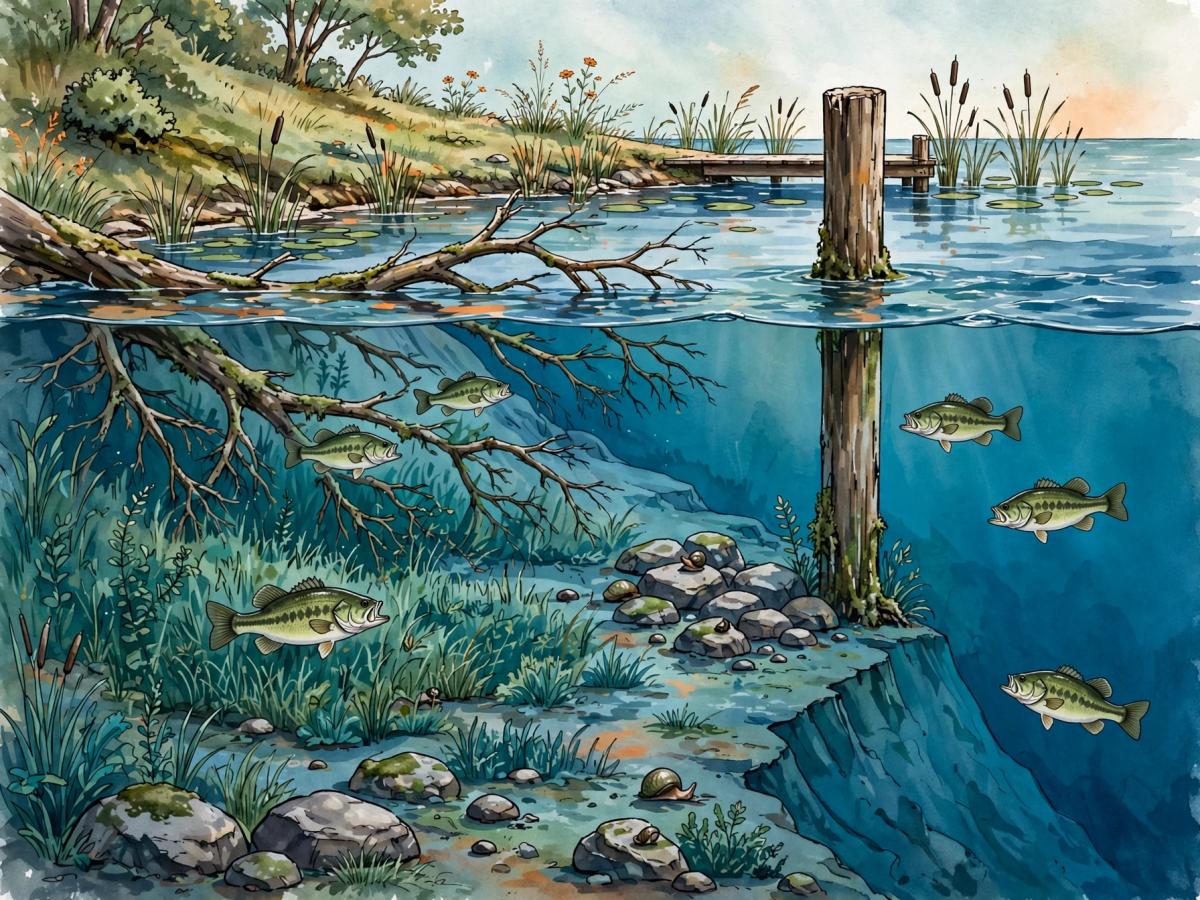
Bass fishing often begins with a visual question: what changes the shoreline or bottom here? Grass, wood, docks, rocks, shade, depth changes, and edges can all shape how fish use a place. They are clues to inspect, not guarantees that a bass is waiting beside every object.
Cover gives you a way to organize a new bank. Instead of casting at random, you can notice the kind of object, the water around it, and the conditions that may change its usefulness. A simple observation routine travels better than a promise about one magic location.
Learning goal
You will learn to recognize common cover types, describe the feature around them, and rank a few accessible places for a first search. You will also practice separating what you can see from what you are only guessing.
Grass changes the water around it
Grass can create shade, edges, and small spaces where forage and fish may move. Look at whether the grass is on the surface, below it, or along a drop. A clean outside edge can fish differently from a dense interior. A pocket, point, or opening changes the shape of the edge and may give you a more defined place to observe.
Grass also catches debris and can affect how a lure moves. Watch the wind, water clarity, and current if the water is moving. A grass bed that looks identical from shore may vary in depth or density. Work within the open water you can control instead of forcing a cast into vegetation that makes a hook or lure difficult to manage.
Wood, docks, and rocks
Fallen trees, standing timber, stumps, and brush create hard edges and irregular shade. Notice which parts are above the water and which parts continue below it. The visible branch is only part of the feature. A submerged limb, a point, or a change in bottom beside the wood may shape the available lane.
Docks combine shade, posts, depth, and human access. Look at the water under and beside the dock, the angle of the sun, and the space your cast would need. A dock is also a shared structure. Keep lures, line, and hooks clear of people, boats, ropes, and property.
Rocks can warm, shade, redirect current, and change the bottom. Notice scattered rock, a wall, a point, or a transition into softer bottom. A rock edge beside deeper water may deserve a closer look than a uniform stretch, but the observation still needs to be tested with a controlled presentation.
Shade, depth, and edges
Shade changes light and temperature at a small scale. Trees, docks, banks, and clouds can create different windows during the day. Observe whether shade reaches shallow water, a drop, or a piece of cover. The same object can present a different scene as the sun moves.
A depth change is a slope, drop, channel edge, or shelf that moves from shallow to deeper water. You may notice it through bottom color, a bank contour, a change in vegetation, or a line where waves behave differently. You do not need exact depth to start. You need to recognize that a change exists and choose a cast you can control.
An edge is any boundary between two conditions, such as grass and open water, rock and sand, shade and sun, or fast and slow water. Edges collect attention because they create contrast. Rank an edge by what else surrounds it, then see whether the water gives you a reason to stay.
Read the whole scene
Cover becomes more useful when you add conditions. Ask how light, wind, water clarity, season, temperature, and recent weather may change what you can see. A windy bank may have moving food but also a harder cast. A clear, calm bank may let you inspect the bottom but make your approach easier to notice. These are possibilities to observe rather than formulas to memorize.
Start with accessible cover and keep the first search simple. Make several short casts or presentations around one feature, then compare it with another feature nearby. Record what changed: bottom, light, depth, water movement, or the angle available from shore. If you cannot explain what changed, keep observing before changing tackle.
Try this: the cover map
Choose a shoreline you can reach safely. Walk or look along a short section without casting and mark five features: one grass edge, one hard cover feature, one shade line, one depth clue, and one transition. Some features may overlap. Beside each, write what you can see and what remains unknown.
Rank the top two starting places using three questions: Can I reach the feature without unsafe footing? Can I keep the lure and hooks away from people or branches? Can I make a controlled presentation and see what happens? Start with the place that gives you the clearest information, not the place that looks most dramatic.
Water, hooks, and local rules
Cover attracts snags and hidden hazards. Keep hooks away from hands, faces, pets, bystanders, and boats. Look overhead before casting around trees, and check the ground before stepping along a bank. If a lure snags, do not pull it toward yourself or wrap line around your hand. Move to a safe angle or accept that a lure may need to be recovered by a safer method.
Check local license, access, season, size, bag, and species rules before fishing. Docks and shorelines may cross private property or restricted access. Follow posted signs and respect other anglers. A feature is useful only inside the boundaries of safe and lawful access.
Recap
Grass, wood, docks, rocks, shade, depth changes, and edges help you describe a shoreline. Look at the object and the water around it, then add light, wind, clarity, season, and access to the picture. Rank places by the quality of the observation and the safety of the presentation. Cover provides clues. Your next cast tests one of them.
Test Your Knowledge
Ready to see how much you've learned? Take this quick 4-question quiz to complete the lesson.
Take the Quiz to Finish
Complete the quiz above to unlock the lesson completion.