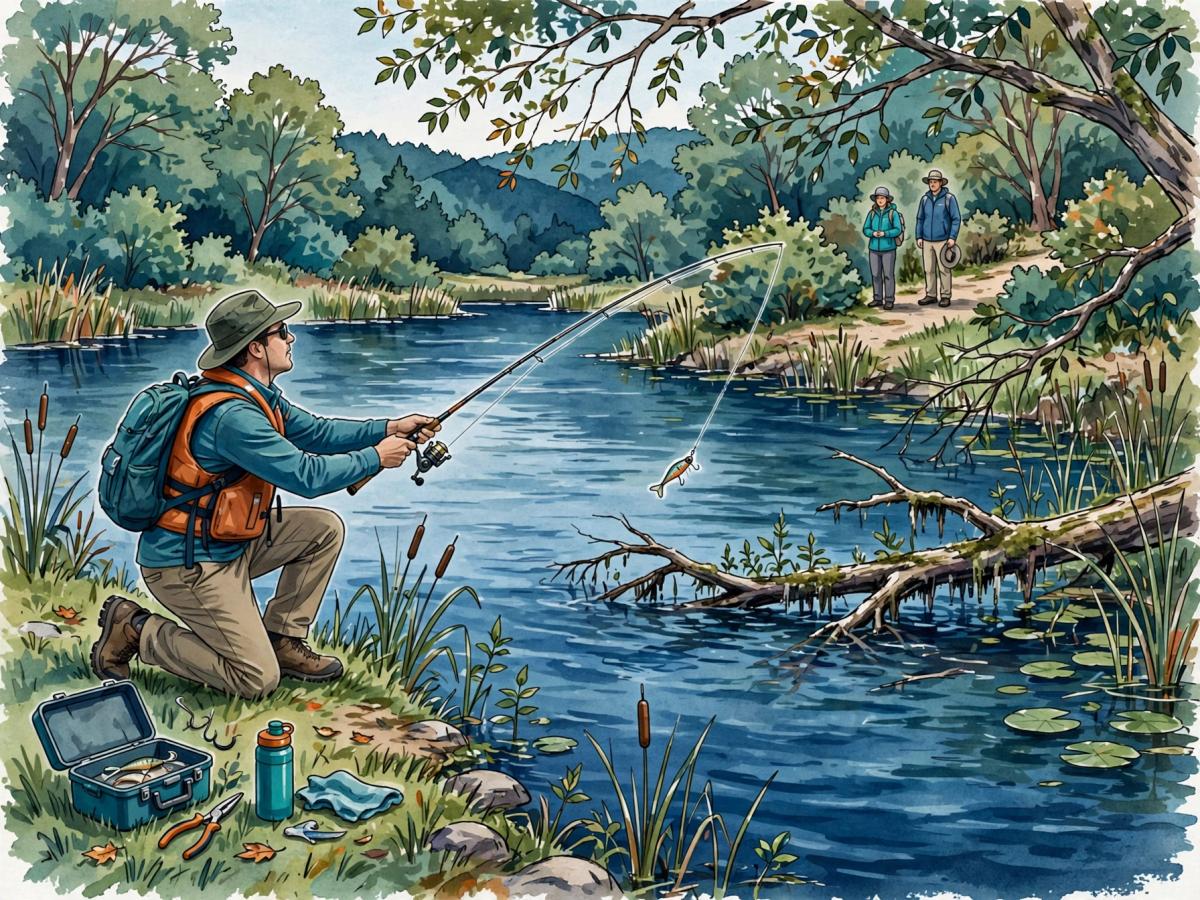
Cast Around Cover Safely
Cover gives bass fishing its visual character, and it also gives hooks many places to go. Trees, docks, grass, rocks, and brush reward a careful casting plan. You can learn to place a lure near a feature without turning every cast into a risky attempt at the smallest opening.
Accuracy grows from a repeatable setup: inspect the space, choose an angle, control the amount of line, and stop before a risk becomes a problem. A close, deliberate cast you can manage teaches more than a heroic cast you cannot recover safely.
Learning goal
You will learn to choose casting angles around cover, plan the lure's path, identify hook and snag hazards, and stop before a cast puts you or another person at risk. You will also practice with a hookless end so safety becomes part of accuracy.
Choose an angle before you cast
Start by looking at the cover from the bank. A fallen limb, dock post, grass edge, or rock line can be approached from several angles. One angle may place the lure beside the cover, another may cross it, and another may run parallel. Choose the path that gives you the clearest view and the simplest recovery if the lure catches.
Distance changes the amount of control you have. A shorter cast may let you see the lure, line, and surface contact. A longer cast may reach more water but can cross wind, current, or another person's space. Use the shortest distance that answers your question, then extend only when the casting lane remains clear.
If you are on a bank, keep your feet planted before the cast. Do not lean around a tree or step onto a wet edge to improve an angle. Move your position only when the new stance is stable and the route back is clear.
Read the snag path
Look beyond the spot where you want the lure to land. Follow the whole path from rod tip to target and imagine the retrieve back to your feet. Branches can catch a back swing or line. A dock rope can collect a moving lure. Grass can hide a hook after the lure reaches the water.
Hard cover and soft cover require different attention. A lure passing beside a stump may have a clear outside lane. Grass may require watching whether the lure rides over, enters, or catches in the stems. If you cannot see the route or cannot retrieve without pulling toward yourself, choose another angle.
When a lure snags, keep the rod pointed away from your body and other people. Do not wrap line around your hand or pull with your face near the line. Move to a safer angle if you can do so without climbing or leaning. If the lure cannot be recovered safely, leaving it is better than turning a tackle problem into an injury.
Make three checks
Before each cast around cover, use three quick checks.
- Behind and overhead: Are there people, branches, wires, vehicles, or structures in the rod and line path?
- Beside and in front: Is the target lane clear of people, boats, pets, ropes, and protected property?
- After the landing: Can you retrieve, stop, and handle a snag without stepping toward unstable ground or pulling a hook toward yourself?
If any answer is uncertain, shorten the cast, change the angle, remove the hook for practice, or wait. Stopping is a casting skill. The water will still be there when the lane is safe.
Let the cast stay smooth
Aiming around cover does not require a violent motion. Use a smooth stroke that matches the lure's weight and your tackle. Keep the rod path predictable and let the lure travel on the line rather than throwing your whole body toward the target. A controlled release makes it easier to stop short of a branch or post.
Use a visible marker or a hookless practice plug when learning. Place the marker beside a feature, then repeat from a slightly different angle. Notice how rod position and line length change the landing point. Adjust one element at a time. If the cast repeatedly overshoots, shorten the motion or release earlier rather than adding speed.
Try this: the safe-angle drill
Find a practice area with a visible target such as a leaf, towel, or small marker. Remove the hook or use a safe practice plug. Stand in one stable position and make five short casts to the near side of the target. After each, point to the line path and name one hazard you checked.
Next, shift only your casting angle while keeping the distance short. Compare which angle leaves the clearest retrieve path. End the drill if a person, pet, vehicle, branch, or unstable edge enters the space. The goal is to make a safety check part of every cast, not to reach a risky opening.
Water, hooks, and local rules
Hooks can spring free when a lure snags. Wear eye protection when appropriate, keep bystanders outside the casting lane, and alert nearby anglers before you cast. Store spare lures with points secured. Never cast toward a person or over a path you cannot see.
Check local access rules around docks, homes, bridges, and managed shorelines. Follow posted signs and keep casts away from boats, ropes, and private structures. Local rules may also restrict lure or hook styles, seasons, species, and harvest. Stop when wind, lightning, darkness, poor footing, or crowding removes your control.
Recap
Cast around cover by choosing the angle before the lure leaves the rod. Trace the full snag and retrieve path, make the three safety checks, and keep the motion smooth. Practice with a hookless end and a short distance. Accuracy grows through control and clear decisions, while a risky cast is always optional.
Test Your Knowledge
Ready to see how much you've learned? Take this quick 4-question quiz to complete the lesson.
Take the Quiz to Finish
Complete the quiz above to unlock the lesson completion.