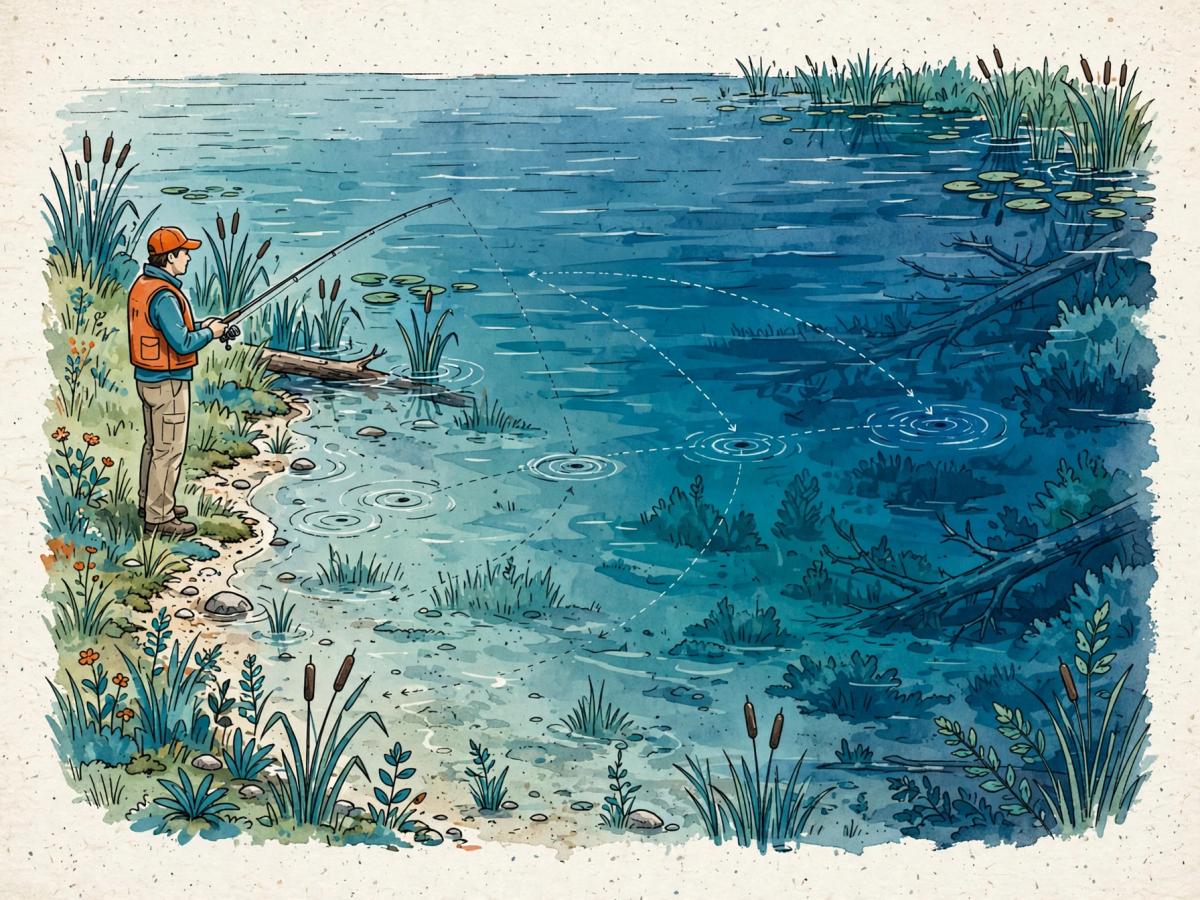
Search From Shallow to Deep
A shoreline search becomes easier when you give it a repeatable order. Starting in accessible shallow water and moving toward deeper clues lets you compare the scene instead of jumping between random casts. The order is a learning tool, not a rule about where bass must be.
Water level, season, weather, light, temperature, forage, clarity, and access can change the useful depth. Some days the best information is close to shore. Other days a slope, channel, or deeper edge may deserve attention. The point is to build a plan that can change with evidence.
Learning goal
You will practice a shallow-to-deep search pattern, use fan casts and cover checkpoints, and record one variable at a time. You will also learn how to stop a search when conditions or access make the next cast unsafe.
Start with the water closest to you
Before casting, look at the first few yards of water. Notice bank contour, grass, wood, rocks, shade, bottom color, and any visible depth change. Fish may be close to shore, and a long cast can cross the water you have not yet inspected. Make the first presentation short enough to see what the lure does.
Work the shallow lane with a small fan of casts: near the bank, slightly out, and toward an edge or visible piece of cover. Keep the lure and line clear of your feet and nearby people. After each cast, ask what changed. Did the bottom feel different? Did the lure pass through grass? Did wind or current move the line?
A shallow start also protects your observations. If a lure hits bottom immediately, you learn something about the slope or weight. If it stays above cover, you learn something about the retrieve. The information is useful even without a fish.
Move through the middle zone
The next zone may be a drop, shelf, outside grass edge, dock line, rock transition, or the distance where the bottom becomes harder to see. You may not know the exact depth. Use bank contours, lure contact, line angle, and surface changes as clues.
Change your casting angle before changing everything else. A parallel cast along an edge shows a different path from a cast straight out. A cast toward a point may cross several depths. Choose the angle you can control and make enough casts to understand its path.
Watch the conditions as you work. Wind can push forage or make one bank more active, but it can also reduce casting control. A bright sky can make shade more noticeable, while cloud cover changes the contrast. Treat these observations as reasons to compare places, not as guarantees about a bite.
Test deeper clues with patience
Deeper water may be suggested by a steep bank, channel edge, dark bottom, drop-off, or a lure that takes longer to reach the bottom. Deeper does not automatically mean better. It can be harder to read and harder to retrieve from safely, especially from a high or uneven bank.
Make the first deep search simple. Choose a lure and retrieve you can feel, keep the line controlled, and count or notice the path without turning the exercise into a race. If the lure catches bottom or cover, pause and assess before pulling. If the water is beyond your casting or landing control, return to an accessible lane.
A deeper presentation also deserves a time limit. Give the zone a fair look, then compare what you learned with the shallow and middle zones. Your notes may show that the change was depth, bottom, light, cover, or simply a different casting angle.
Change one variable at a time
A common search problem is changing location, lure, color, weight, retrieve, and cast angle together. That creates movement, but it leaves no clear lesson. Keep a short record with four fields: zone, feature, presentation, and observation.
If the shallow lane gives no useful information, change only the next variable. You might move to the middle zone while keeping the lure and retrieve steady. Or you might keep the same water and alter the angle. After a few controlled comparisons, you can make a larger change with a reason.
The record does not need to be perfect. A note such as “shallow grass edge, slow retrieve, line pulled sideways by wind” is enough to help you choose the next test. Over time, you are building a local observation log, not copying a universal formula.
Try this: the three-zone shoreline lap
Choose a shoreline section you can walk safely. Divide it into shallow, middle, and deeper-clue zones. Spend a few minutes observing each before you cast. In each zone, make a small fan of controlled presentations using the same lure family and a similar retrieve when practical.
After each zone, write one visible feature, one presentation detail, and one uncertainty. Change only one variable between zones. If you notice a snag, unstable footing, private property, or people entering the lane, stop the lap and choose a safer end point. The exercise is complete when you can explain what each zone taught you.
Water, hooks, and local rules
Use a bank route with stable footing, room for the rod, and a clear retreat path. Watch overhead branches, fences, boats, and people. Keep hooks away from your body and never wrap line around your hands. If a lure snags, move to a safe angle or leave it rather than leaning, climbing, or pulling toward yourself.
Check current rules for license, seasons, species, size, bag limits, and access. A shallow-to-deep search does not grant permission to enter restricted water or trespass across a private shoreline. Keep your plan inside the conditions and skills you actually have.
Recap
A shallow-to-deep pattern gives a shoreline search an order. Start close, compare a middle zone, then test deeper clues when the water and access remain controllable. Use fan casts, watch the lure and line, record what changed, and adjust one variable at a time. Depth is a clue, not a promise, and a safe stopping point belongs in every search plan.
Test Your Knowledge
Ready to see how much you've learned? Take this quick 4-question quiz to complete the lesson.
Take the Quiz to Finish
Complete the quiz above to unlock the lesson completion.